
Bittensor (TAO) price outlook as subnet exit causes governance crisis

AI Sentiment: 18/100 Bearish
This score is generated through AI-driven analysis of the article's content.

powered by

Buy Bittensor (TAO) spot for a stabilization bounce. The selloff is governance-driven but already forced through long liquidations; price is now testing the $263–$250 demand zone where prior retracements/short-term MAs sit. If that band holds, you get a reflexive mean reversion toward $280 (first resistance) as sentiment stops deteriorating.
Key Risk: A governance credibility shock escalates into further subnet exits or protocol-level changes that permanently impair TAO’s incentive structure, breaking $250 and opening $233.
Sell/short TAO via perpetuals (TAOUSDT perp) if $250 fails. The article shows a liquidation feedback loop and a momentum break below $300; a clean breakdown under the $250 battleground likely triggers another wave of forced selling and accelerates toward $233.
Key Risk: Buyers defend $250 with sustained spot absorption and TAO reclaims $280 quickly, trapping shorts and reversing the liquidation cascade.
- Covenant AI's exit sparked governance concerns and heavy TAO selloff.
- Liquidations and leverage unwind accelerated the sharp price decline.
- Key support sits near $263–$250 with risk of further downside below $250.
Bittensor (TAO) has entered a turbulent phase after a sharp and sudden selloff that wiped out a significant portion of its recent gains.
At press time, the price of TAO was down 20.2% to around $273.32.
The sudden price drop was triggered by a major shift in sentiment around the project’s governance structure after the exit of a major subnet operator known as Covenant AI.
Covenant AI exit triggered governance concerns
Covenant AI’s exit was not a quiet departure. It came with strong accusations aimed at the Bittensor’s leadership, particularly around claims of centralised control within what is marketed as a decentralised AI network.
Covenant AI alleged that key decisions within the ecosystem were being influenced or controlled by a small group, despite the project’s broader decentralisation narrative.
The accusations included claims of unilateral governance actions, changes to subnet incentives, and a lack of transparent community participation in certain decisions.
These statements quickly spread across the market and shifted sentiment almost overnight.
In systems like Bittensor, where subnets play a core role in the ecosystem’s function and incentives, the exit of a major participant can have effects far beyond simple token selling. It raises concerns about long-term stability and participation, which is exactly what the market began to price in.
At the same time, the departing entity liquidated a significant portion of its holdings, adding direct selling pressure on the market, compounding the negative sentiment already building from the governance concerns.
Liquidations and market reaction intensify the decline
What began as a reaction to the news quickly turned into a broader market unwind.
A large wave of long positions was liquidated as prices broke below key levels, forcing leveraged traders out of the market.
This created a feedback loop. Falling prices triggered liquidations, and liquidations pushed prices even lower.
In total, millions of dollars in long positions were wiped out during the move, showing how overexposed bullish positioning had become during the prior uptrend.
The broader crypto market conditions did not offer much support either.
While some major assets remained relatively stable or even gained slightly, TAO underperformed significantly, highlighting that the move was driven more by internal project-specific concerns than wider market weakness.
Volume also surged during the selloff, suggesting that the move was not a slow bleed but a forced repositioning event.
In simple terms, holders were not gradually exiting, with many either reacting to the governance concerns or being forced out due to leveraged exposure.
TAO technical analysis
From a technical perspective, TAO’s chart structure weakened quickly during the decline.
The price had recently been trading near the $340 region before reversing sharply.
Once selling pressure increased, that level failed to hold, followed by a breakdown through multiple intermediate support zones.
The most important break came when TAO slipped below the $300 psychological level, which had previously acted as a short-term buffer during volatility.
After that, momentum accelerated downward toward the mid-$260 range, where the market is now attempting to stabilize.
This area has become important because it aligns with previous retracement levels and short-term moving averages.
However, the speed of the decline suggests that confidence has not fully returned, and buyers are still cautious about stepping in aggressively.
Bittensor price forecast
Looking ahead, TAO’s short-term direction is likely to depend on whether the current support zone can hold.
The immediate area of interest lies between the $263 and $250 range, which has become a key battleground where buyers are attempting to absorb selling pressure and stabilize the price.
If TAO manages to hold above this zone and gradually rebuild momentum, a consolidation phase could develop.
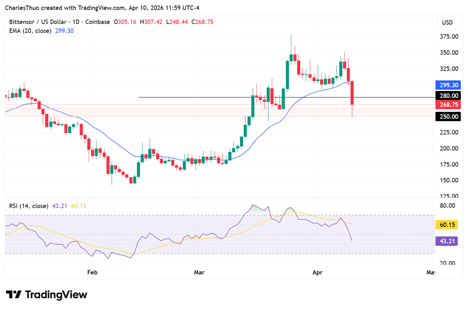
In that scenario, the market may attempt a recovery back toward the $280 region, which now acts as the first meaningful resistance level.
A move above that area would be an early sign that sentiment is beginning to recover.
However, failure to hold the $250 level would shift the outlook again. In that case, the next significant downside area comes into focus around $233.

Pi stabilizes near $0.089 as bulls target a return above $0.10

Bitcoin SV gets rejected at $15.39: was this breakout already a trap?

Dogecoin’s whale buying is rising fast: can DOGE reclaim $0.07 next?

Ethereum whales are buying again, so why can’t ETH break above $2,000?

XRP is testing $1 while whales buy, but the charts still look dangerous
No results found
Loading articles...
Failed to load articles. Please try again.