
Is XRP price at risk as Senate delays CLARITY Act vote?

AI Sentiment: 35/100 Bearish
This score is generated through AI-driven analysis of the article's content.

powered by

Crypto is already in a defensive posture ahead of Fed and legislative uncertainty hit alts harder than majors. BTC briefly broke below $63,500 while XRP sold off more sharply; that divergence favors buying BTC as the relative “risk-off” beneficiary. Target a move back toward recent highs after deleveraging cools, using BTC as the core long while trimming alt beta.
Key Risk: A broad crypto risk-off shock (Fed surprise or renewed regulatory panic) drives BTC below key support and drags the whole complex lower.
CLARITY Act timing risk is still unresolved and XRP remains below the 20/50/100/200-day EMAs (stacked bearish). Trade the path of least resistance: sell/short XRP around $1.08–$1.10 and target a retest of $1.05, then $1.00 if momentum rolls over. The July 28 drop was driven by leveraged longs getting liquidated, and the rebound looks orderly—not a breakout—so overhead resistance likely caps rallies.
Key Risk: Senate schedules and signals a near-term CLARITY Act floor vote, triggering a sustained reclaim of the 20-day EMA and a momentum reversal.
- XRP fell to $1.05 after regulators delayed the CLARITY Act.
- More than $3.6 million in long XRP positions were liquidated during the selloff.
- Price remains below key moving averages, with $1.05 and $1.00 acting as support.
XRP has traded under renewed pressure since July 27, falling from around $1.10 to an intraday low near $1.05 as the US Senate delayed consideration of the Digital Asset Market Clarity Act.
According to CoinGecko data, XRP extended losses through July 28 after Senate Majority Leader John Thune gave priority to a Russia sanctions package and federal nominations instead of bringing the Digital Asset Market Clarity Act, commonly known as the CLARITY Act, to the Senate floor.
The move pushed any vote beyond Congress' Aug. 8 recess, removing what many market participants had viewed as a near-term regulatory catalyst for the token.
Although the proposal has not been rejected, the delay introduced fresh uncertainty over when lawmakers will address one of the crypto industry's most closely watched market structure bills.
The legislation seeks to define how digital assets are regulated by drawing clearer boundaries between the Securities and Exchange Commission and the Commodity Futures Trading Commission, an outcome many XRP investors have been monitoring because of Ripple's long-running legal battle with the SEC.
As the Senate's legislative schedule became clearer, the broader crypto market was already moving into a defensive stance before the Federal Open Market Committee's July 28–29 meeting.
Bitcoin briefly fell below $63,500 while Ethereum lost about 4%, triggering another round of deleveraging across large-cap cryptocurrencies.
For XRP, the reaction proved particularly sharp. CoinGecko data showed the token sliding from roughly $1.10 on July 27 to nearly $1.05 during trading on July 28 before buyers gradually returned, lifting the price back toward $1.08 by July 29.
Even after the rebound, XRP remained below the levels seen before the Senate's scheduling decision.
Senate delay sparks profit-taking
The CLARITY Act has become one of the most important crypto bills before Congress because it proposes a federal framework that assigns oversight responsibilities between the SEC and CFTC.
Traders expecting quicker progress had increasingly viewed the legislation as a positive catalyst for XRP and other digital assets.
Instead, Senate leadership chose to prioritise other legislative business before lawmakers leave Washington for the August recess.
The postponement did not change the bill's committee status, but it delayed any immediate path toward a floor vote.
Market participants later reassessed the development after the initial selloff.
Rather than treating the move as a sign that the legislation had lost political support, traders increasingly interpreted it as a scheduling issue, allowing some buying interest to return after the first wave of selling subsided.
With the Federal Reserve's interest rate announcement approaching, short-term traders began reducing bearish positions after the initial risk-off move, helping several large cryptocurrencies recover part of their losses.
Institutional demand also remained relatively stable beneath the surface.
Continued net inflows into US spot XRP exchange-traded funds helped absorb part of the selling pressure, limiting the depth of the decline despite heightened uncertainty surrounding US crypto legislation.
Liquidation data further illustrates how quickly sentiment changed. During the past 24 hours, approximately $4.25 million worth of XRP positions were liquidated, with long positions accounting for $3.64 million while short liquidations totaled about $614,000.
The imbalance suggests the decline was driven largely by leveraged bullish positions being forced out of the market rather than aggressive short selling.
After most leveraged longs had already been flushed out, forced selling eased considerably, allowing XRP to stabilize around the $1.05 support zone before recovering toward $1.08.
The relatively small amount of short liquidations also indicates the rebound has not yet developed into a broad short squeeze.
XRP price analysis
From a technical perspective, XRP continues to trade inside a broader bearish structure despite recovering from Tuesday's low.
On the daily chart, XRP remains below its 20-day, 50-day, 100-day and 200-day exponential moving averages, which currently sit near $1.10, $1.13, $1.22 and $1.41, respectively.
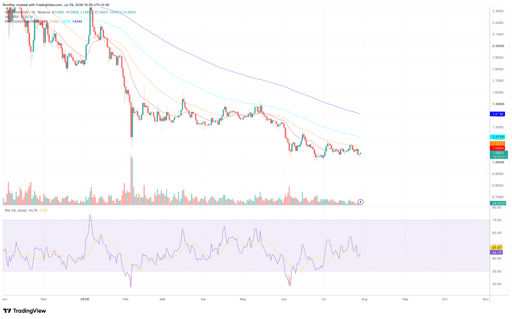
XRP/USDT 1-day price chart. Source: TradingView.
The stacked arrangement of those moving averages continues to favor sellers and indicates that every recovery still faces multiple layers of overhead resistance.
Momentum indicators, however, read a bit more balanced. The daily Relative Strength Index has climbed back to around 45 after weakening earlier this month, showing bearish momentum has moderated without signaling that buyers have fully regained control.
Because the RSI remains below the neutral 50 level, the indicator continues to favor caution rather than confirming a sustained trend reversal.
The 4-hour chart presents early signs that selling pressure is beginning to cool. See below.
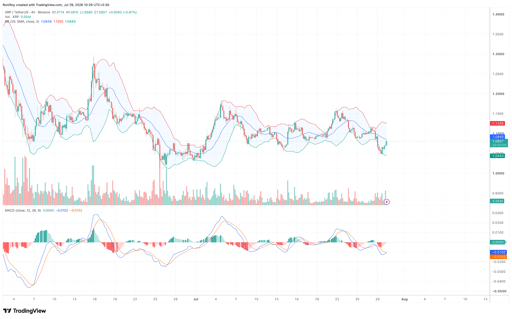
XRP/USDT 4-hour price chart. Source: TradingView.
XRP rebounded after testing the lower Bollinger Band near the $1.04-$1.05 region, an area that also coincided with the support established during the Senate-driven selloff.
Since then, the token has climbed back toward the middle Bollinger Band around $1.08.
Meanwhile, although both MACD lines remain below the zero line, the histogram has become less negative, and the MACD line is gradually converging with the signal line.
Such a setup typically indicates fading bearish momentum, though confirmation would require a bullish crossover supported by stronger buying volume.
After falling sharply on July 28, XRP spent several hours building a base near $1.05 before beginning to print higher lows and higher highs during July 29.
Buyers have managed to defend the support zone so far, but the recovery has remained orderly instead of accelerating into a breakout.
The immediate hurdle now sits around the 20-day EMA near $1.10.
A sustained move above that level could expose the next resistance around the 50-day EMA near $1.13, while continued buying could eventually bring the $1.22 area, where the 100-day EMA currently resides, back into focus.
On the downside, the $1.05 level remains the first major support after repeatedly attracting buyers during the recent decline.
If sellers regain control and XRP loses that zone, attention could quickly turn to the psychological $1.00 level, which has served as a high-conviction demand area during previous pullbacks.

PI coin rises ahead of Protocol 27, can it recover above $0.10?

Solana tests $100 as whale traders bet on a rebound

Zcash eyes further gains, but overbought RSI warns of pullback

Interview: Bitcoin Japan’s big bet on AI economy, from SpaceX to rare earths

Why is XRP falling even as ETF money keeps flowing into the market?
No results found
Loading articles...
Failed to load articles. Please try again.