
Oracle stock has become a bargain, but a risky pattern has emerged

AI Sentiment: 35/100 Bearish
This score is generated through AI-driven analysis of the article's content.

powered by

Buy ORCL. The news shows real demand: cloud infrastructure revenue +93% and RPO/backlog up $85B to $638B, with Q1 revenue guidance +27% to +29% and annual revenue raised to ~$90B. Valuation is already discounted (forward P/E ~18 vs sector ~22), so the market is pricing fear more than fundamentals. Thesis: backlog + cloud growth will keep converting into revenue even while capex rises.
Key Risk: Oracle’s debt/capex plan triggers a credit scare (bond yields keep rising and refinancing gets expensive), forcing margins down and breaking the growth-to-cash conversion.
Sell ORCL if it breaks $118.90 (neckline). The article flags a giant head-and-shoulders pattern and notes the stock is below the 50 EMA—classic momentum/technical downside. Thesis: once the neckline fails, systematic and technical traders add selling, accelerating the move toward the next support.
Key Risk: ORCL holds $118.90 and rebounds on strong guidance/earnings follow-through, invalidating the breakdown and triggering a sharp short-covering rally.
- Oracle stock has retreated sharply in the past few months.
- The company has become a bargain as its backlog surges.
- The risk is that it has formed a head-and-shoulders pattern.
Oracle stock remains under intense pressure this week, extending a steep decline that began after the shares peaked at $345 in September last year. The stock has since plunged nearly 60% from its all-time high, with its valuation increasingly appearing attractive even as investors remain concerned about the company’s rising debt burden and significant exposure to major customers such as OpenAI.
Oracle has become the most hated AI stock
Larry Ellison’s Oracle has slowly become the most hated company in the artificial intelligence industry despite its strong growth. Its most recent financial results showed that its revenue growth is continuing, with analysts expecting the momentum to continue because of its role in the AI space.
The results showed that revenue jumped by 21% in the fourth fiscal quarter to $19.2 billion, with its cloud infrastructure soaring by 93% to $5.8 billion. Most notably, the Remaining Public Obligations (RPO) jumped by $85 billion in the quarter to $638 billion. This makes its RPO or backlog one of the biggest in the industry.
The company also expects that its revenue will continue to grow in the foreseeable future. Its guidance is that its Q1 revenue will grow by between 27% and 29%, with annual revenue soaring to $90 billion. The annual estimate was higher than the average $89 billion that analysts were expecting. It will then be followed by $130 billion in the following financial year.
Soaring capital expenditure and debt
The main reason why Oracle stock has slumped is that investors are concerned about its spending and soaring debt. It expects to spend $48 billion in capital expenditure this year followed by $70 billion next year. This, in turn, will push the company to raise substantial sums of money through debt and equity. It plans to raise $40 billion in debt and equity this year.
As a result, its total debt has jumped substantially in the past few months. It jumped to $129 billion, with its short-term debt being $7.2 billion. It spent over $1.4 billion in the last quarter in interest payments to its creditors. While its bonds are not currently junk-rated, they are on the verge, with their yields continuing to rise. S&P Global downgraded the company to BBB in June.
Oracle stock has also slumped as investors remain concerned about the AI bubble, which Michael Burry has warned about. Also, there are concerns about its exposure to OpenAI, a company whose revenue growth has slowed.
Still, on the positive side, there are signs that the company has become relatively undervalued, with its forward price-to-earnings ratio being 18, lower than the sector median of 22.
Analysts believe that the ORCL stock should be higher than where it is today. UBS has a target of $245, while Wedbush and Bernstein have a target of $240 and $325. Barclays and Moffett Nathanson have targets of $250 and $325, respectively.
Oracle stock price technical analysis as a risky pattern forms
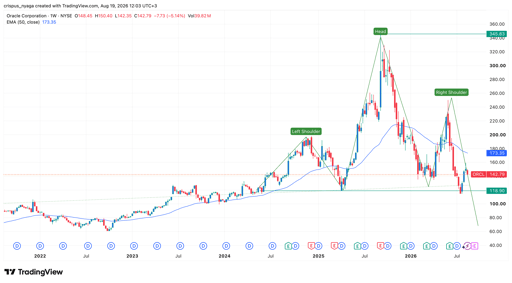
ORCL stock chart | Source: TradingView
The weekly chart shows that the ORCL stock has slumped from a record high of $345 in September last year to the current $142. It has remained below the 50 Exponential Moving Average.
At the same time, it has formed a giant head-and-shoulders pattern whose neckline is at $118.90. This pattern often leads to more downside over time. Therefore, there is a risk that the stock will continue falling, potentially to the next key support being at $118.90. A drop below that level will point to further downside.

KOSPI rockets above 7,000 as AI stocks overpower yen and oil fears
Here’s why SK Hynix stock is skyrocketing today

SoftBank stock jumps 5% while yen strengthens: why that combination is unusual

Dow falls 600 points as oil rises and Fed rate hike bets strengthen

Evening digest: AMD rallies, Gold drops on Fed rate hike bets
No results found
Loading articles...
Failed to load articles. Please try again.