
Will these four macro threats push Bitcoin below $76,000 this week?

AI Sentiment: 18/100 Bearish
This score is generated through AI-driven analysis of the article's content.

powered by

Buy downside protection via BTC put options (e.g., 1–3 month BTC puts struck around $75,000). If BTC loses $76,000, the move toward $70k–$71k should expand implied volatility and pay off puts. This directly monetizes the “liquidity tightening + technical breakdown” combo rather than betting on exact timing. Key risk: BTC chops sideways above $76,000 and implied volatility collapses after the Fed/BOJ decisions.
Key Risk: BTC stays above $76,000 and volatility drops, making puts lose value even if the macro stays bearish.
Sell/short Bitcoin (BTC-USD) targeting $70,000–$71,000 after a breakdown risk below $76,000. The setup is a rounded-top with weakening momentum (RSI rolling over, MACD drifting toward negative) plus macro headwinds: 10Y yields >5%, Fed likely hikes, and BOJ tightening that forces yen-carry unwind. Key risk: BTC reclaims and holds above $80,000 quickly, invalidating the breakdown path and squeezing shorts.
Key Risk: BTC breaks back above $80,000 and holds, proving the $76,000 support failure was a false signal.
- Bitcoin dips 1% to around $76,9000 as its recovery toward $80,000 lost momentum.
- Markets expect the Federal Reserve to raise rates by 25 basis points on Wednesday.
- Bitcoin could drop towards the $71,000 support level if the bearish trend persists.
Bitcoin is back in the red on Tuesday after rallying above $79,000 on Monday.
The leading cryptocurrency by market cap has lost more than 1% of its value in the last 24 hours and now trades below $77,000.
The latest decline strengthens the possibility of a correction toward the $70,000–$71,000 region, particularly if Bitcoin confirms the rounded-top pattern developing on its chart.
Three macro threats put pressure on Bitcoin
Bitcoin is underperforming at the moment as traders anticipate four macro threats to the market.
The first warning comes from the US bond market, as the benchmark 10-year Treasury yield climbed above 5.02% on Tuesday, reaching its highest level since mid-2007.
Rising government bond yields are potentially bearish for Bitcoin because they increase the returns available from comparatively safer investments.
Since BTC does not provide a contractual yield, investors may demand a greater potential return before accepting its volatility.
Higher yields also increase borrowing costs, tighten financial conditions, and often support the US dollar. These factors can reduce the liquidity available for cryptocurrency and other speculative assets.
The second macroeconomic threat comes from energy markets.
Brent crude climbed to approximately $107.37 per barrel on Tuesday, while West Texas Intermediate crude traded above $103.
The rally followed attacks on Saudi Arabian infrastructure that renewed fears of global supply disruptions.
Saudi Arabia’s East-West pipeline has also been disrupted.
The pipeline can redirect roughly 4% of global oil supplies away from the Strait of Hormuz, making it strategically important during periods of regional instability.
Persistently elevated oil prices could increase transportation, manufacturing and consumer costs, placing renewed upward pressure on inflation.
And finally, markets are pricing in approximately a 90% probability that the Federal Reserve will increase interest rates by 25 basis points on Wednesday.
The expected move would be the Fed’s first rate increase since mid-2023. A Reuters survey found that 85% of economists anticipate an increase in the federal funds target range to 3.75%–4%.
Morgan Stanley economists also expect another rate hike in December, while futures markets suggest several additional increases could occur through the middle of 2027.
A sustained tightening cycle would increase the cost of capital and could encourage investors to reduce exposure to volatile assets.
In addition to these, the Bank of Japan could tighten monetary policy just two days after the Federal Reserve’s decision.
Approximately 97% of economists surveyed by Reuters expect the BOJ to raise its policy rate to 1.25% on September 18. Many respondents anticipate further increases afterward.
Higher Japanese interest rates are especially relevant to global risk markets because years of ultra-low borrowing costs supported yen-funded carry trades.
Investors borrowed cheaply in yen and deployed the capital into higher-returning assets worldwide.
A stronger yen and higher domestic rates could force traders to unwind those positions, withdrawing liquidity from equities, cryptocurrencies, and other risk-sensitive markets.
Technical indicators suggest a weakening bullish momentum
The BTC/USD daily chart remains bullish and efficient but is showing signs of weakening momentum following the recent dip.
The technical indicators suggest that the bulls could be running out of breath following a massive rally three weeks ago.
The RSI of 52 remains above the neutral level but is significantly lower than the overbought reading of 83 recorded on August 21 when Bitcoin topped $82,000.
In addition to that, the MACD lines are converging towards the negative territory, adding further confluence to a declining bullish momentum.
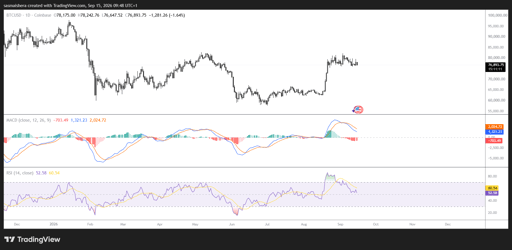
If the bearish trend persists, Bitcoin could drop below the $76,000 support level in the near term.
The rounded-top formation points to a possible decline toward $70,000–$71,000 if BTC loses the pattern’s neckline near $76,000.
Rising yields, expensive oil, and simultaneous Fed and BOJ tightening could provide the catalysts for that breakdown.
However, a recovery above $80,000 would reduce the immediate bearish risk. Until that happens, Bitcoin remains exposed to a deeper correction as global liquidity conditions tighten.

Is Ethereum price at risk of a drop below $2,400?

XRP jumps 6% as traders turn bullish, but overheating signals are flashing

Stellar price surges 6% before Protocol 28 vote: can XLM break $0.20?

Can HYPE reclaim $90 after bouncing from $77?

Zcash price slips from $1,300: could ZEC fall to $850 before targeting $2,500?
No results found
Loading articles...
Failed to load articles. Please try again.