
Ethereum open interest drops 25% as $1,500 support comes into focus

AI Sentiment: 28/100 Bearish
This score is generated through AI-driven analysis of the article's content.

powered by

Open interest is down ~25% since May and exchange reserves have fallen ~480k ETH—both point to leverage being flushed and less immediate sell supply. With ETH still holding above the $1,500 line and RSI ~25 (deeply oversold), the setup favors a rebound attempt toward $1,700–$1,850 if CPI doesn’t surprise hot. Buy spot ETH (or ETH ETF where available) with a focus on holding through the CPI window.
Key Risk: ETH breaks and holds below $1,500 on a weekly basis, triggering a fast move toward ~$1,000 and invalidating the “support holds” thesis.
Binance funding is negative (~-0.0047), meaning shorts are paying to keep positions—this is a crowded “cautious” stance that often flips when price stabilizes. Short ETH perpetual futures (or use an inverse/short perp strategy) to profit if the market squeezes higher after leverage resets elsewhere.
Key Risk: Funding turns positive and price accelerates down (or stays weak) so the short keeps paying and the squeeze thesis fails.
- ETH exchange reserves fell by 480,000 coins in a few days.
- ETH futures activity has returned to April 2025 levels.
- A break below $1,500 could bring $1,000 into focus.
Ethereum's futures open interest has fallen 25% since May, while nearly 480,000 ETH has left major exchanges, placing fresh attention on the cryptocurrency's ability to hold above the closely watched $1,500 support level.
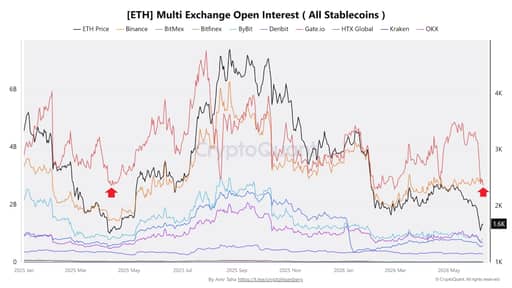
According to CryptoQuant analyst Amr Taha, total ETH futures open interest across exchanges has dropped to $12.6 billion from $16.6 billion recorded in May.
The decline has pushed activity on several major platforms back to levels last seen in April 2025, showing that a large portion of leveraged positions has already been cleared from the market.
Gate.io recorded the steepest contraction. ETH open interest on the exchange fell to $2.68 billion on June 9 from $4.84 billion on May 7, a decline of about 45%.
The figure now sits almost exactly where it stood on April 11, 2025.
Bybit has experienced a similar reset, with open interest near $805 million compared with roughly $795 million in early April 2025.
A different picture has emerged on Binance.
Open interest remains around $2.76 billion, while funding rates have turned negative to approximately -0.0047.
Such readings indicate that short sellers are paying to maintain their positions, suggesting traders remain cautious despite the recent reduction in leverage elsewhere.
ETH hovers above key support as traders await CPI data
Beyond derivatives markets, exchange reserves have also moved lower.
Data tracking Binance, OKX, Gemini, and Bitfinex shows roughly 480,000 ETH left those platforms over the past few days.
ETH exchange reserves. Source: CryptoQuant.
Binance's reserves declined to 3.65 million ETH on June 9 from 3.87 million ETH on June 4.
Bitfinex holdings fell to 2.50 million ETH from 2.67 million ETH at the end of May.
OKX posted the largest percentage drop, with reserves decreasing from 424,000 ETH to about 336,000 ETH, while Gemini's balance slipped to roughly 522,000 ETH.
Lower exchange balances can reduce the readily available supply if demand begins to return.
Yet price action remains under pressure as macroeconomic uncertainty weighs on risk assets.
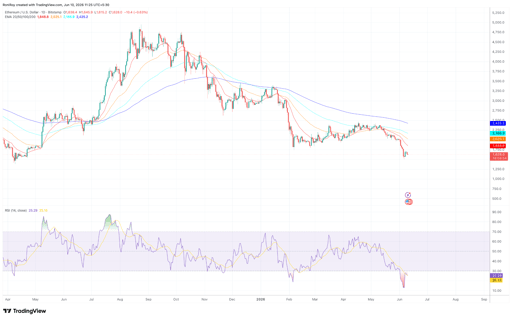
Over the past seven days, ETH has lost about 12% and was trading near $1,628 at the time of writing.
Recent market action shows buyers briefly pushing the asset back toward $1,700 after a sharp selloff on June 6, only for that recovery attempt to lose momentum below resistance.
The daily chart shows ETH trading beneath its 20-day, 50-day, 100-day, and 200-day exponential moving averages, a structure that points to continued weakness.
ETH/USD 1-Day price chart. Source: TradingView.
The 20-day EMA near $1,848 now represents the first major recovery hurdle, while the 50-day EMA around $2,025 sits higher as another resistance zone.
Momentum indicators have entered deeply oversold territory.
The daily relative strength index has fallen to around 25, a level that often accompanies periods of heavy selling pressure.
Even so, no confirmed bullish divergence has appeared on the chart, leaving traders focused on whether support can hold.
Adding to the uncertainty, markets are awaiting the latest US Consumer Price Index report.
Following stronger-than-expected US jobs data last week, expectations for another Federal Reserve rate hike by December have risen to roughly 70%.
A hotter-than-expected inflation reading could push those odds above 80%, increasing pressure on risk assets such as Ethereum as investors rotate toward yield-bearing instruments, including short-dated US Treasuries.
A softer inflation print could provide relief for crypto markets and help ETH attempt another move toward the $1,700 to $1,850 range.
On-chain data cited by market commentator Gonza Goth shows only 11% of Ethereum's supply is currently sitting on gains of 3x or more, the lowest level since February 2017.
Only 11% of $ETH supply is currently sitting at 3x+ profit.
— Gonza Goth (@GonzaGoth) June 8, 2026
Lowest level since February 2017.
Historically, extreme pessimism has created the best opportunities. pic.twitter.com/iaSwhBD6aY
According to Goth, periods of extreme pessimism have historically coincided with attractive opportunities for long-term investors.
Attention now remains fixed on the $1,500 area.
Fellow analyst and investor Ash Crypto noted that Ethereum failed to hold successive support levels during the 2022 bear market before eventually bottoming near $880.
$ETH has only done this once before in its entire history.
— Ash Crypto (@AshCrypto) June 8, 2026
Back in June 2022, ETH broke through every support level and crashed to $880. Everyone gave up on it. That turned out to be the exact bottom of the whole bear market.
Now it's June 2026, the same month, same breakdown,… pic.twitter.com/v8IulXZuPl
According to the analyst, a weekly close above $1,500 would preserve a historically important support zone, while a sustained break below that level could bring the next major support region near $1,000 into focus.

Will Bitcoin price fall below $60,000 again?

Why is the Lighter crypto price rising as the broader market falls?

Will VVV resume its rally amid easing demand? Check forecast

Chainlink forecast: LINK stays below $8 despite network growth

Monero (XMR) price forecast: Can the Cake Wallet integration spur a rebound?
No results found
Loading articles...
Failed to load articles. Please try again.