
Hang Seng Index rallies as Alibaba, Tencent, Lenovo shares surge

AI Sentiment: 72/100 Bullish
This score is generated through AI-driven analysis of the article's content.

powered by

Buy BABA. The news shows a clear rotation back into Chinese tech laggards, with Alibaba up ~8% on the day. Valuation is the anchor: Hang Seng trades around ~11 P/E versus ~20 for the S&P 500, giving room for multiple expansion if sentiment improves. Alibaba also benefits from any stabilization in chip/memory costs that pressured profitability earlier.
Key Risk: A renewed earnings hit from higher costs or weak ad/cloud demand that forces investors back out of Chinese tech.
Buy SMIC. It surged ~7.5% as investors chase the “picks-and-shovels” of the China tech rebound. If the rotation is real, semis typically lead because they’re tied to the whole ecosystem’s capex and product cycles. A rebound in China tech spending would flow through to foundry utilization and pricing.
Key Risk: US/China export restrictions tighten again or demand stays weak, capping utilization and preventing the stock from sustaining gains.
- The Hang Seng Index jumped to its June 18 highs.
- Technology companies like Lenovo and Alibaba led the gains.
- The Hang Seng Tech Index soared to a multi-week high.
The Hang Seng Index staged a strong comeback today, reaching its highest level since June 18, as investors rotated towards Chinese technology companies that have been left behind in the recent rally. It jumped to 24,057, up by 6.8% from its lowest point this year.
Hang Seng Index soars as tech firms jump
Chinese tech firms have been under pressure this year as investors focused on big names in South Korea and Japan. The closely watched Hang Seng Tech Index remains 30% below its highest point last year, even as the Kospi and Nikkei 225 have soared.
There are signs that a sector rotation is happening now as Chinese tech companies have started to come back. The HSTECH Index jumped to 4,687, its highest level since June 16.
Lenovo Group, the best-performing Hang Seng Index stock this year, jumped by 9.48%, while Alibaba Group soared by 8.14%. Semiconductor Manufacturing International (SMIC) soared by 7.5%, while Kuaishou Technology was up by 6.8%.
Xiaomi stock has risen by 5.6%, while other big names like BYD, Baidu, and Netease rose by over 4%. With tech stocks rising, the top laggards in the index were companies in other sectors like WH Group, WuXi AppTec, Contemporary Amperex, and Techtronic Industries.
Chinese tech stocks are rising as investors continue their rotation to companies that have underperformed the market this year. They are also soaring as investors hunt for bargains, something that is also happening in other markets. For example, in the US, software stocks like Figma and Adobe have risen this week.
Still, Chinese technology companies are facing substantial challenges. For example, Xiaomi has seen its revenue and profitability growth struggle amid the rising semiconductor and memory prices.
Its latest results showed that its profits plunged by over 50%. Investors are concerned that hiking prices of its products may lead to further demand destruction. At the same time, there are concerns about its EV business as competition in China remains stiff.
Other tech names like Alibaba and Tencent have been affected by the rising chip and memory prices, which have affected their profitability growth.
The Hang Seng Index remains a bargain in several measures. For example, data shows that it has a price-to-earnings ratio of 11. In contrast, FactSet data places the S&P 500 Index’s forward PE multiple at 20. The FTSE 100 has a multiple of 18.
Hang Seng technical analysis
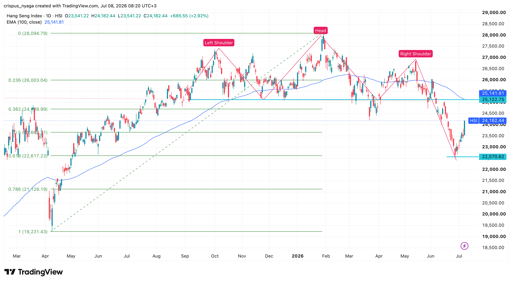
The daily chart shows that the Hang Seng Index has rebounded in the past few days, moving from a low of 22,570 on June 26 to 24,147 today.
It is still too early to determine whether this is the start of a new bull market as the index remains below the 100-day moving average. It also sits below 25,122, the neckline of the head-and-shoulders pattern.
As such, the ongoing rebound may be because it wants to retest the resistance at 25,122, which would confirm a break-and-retest pattern, a common continuation sign.

Why investors see more upside for SanDisk's 500% rally

USD/JPY signal: forecast as a death cross forms ahead of key US, Japan macro data
DRAM ETF gained 18% last month: can it continue its outperformance

UBS sees two Fed hikes in 2026: what should investors buy

Broadcom stock: Why the AI chipmaker’s growth story is gaining steam
No results found
Loading articles...
Failed to load articles. Please try again.