
USD/JPY forecast as US and BoJ forex intervention backfires

AI Sentiment: 68/100 Bullish
This score is generated through AI-driven analysis of the article's content.

powered by

Buy USD/JPY. The intervention shock is fading, ADX is rising (~37) and price is trying to reclaim the 25-day EMA, with 160 as the next clear upside level. The carry trade remains the dominant force: Japan’s rate is still far below the US, so yen demand stays structurally weak unless BoJ hikes accelerate.
Key Risk: BoJ (or US) intervenes again aggressively and breaks the carry-trade momentum, sending USD/JPY back below the reclaimed moving average.
Buy JPY-rate upside via a position that benefits from a September BoJ 25bp hike: go long Japanese short-end rate exposure (e.g., JPY interest-rate futures or options tied to BoJ policy expectations). The article flags a 68% odds jump; if that prints, USD/JPY should drop as the rate gap narrows.
Key Risk: BoJ delays or signals no further hikes, crushing the September probability and widening the US–Japan yield gap again.
- The USD/JPY pair has rebounded in the past few days.
- There are signs that the recent intervention has backfired.
- The jump is because of the wide spread between the US and Japanese rates.
The Japanese yen continued its recent retreat, reaching its lowest level since July 31 as the recent US intervention backfired. The USD/JPY pair rose to 159.43, up by 2.72% from its lowest level this month.
Japanese yen retreat continues as carry trade intensifies
The USD/JPY pair crashed hard earlier this month, reaching its lowest level since May, after the Donald Trump administration made its biggest intervention in years. It did that by converting some of its euro holdings into the Japanese yen, a move that caught European officials offguard.
The Bank of Japan (BoJ) also intervened, pumping billions of dollars to yen buying. This happened after the pair jumped to 163.96, its highest level in decades.
The Trymp administration intervened to prevent the BoJ from intensifying its US government bond sales, which would have driven yields higher. Already, the 30-year yield has remained above 5% for months. And this week, the US government sold ten-year bonds at the highest yield in years.
Historically, forex market interventions tend to have a short-term impact on the currency. A good example of this is how the Japanese yen jumped on April 30th after the BoJ intervened and then resumed its downward trend.
The main issue facing the Japanese yen is that the Bank of Japan maintains low interest rates compared to the Federal Reserve. It recently hiked rates to 1%, the highest level in decades. This rate, however, is much lower than the US, which has remained between 3.50% and 3.75% this year.
The implication of this is that the USD/JPY has become a carry top carry trade pair. A carry trade is a situation where investors borrow from a low interest country and invests in a high interest rate one. In this case, they are borrowing from Japan and investing in the US.
As such, analysts believe that the Japanese yen will only have a sustained uptrend against the US when the BoJ hikes interest rates further. The BoJ has hinted that it may hike rates further this year. A Polymarket poll shows that odds of a 25 basis point hike in September have jumped to 68%.
Separately, the USD/JPY pair reacted mildly to the latest US nonfarm payrolls and consumer inflation data. The jobs report showed that the US economy lost 23k jobs in July, while the unemployment rate dropped to 4.2%. Another report released on Wednesday showed that the US inflation softened a bit in July. These numbers mean that the Fed will maintain rates unchanged this year.
What next for the USD/JPY pair?
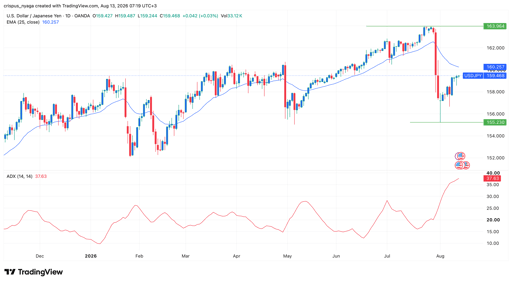
USDJPY chart | Source: TradingView
The daily chart shows that the USD to JPY pair has rebounded in the past two weeks as the impact of the intervention fades. It has now jumped to 159.46, and is attempting to cross the 25-day Exponential Moving Average (EMA).
The Average Directional Index (ADX) has continued rising and moved to 37, the highest level in months, a sign that the uptrend is continuing. Therefore, the path of the least resistance for the pair is bullish, with the next key target to watch being 160. A move above that level will point to more upside.
The only caveat to remember is that the BoJ and the US have hinted at possible interventions, meaning that these gains can easily reverse.

HPE stock forms rare cup-and-handle pattern as Dell earnings set up key catalyst

Here’s why Rolls-Royce share price is falling and what may happen next

NZD/USD signal: forecast as RBNZ hikes rates as New Zealand bond yields jump

Nikkei 225 Index analysis as Japan bond yields surge, Softbank stock plunges

Duolingo stock jumps as charts flash warning amid transition from growth to value
No results found
Loading articles...
Failed to load articles. Please try again.