
Tesla-aktien stiger 2%: Derfor bekymrer en tilbagekaldelse ikke investorer i dag
AI-sentiment: 68/100 Bullish
Denne score genereres ved hjælp af AI-drevet analyse af artiklens indhold.

drevet af

Køb Tesla (TSLA). Tilbagekaldelsen er en softwareløsning for en forsinkelse i bakkameraets billede, ikke en sikkerhedsrelateret hardwarefejl, og markedet behandler det allerede som rutine. Da TSLA stadig er nede siden årets begyndelse (YTD) og for nylig har underperformet det bredere marked, fremstår 2.9% stigningen mere som en rejustering af investorstemningen end et fundamentalt brud. En opadgående katalysator er, at markedet genfokuserer på Terafab/AI-chip-selvforsyning, efterhånden som støjen om tilbagekaldelsen lægger sig.
Nøglerisiko: En anden, mere alvorlig tilbagekaldelse relateret til bremsning/styring eller en hardwarefejl, der kræver dyre udbedringer og skader tilliden.
Køb Intel (INTC). Terafabs anvendelse af Intels 14A-proces er en direkte tillidserklæring til Intel Foundrys roadmap. Hvis Tesla/SpaceX skalerer chipproduktionen, validerer det Intels evne til at levere førende kapacitet og kan fremskynde flere foundry-kontrakter fra AI-/datacenterkunder.
Nøglerisiko: Intel 14A bliver forsinket eller har dårlige udbytter, hvilket får Terafab til at skifte proces og kan få Intel Foundrys troværdighed til at kollapse.
- Tesla rises 2.86% despite recall affecting over 218K vehicles.
- Recall impact limited as focus shifts to Musk’s $119 billion chip plan.
- Terafab project highlights Tesla’s long-term AI and chip ambitions.
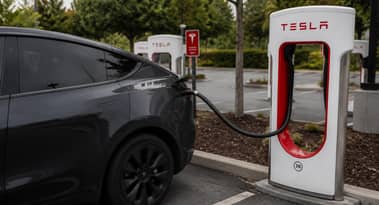
Tesla TSLA shares edged higher on Wednesday, even as the electric-vehicle maker announced a recall affecting more than 218,000 vehicles.
The stock rose 2.86% to $400.50.
Tilbagekaldelsen tiltrækker opmærksomhed men har begrænset markedsmæssig indvirkning
Tesla’s recall affects 218,868 vehicles across its Model 3, Model Y, Model S, and Model X lines operating on software version 2026.8.6.
The issue involves a delay in the rearview camera image when the vehicle is placed in reverse, a defect that the company said will be addressed through a software update.
Recalls are generally not a major driver of stock performance in the automotive sector, as they are considered a routine part of regulatory oversight and product lifecycle management.
However, Tesla’s recalls tend to attract heightened scrutiny given the company’s volatility and its status as the world’s most valuable automaker.
By comparison, Toyota Motor has recalled 1.1 million vehicles in the United States this year across 12 actions, while Ford Motor has led recall activity with nearly 10 million vehicles across 34 actions.
Tesla has conducted two recalls totaling approximately 219,000 vehicles in 2026.
Market participants appeared more focused on macroeconomic developments than the recall itself.
Tesla shares have declined about 0.42% since the onset of conflict in Iran, underperforming the broader market by roughly seven percentage points.
The stock is down 8.5% year-to-date but remains up 45% over the past 12 months.
Terafab-projektet signalerer langsigtede chip-ambitioner
Beyond near-term developments, investor attention is increasingly shifting toward Elon Musk’s broader vision for semiconductor self-sufficiency.
SpaceX has proposed an initial $55 billion investment to build a semiconductor manufacturing facility in Texas, with total investment potentially rising to $119 billion as additional phases are completed.
The project, known as Terafab, is expected to involve SpaceX, Tesla, and Musk’s AI venture xAI.
The facility will include two advanced chip factories: one for Tesla vehicles and its Optimus humanoid robots, and another designed for AI data centers, including potential space-based computing applications.
"We either build the Terafab or we don't have the chips," Musk said during a presentation in Austin in March, highlighting concerns about future chip supply constraints.
Opbygning af AI- og chipproduktionskapacitet
Tesla plans to use Intel’s next-generation 14A manufacturing process for chip production at Terafab, marking a potential milestone for Intel as it seeks to expand its contract manufacturing business.
Musk indicated that by the time the facility reaches scale, Intel’s process technology “will be probably fairly mature or ready for prime time” and “seems like the right move.”
In the near term, Tesla is focusing on building a smaller research and fabrication facility at its Giga Texas campus in Austin, with an estimated cost of $3 billion.
This initial phase is intended to test concepts and produce a limited number of wafers.
"What we figured out thus far is Tesla doing the research fab, SpaceX doing the initial part of the large-scale Terafab. And then we got to figure out the rest," Musk said.
The long-term vision is ambitious.
Terafab is expected to eventually produce one terawatt of computing capacity annually—double the current output of the entire United States.
However, estimates suggest that building such capacity could require between $5 trillion and $13 trillion in capital expenditure.
Nvidia-aktieanalyse: hovedårsager til, at aktien snart kan stige kraftigt

Broadcom-aktien rammer vigtig støtte – springer den efter regnskabet?

Kan AI styre din portefølje? InvestorAIs Bruce Keith svarer i 'Zero Sum'
Meta-aktien virker undervurderet: forlig og AI kan frigøre op til 40% kursstigning
Micron og SanDisk falder før åbningen efter ny Kina‑risiko
Ingen resultater fundet
Indlæser artikler...
Failed to load articles. Please try again.