
Zcash rebounds to $530 following exploit-driven crash

AI Sentiment: 58/100 Bullish
This score is generated through AI-driven analysis of the article's content.

powered by

Exploit-driven crash is already being bought aggressively: ZEC rebounded from ~$250 to ~$530, volumes nearly doubled, and ~$21M of shorts were liquidated—classic momentum + forced-covering setup. Enter/add on strength with a focus on holding above $500 (daily close). Thesis: the market is repricing the worst-case fear and the squeeze/volume tailwind carries price higher.
Key Risk: A confirmed failure to hold above $500 that turns the rally into a breakdown back toward $416/$300.
The rebound is partly mechanical (short squeeze) and partly speculative (RSI ~77). At ~$530, risk/reward skews toward a fade if the “security/supply integrity” narrative reasserts itself. Sell/trim on any push above ~$550–$600 and look for mean reversion toward the $500 level or the $416 liquidity zone.
Key Risk: New positive security/supply clarity that triggers sustained spot buying and keeps price grinding up without reverting.
- ZEC is up 25% and is now trading above $530, outperforming the other major coins.
- The coin dropped below $250 on June 5 after a critical vulnerability in the network's codebase.
- ZEC could extend its rally past the $550 resistance level if the rally persists.
Zcash ZEC has staged a dramatic recovery after suffering a sharp selloff last week triggered by revelations of a critical vulnerability in the network's codebase.
The bearish trend began after Zcash founder Zooko Wilcox disclosed the existence of an exploit that could have allowed malicious actors to mint an unlimited number of ZEC tokens.
The disclosure rattled investor confidence and raised concerns about the integrity of the blockchain’s monetary supply.
As news of the flaw spread, ZEC plunged to around $250 on June 5, marking one of its steepest declines in recent months.
Buyers step in at key support level
Despite the severity of the selloff, buyers quickly emerged at the $250 level, helping stabilize the market and prevent a deeper collapse.
Strong demand at that price point sparked a sharp rebound, with ZEC climbing steadily in the days that followed.
The token has since recovered to approximately $530, effectively doubling from its post-crash low.
The recovery has been accompanied by a surge in trading activity.
Over the past 24 hours, trading volumes have nearly doubled to around $1 billion, representing roughly 10% of Zcash’s circulating market capitalization.
Part of the recent price surge appears to have been fueled by a significant short squeeze.
Data from CoinGlass indicates that approximately $21 million worth of ZEC short positions have been liquidated over the past two days.
The forced closure of bearish positions likely added momentum to the rally, amplifying gains as traders rushed to cover their shorts.
Despite the strong recovery in price, on-chain data suggests confidence among some long-term holders may be weakening.
The Orchard Pool, Zcash’s largest shielded pool, has experienced one of its largest withdrawals on record since the exploit disclosure.
Nearly 800,000 ZEC tokens have reportedly been withdrawn from the pool during that period.
At current prices, those withdrawals represent roughly $400 million in value leaving the protocol, a significant outflow that could indicate growing caution among privacy-focused users and investors.
Technical indicators favor bulls
The ZEC/USD 4-hour chart has flipped bullish as the momentum remains constructive in the short term.
The Relative Strength Index (RSI) has moved above its signal line and climbed to 77, indicating strengthening bullish momentum.
Rising trading volumes further support the possibility of continued upside pressure.
However, analysts caution that strong rallies following major negative events can sometimes produce false breakouts, particularly when fueled by short covering and speculative buying.
If the daily candle closes above the $500 psychological level, it could strengthen the bullish case and encourage additional momentum-driven buying.
However, failure to hold above $500 could trigger renewed selling pressure and signal that the recovery is losing strength.
However, if the bulls fail to push higher, ZEC could retest the lower support level at $416, which is also the 4-hour Transactional Liquidity (TLQ) zone.
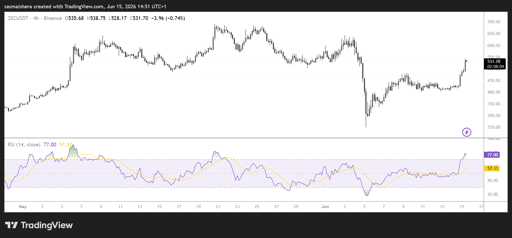
Should a confirmed breakdown occur, ZEC could experience a rapid decline toward the $300 area, where stronger long-term support may emerge.
While Zcash has delivered an impressive rebound from its exploit-driven crash, questions surrounding network security, supply integrity, and investor confidence continue to cloud the long-term outlook.

Can HYPE reclaim $90 after bouncing from $77?

Zcash price slips from $1,300: could ZEC fall to $850 before targeting $2,500?

CLARITY Act Senate vote on Tuesday: what to expect

Ethereum’s breakout setup is getting harder to ignore as bulls press $2,550

Why XRP may need more than ETF inflows to break above $1.40
No results found
Loading articles...
Failed to load articles. Please try again.