
Micron stock gains 2% today: here's why

AI Sentiment: 78/100 Bullish
This score is generated through AI-driven analysis of the article's content.

powered by

Buy MU. The $10B Boise AI research lab is a direct demand-and-capability catalyst for high-bandwidth memory and next-gen DRAM/compute systems, and the stock is still only modestly above key averages (RSI neutral). The bigger upside is capital return: CHIPS Act buyback limits end Dec. 9, and Micron is sitting on massive projected free cash flow, setting up a buyback-driven rerating.
Key Risk: Micron’s AI-memory roadmap slips or margins compress, so free cash flow doesn’t support large buybacks after Dec. 9.
Buy SK Hynix. It’s already executing aggressive buybacks while benefiting from AI infrastructure memory demand; that combination usually tightens supply/demand for shares and supports earnings per share even if memory pricing is volatile. It also reduces the risk that investors wait for Micron’s capital-return timing.
Key Risk: AI memory demand growth slows sharply or pricing falls faster than buybacks can offset, crushing EPS.
- Micron plans a $10B AI research lab in Boise, Idaho.
- Buyback restrictions on Micron are set to expire Dec. 9.
- UBS sees $380 billion in Micron free cash flow in 2027-28.
Micron Technology MU shares rose 2% on Aug. 20 after the memory chipmaker announced plans to build a $10 billion artificial intelligence research laboratory in Boise, Idaho.
The facility is expected to be constructed over the next decade and will focus on memory technology, compute systems and future semiconductor manufacturing.
The investment comes as Micron and other memory chipmakers benefit from growing demand tied to the expansion of AI infrastructure.
Micron plans $10 billion research facility
Micron said construction of its advanced Micron Research Labs facility is expected to begin in 2027.
The site will have space for hundreds of researchers and will focus on advancing memory technologies, developing compute systems and supporting future microchip manufacturing.
The new facility represents the latest major investment by Micron as the company expands its US research and manufacturing footprint.
Micron Chairman, President and CEO Sanjay Mehrotra said the investment adds on to the $250 billion which the company has already committed to develop manufacturing and R&D in the US.
Micron's investment comes as AI infrastructure expansion drives demand for memory chips.
Other major memory companies, including SK Hynix, have also benefited from the increase in demand associated with AI-related infrastructure spending.
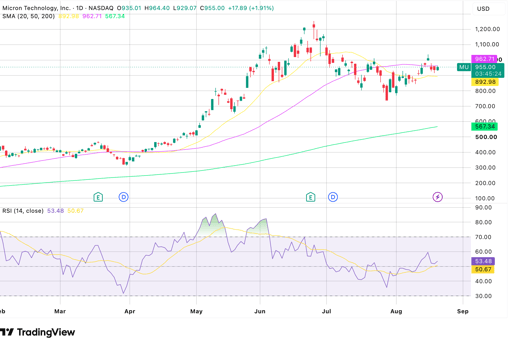
Micron shares were trading at $955, putting the stock about 6.9% above its 20-day simple moving average of $892.98 and 0.8% below its 50-day average of $962.71.
The stock's Relative Strength Index stood at 53.48, indicating neutral momentum.
Shares were also significantly above the 200-day moving average of $567.34, pointing to a strong longer-term trend.
However, the 20-day moving average remained below the 50-day moving average, which is generally viewed as a bearish technical signal.
Micron lags rivals on share buybacks
While Micron is increasing investment in research and manufacturing, it has not announced share buybacks on the scale seen among some of its memory-chip rivals.
SK Hynix has announced plans to repurchase 40 trillion won, or about $29 billion, worth of shares over the three months beginning Aug. 20.
Japan's Kioxia completed a roughly $5 billion stock buyback earlier this month.
Samsung Electronics is also expected to announce a shareholder return program worth more than 100 trillion won later this month, according to multiple South Korean media reports.
Micron's ability to return capital to shareholders has been constrained by conditions attached to funding it received under the US CHIPS Act in 2024.
Those restrictions currently limit the company's ability to conduct large share buybacks or issue special dividends.
However, the restrictions on buybacks are expected to expire on Dec. 9, allowing Micron greater flexibility over its capital allocation.
Micron has indicated that it intends to increase capital returns once the restrictions expire.
Analysts see room for major capital returns
The potential for increased buybacks has become an important consideration for Micron investors as the company generates substantial cash from its business.
UBS analyst Timothy Arcuri estimates that Micron could generate about $380 billion in cumulative free cash flow across 2027 and 2028. He expects the company could use the “vast majority” of that cash to repurchase shares.
Micron had a market capitalization of about $1.06 trillion as of Wednesday's close.

Apple unveils foldable iPhone, redefining flexible displays

Apple shares fall 1.5% as iPhone 18 Pro launch comes with $100 price ike

UnitedHealth sells WellMed to TPG: what it means for UNH stock

Dell stock hits 52-week high as AI demand fuels growth

Apple stock: what a foldable iPhone really means for it
No results found
Loading articles...
Failed to load articles. Please try again.