
Bitcoin slips below $74K as US-Iran clash derails weekend rally

AI Sentiment: 28/100 Bearish
This score is generated through AI-driven analysis of the article's content.

powered by

Buy BTC on a reclaim of $74,000 with tight risk, targeting a retest of $78,300 as the weekend rally resumes once headline shock fades. Setup: price is holding above the $74K line after a geopolitical-driven flush; Fear & Greed is still in fear (29), leaving room for mean reversion without full risk-on confirmation. Key level: $72,000 is the pivot—hold it and the market is signaling dip-buying durability.
Key Risk: A decisive weekly break of $72,000 that turns the move into a trend reversal toward $68,000.
Sell WTI (e.g., NYMEX WTI futures) into strength after the +4.5% spike, targeting a pullback as the market overprices immediate Strait of Hormuz disruption. Setup: ceasefire exists but is under strain; crypto is already reacting to the worst-case narrative, while the article flags only “threat” of full closure. If BTC stabilizes above $74K, it implies the energy shock is being partially discounted—WTI should mean-revert.
Key Risk: Escalation that results in actual sustained Strait of Hormuz disruption, keeping oil bid above $95.
- Bitcoin gave up weekend gains as US forces intercepted Iranian vessels.
- Iran has pulled out of scheduled peace talks.
- Traders are closely watching the $72,000 level for downside risk.
Bitcoin dipped below the $74,000 mark on Sunday as a military confrontation between the US and Iran dismantled a brief weekend rally.
Data from Coinbase shows the flagship crypto hit a multi-month high near $78,300 late Friday, reaching its highest valuation since early February.
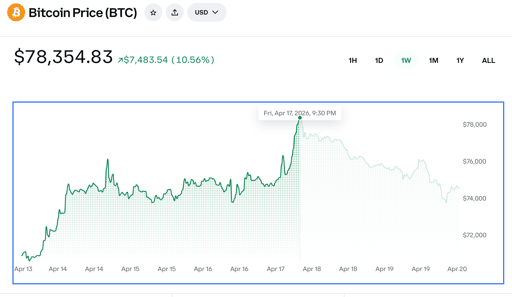
Bitcoin price (weekly timeframe). Source: Coinbase.
However, prices began to slip on Saturday after Tehran threatened to shut down critical shipping lanes in the Strait of Hormuz.
The decline accelerated into Sunday night when the US military intercepted and seized an Iranian cargo vessel, alleging the ship attempted to bypass a blockade of Iranian ports.
Geopolitical friction rattles markets once again
According to Iranian state media, Tehran has officially withdrawn from a scheduled second round of peace negotiations in Islamabad, Pakistan.
Iranian officials have called the seizure of the cargo ship Touska a direct breach of the two-week ceasefire agreement, which had already been under strain and was originally set to expire this Wednesday.
The semi-official Tasnim news agency reported that the Iranian leadership currently has no intention of sending a delegation to the summit, citing what they called Washington’s "unrealistic expectations" and the continued enforcement of a naval blockade.
"Tehran has vowed to retaliate over the US military’s seizure of the ship," the state-affiliated outlet noted while confirming the rejection of Monday's talks.
Market sentiment soured across traditional sectors as news of the naval engagement and the subsequent breakdown of diplomacy broke.
S&P 500 futures fell 0.8% on Sunday night, while Dow Jones futures dropped roughly 450 points, or 0.9%.
Technology-heavy Nasdaq-100 futures saw a similar 0.6% slide as investors moved away from riskier assets.
Energy prices reacted sharply to the prospect of a prolonged supply disruption in the Middle East.
The renewed hostilities and Iran’s threat to fully re-close the Strait of Hormuz a waterway responsible for a fifth of the world’s oil supply triggered a spike in global benchmarks.
Crude oil futures jumped more than 4.5% to exceed $95 per barrel, reversing the brief price relief seen during the early days of the ceasefire.
The Crypto Fear & Greed index climbed two points to reach 29 on Monday, a slight improvement that likely reflects the rally seen before the ship seizure.
Although this represents the highest level of confidence recorded since late January, the metric remains firmly in "fear" territory as investors weigh the potential for further escalation before the ceasefire officially concludes mid-week.
Will Bitcoin price crash?
At the time of writing, Bitcoin price had recovered back above $74,000, which means there is still significant buying interest at lower levels that could prevent a total collapse in the short term.
Many traders appear to be treating the dip as a temporary reaction to the headline risk rather than a long-term trend reversal.
All eyes are now on the $72,000 support level, which, if broken decisively, could trigger a deeper correction towards the $68,000 range.
This psychological floor has historically served as a pivot point for the market during periods of heightened volatility.
On the contrary, any sustained upside move would likely be dependent on whether tensions between the two nations de-escalate in the coming days.
If the planned diplomatic channels remain closed and oil prices continue to climb, the asset may struggle to reclaim the $78,000 peak established earlier in the weekend.

BitMine stakes 85% of its ETH: why $330M barely changes the risk equation

XRP price is flashing a 48% upside setup, but $1.50 must break first

Bitcoin rebounds $1,500 from its intraday low: who keeps buying near $77K

Why is Hyperliquid price still rising after an $820 million token unlock?

PI coin rises ahead of Protocol 27, can it recover above $0.10?
No results found
Loading articles...
Failed to load articles. Please try again.