
BoE signals potential hikes as Iran war fuels inflation concerns
AI Sentiment: 25/100 Bearish
This score is generated through AI-driven analysis of the article's content.

powered by

Buy UK bank rate-sensitive equities: Barclays (BARC) and Lloyds (LLOY). If BoE is forced toward tighter policy, net interest income tends to benefit from higher/steeper rate expectations and sticky deposit pricing, while the market will also price in stronger credit discipline from higher rates. The BoE’s emphasis on “material second-round effects” is a direct catalyst for a hawkish curve repricing that banks typically outperform on.
Key Risk: Higher rates trigger a sharp credit deterioration (consumer stress/loan losses) that overwhelms any net interest benefit.
Sell iShares Core UK Gilts UCITS ETF (IGLT) / short UK 2–5Y gilts. BoE dropped its central forecast and laid out a credible “forceful tightening” path if energy stays high and second-round wage effects show up. With oil >$122 and Scenario C keeping inflation above target for years, the market will reprice rate cuts out and push yields higher, hurting gilts most in the front end.
Key Risk: Energy shock fades fast and wage/price pass-through doesn’t materialize, letting BoE lean back toward Scenario B and yields fall.
- BoE keeps rates steady, cites uncertainty from Iran war.
- Energy shock may push inflation higher, tightening risk rises.
- Policymakers split on timing as growth concerns deepen.
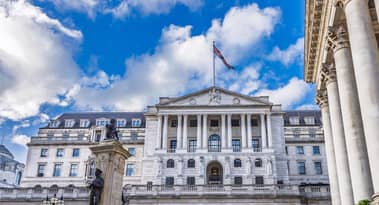
The Bank of England kept interest rates unchanged on Thursday, while warning that a prolonged energy shock linked to the Iran war could force a sharper tightening of monetary policy.
The central bank’s Monetary Policy Committee (MPC) voted 8-1 to hold the benchmark Bank Rate at 3.75%.
Chief Economist Huw Pill was the sole dissenter, voting for an immediate increase to 4.0%.
The decision comes a day after the Federal Reserve kept rates on hold, and ahead of an expected pause by the European Central Bank.
Inflation risks balanced by weakening labour market
The MPC said it would continue to monitor developments in the Middle East closely.
Policymakers highlighted the risk of “material second-round effects” from rising energy prices, including higher wage demands and businesses passing on costs to consumers.
At the same time, the central bank noted signs of a weakening labour market and said higher borrowing costs in financial markets could help contain inflationary pressures.
“The Committee stands ready to act as necessary to ensure that CPI inflation remains on track to meet the 2% target in the medium term,” the MPC said, as cited in a Reuters report.
BoE drops central forecast, outlines scenarios
Facing heightened uncertainty, the Bank of England abandoned its usual central forecast and instead outlined three potential scenarios based on energy prices and second-round effects.
Under the most severe Scenario C, inflation could peak at 6.2% and remain above the 2% target for three years.
This scenario assumes persistently high energy prices and stronger inflationary spillovers.
Global oil prices rose above $122 a barrel on Thursday, the highest since March 2022, amid concerns over a prolonged blockade of the Strait of Hormuz.
If such conditions materialise, the BoE said it would be “likely to warrant a forceful tightening in monetary policy.”
In contrast, Scenarios A and B suggest a less aggressive policy response, with rising market-based borrowing costs already helping to offset inflation.
Policymakers divided on next steps
BoE Governor Andrew Bailey said he placed the most weight on Scenario B, “albeit with slightly reduced second-round effects,” while also assigning “some weight” to Scenario C.
Around half of the MPC members who supported holding rates also leaned towards Scenario B.
The central bank noted differing views within the committee.
Some members “might prefer to act early” to prevent inflation from becoming entrenched, while others favour waiting for clearer evidence.
Before Thursday’s decision, investors had priced in nearly three quarter-point rate increases for the year.
Growth concerns and fiscal pressures persist
Beyond inflation, the BoE flagged risks to economic growth.
Britain is seen as particularly vulnerable to rising energy costs due to its reliance on natural gas.
Recent data showed firms facing higher input costs and raising price expectations at a record pace.
At the same time, political uncertainty is adding to investor concerns.
Prime Minister Keir Starmer is facing challenges in maintaining control, raising questions about fiscal policy direction.
British government bond yields are currently the highest among Group of Seven economies, underscoring market concerns over inflation and fiscal risks.
Bailey and other senior officials are scheduled to hold a news conference later in the day.
Fed Minutes show split over rate hikes and cuts as inflation risks persist

Bank of England warns AI could amplify market and cyber risks

Eurozone credit growth continues to strengthen as corporate lending accelerates

Eurozone inflation decline in May as longer-term outlook holds steady

ECB study flags limited impact of AI boom on US jobs and wages
No results found
Loading articles...
Failed to load articles. Please try again.
