
Cuba has run out of diesel: what happens to its economy now?
AI Sentiment: 10/100 Bearish
This score is generated through AI-driven analysis of the article's content.

powered by

Buy: Frontline Ltd (FRO) and Scorpio Tankers (STNG). Cuba’s diesel/fuel oil gap raises the odds of more spot demand for refined products and crude-to-refining logistics, keeping charter rates and utilization supported as shipping costs stay elevated. The article flags no reserves and fragile delivery timing—exactly the kind of situation that pulls incremental tonnage into the market.
Key Risk: A sharp drop in global refined-product demand or a collapse in charter rates that offsets any Cuba-driven incremental demand.
Sell: Maersk (AMKBY). Cuba’s fuel procurement is constrained by sanctions, compliance, and payment risk; that environment increases the probability of disrupted routes, higher compliance costs, and slower cargo execution for any carrier exposed to higher-risk trades. The article emphasizes practical transaction barriers even when sellers are willing.
Key Risk: Regulatory clarity or a shift in trade flows that reduces sanctions friction and restores predictable volumes for Maersk.
- Cuba says it has run out of diesel and fuel oil amid a worsening energy crisis.
- Havana neighborhoods are facing up to 22 hours of blackout each day.
- Rising oil and shipping costs are making fuel imports even harder to secure.
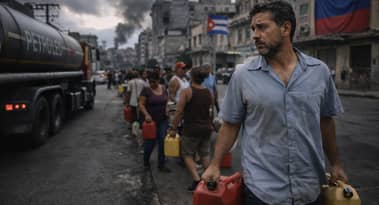
Cuba has run out of diesel and fuel oil, according to Energy Minister Vicente de la O, leaving the island facing one of its most severe power crises in decades.
In Havana, many neighbourhoods are now enduring between 20 and 22 hours of blackout a day, a level of disruption that points to a broader breakdown in the country’s ability to secure and distribute fuel.
The immediate story is about shortages.
The more important story is what those shortages imply. When a country runs out of transport and generation fuel at the same time, the impact quickly spreads beyond electricity supply.
It affects public transport, food distribution, industrial activity, tourism, healthcare logistics and confidence in the state’s ability to manage the crisis.
Reuters reported from Havana that the US fuel blockade has “strangled” supplies to the island.
De la O said Cuba remains open to any seller willing to supply fuel, adding that negotiations to import cargoes are continuing.
He also pointed to higher global oil and shipping costs linked to the US-Israeli war with Iran, which has made an already difficult procurement environment even tougher.
Why the shortage matters
The blackout figures alone show why this is no longer just an energy story.
If residents in the capital are spending most of the day without power, the consequences are likely to reach deep into daily economic life.
For households, prolonged outages mean higher food spoilage, water shortages, weaker mobile connectivity and greater reliance on costly backup solutions.
For businesses, especially small private operators, it means lost trading hours, damaged inventory and lower productivity.
Tourism, one of Cuba’s most important sources of hard currency, is also exposed if hotels, restaurants and transport services cannot guarantee reliable power.
The shortages matter even more because Cuba has limited buffers.
Reuters reported that the island has no diesel or fuel oil reserves, while only one Russian tanker has delivered crude since December.
That suggests the government is operating with little margin for error. Any delay in fresh deliveries could prolong the crisis or force even harsher power rationing.
Why imports are hard to secure
Cuba’s fuel problem is not simply about demand exceeding supply.
It is also about financing and access.
Sanctions make transactions harder, freight costs have risen and sellers may be reluctant to engage because of compliance and payment risks.
Even where there is a willing buyer and a willing seller, shipping and insurance can become obstacles.
The UN has called the US blockade unlawful, according to Reuters, but that does not change the practical constraints facing Havana in the market.
The island’s grid relies on a combination of domestic crude, gas and constrained solar generation, which means imported fuel still plays a critical role in keeping electricity flowing.
If imported cargoes do not arrive in time, generation capacity remains exposed.
What the implications are
The biggest implication is that Cuba’s economic weakness could deepen.
Longer blackouts can reduce output, hit export-linked sectors and worsen shortages elsewhere in the economy. They can also intensify inflationary pressure if transport and supply chains become less reliable.
There is also a social implication. Extended outages in the capital tend to carry greater political sensitivity than shortages in outlying areas.
If the crisis persists, the government may face rising public frustration, especially if there is no clear timetable for new imports or improved generation.
Diplomatically, the shortage also sharpens the significance of Cuba’s search for suppliers.
Any successful deal would be more than a commercial transaction; it would signal which partners are still willing and able to support the island under tightening external pressure.
What to watch next
The key question is whether Cuba can secure fuel quickly enough to stabilise power generation.
Markets and policymakers will be watching for confirmation of new import agreements, tanker arrivals and any change in the severity of Havana’s outages.
A second issue is whether global oil and shipping costs remain elevated.
If they do, Cuba’s procurement challenge will become more expensive just as the country appears least able to absorb it.
For now, the fuel shortage is best seen not as a short-term supply hiccup, but as a stress test of Cuba’s economic resilience.
The blackouts are the most visible symptom. The deeper risk is that they expose how little room the island has left to manage another external shock.

LATAM crypto news: Brazil tokenization soars as cryptojacking spreads

Venezuela’s oil exports hit 7-year high on US, India demand

IMF signals Venezuela loan if data and reforms advance

Chile peso falls despite trade surplus as LatAm FX feels dollar pain

Chile retail activity rises 5.3% in February
No results found
Loading articles...
Failed to load articles. Please try again.