
France beats UK and Germany to remain Europe’s top FDI destination

AI Sentiment: 72/100 Bullish
This score is generated through AI-driven analysis of the article's content.

powered by

Buy: VINCI (DG) and Schneider Electric (SU). France is Europe’s top FDI destination (852 projects in 2025) and is pitching record €93bn pledged investments, which should lift capex for transport infrastructure and industrial electrification—direct demand for VINCI’s construction/transport work and Schneider’s grid, automation, and energy-efficiency upgrades tied to new factories and research sites. Key risk: A sharp slowdown in announced projects turning into real spending (incentives fail to convert, or macro/geopolitics delays capex), cutting order visibility.
Key Risk: Announced FDI projects don’t convert into actual construction and equipment spending.
Sell: Siemens (SIE). Germany’s foreign investment projects are down 44% vs 2019 and are at the lowest since 2009, with energy costs and regulatory complexity deterring new plants and expansions. That mix is a headwind for Siemens’ industrial automation and electrification demand, especially where new customer capex is the driver. Key risk: Germany quickly fixes the structural issues (energy/regulation) and foreign investment rebounds, restoring industrial order growth.
Key Risk: Germany’s investment slump reverses and industrial capex demand rebounds.
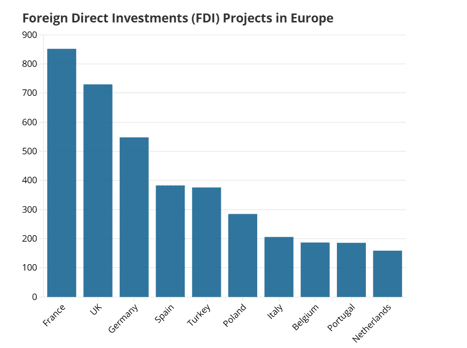
- France attracted 852 FDI projects in 2025, leading Europe.
- The UK second with 730, Germany is third with 548 projects.
- Europe records its lowest foreign investment in 11 years.
France has maintained its position as Europe’s leading destination for foreign direct investment projects, according to the latest EY Europe Attractiveness Survey.
The country attracted 852 new investment projects in 2025, far ahead of its closest rivals, even as the overall number of projects across Europe fell to the lowest level in 11 years, the survey was quoted in a Euronews report.
Foreign investment is widely regarded as a vital driver of economic growth, innovation, and job creation.
Governments across the continent are competing aggressively with incentives, tax breaks, and high-profile summits to lure international companies.
France strengthens lead with Choose France initiative
President Emmanuel Macron’s “Choose France” campaign, launched in 2018, continues to deliver results. At this year’s summit, Macron announced that foreign companies had pledged investments worth a record €93 billion.
Despite a 17% drop in new projects to 852 in 2025, France comfortably retained the top spot. The country has successfully positioned itself as a stable and attractive hub for international investors.
UK and Germany follow as investment slows across Europe
The United Kingdom ranked second with 730 projects in 2025, down 14% from the previous year. Germany placed third with 548 projects, a 10% decline and its lowest level since 2009.
The long-term trend for Germany is particularly concerning. Compared to 2019, the number of foreign investment projects has plunged 44%, a steeper fall than in France (-28%) or the UK (-34%).
Europe as a whole recorded 5,026 new investment projects in 2025, down 7% from 2024.
This marked the lowest annual total in 11 years, reflecting broader economic uncertainties, geopolitical tensions, and slower global growth.
Why France continues to win
Analysts attribute France’s resilience to proactive government policies, improved business environment reforms, and its central position in the European Union.
The “Choose France” initiative has helped the country stand out by offering tailored incentives and high-level engagement with investors.
In contrast, Germany continues to face challenges, including high energy costs, regulatory complexity, and weaker domestic demand, which appear to be deterring some foreign investors.
The UK has benefited from post-Brexit flexibility in certain sectors but continues to face headwinds from labour shortages and trade frictions.
Broader implications for European competitiveness
The EY survey tracks actual announced investment projects rather than capital flows, providing a clearer picture of real economic activity on the ground.
These projects typically involve new factories, research centres, and expansions that create direct jobs and strengthen supply chains.
The overall decline in projects across Europe signals growing challenges in attracting foreign capital at a time when many economies are seeking to boost growth and innovation.
Competition from the United States, Asia, and emerging markets remains intense.
Outlook for 2026
With global economic conditions still uncertain, European nations are expected to intensify their efforts to attract foreign investment.
France appears well-positioned to defend its lead, while the UK and Germany will need to address structural issues to regain momentum.
As governments prepare new incentives and policy measures, the battle for foreign investment projects is likely to heat up further in 2026.
Success in this area could prove decisive for Europe’s economic recovery and long-term competitiveness.

Invezz Explains: why you should closely watch payrolls, claims, ADP and JOLTS data

Column: The Fed’s inflation problem is getting harder to ignore

USD/JPY forecast ahead of Warsh Jackson Hole Speech as BoJ official hints at hikes

America wants cheaper debt: why Wall Street says Treasury tricks won’t fix it

US-Canada trade talks collapse as 50% tariffs take effect: what happens next?
No results found
Loading articles...
Failed to load articles. Please try again.