
Kospi Index forms bearish divergence ahead of Micron earnings

AI Sentiment: 18/100 Bearish
This score is generated through AI-driven analysis of the article's content.

powered by

The article flags “fear” around MU after Broadcom/Oracle reactions, but it also cites very aggressive consensus growth (revenue +279% YoY last quarter; +275% current quarter; +205% annual). If guidance is merely solid, the stock can snap back because the market is already positioned for disappointment. Buying MU targets a post-earnings mean reversion and re-rating within the memory supercycle narrative.
Key Risk: MU guides down or signals HBM/DRAM demand is cooling sooner than expected, breaking the supercycle thesis.
Kospi Composite is showing bearish divergence and a double-top, and the market is primed for a Micron earnings-driven tech selloff. If MU wobbles, Korea’s AI-memory complex (Samsung/SK Hynix/MU) will likely de-rate together, dragging the index. EWY gives direct exposure to the broad move.
Key Risk: Micron and peers beat hard with strong forward guidance, triggering a fast risk-on rebound that overrides the bearish technicals.
- Kospi Index has retreated as investors focus on Micron’s earnings.
- It also dropped as SK Hynix started to shift production capacity to lower end chips.
- It has formed a bearish divergence pattern on the daily chart.
The Kospi Index retreated sharply this week, reaching its lowest level since June 12, as technology stocks plunged. It retreated by 10% on Tuesday, and continued the trend today, June 24. This retreat may continue if Micron (MU) stock retreats after its earnings later today.
Kospi Index waits for Micron earnings
Kospi, an index tracking the biggest South Korean companies, has been in one of the longest bull runs ever seen. After bottoming at 2,268 in April last year, it jumped and peaked at 9,387 on Monday, a 320% surge.
This surge has been driven by the ongoing AI supercycle that has boosted Samsung and SK Hynix to a valuation of over $1 trillion as the memory demand jumped.
These companies, together with Micron, their top US competitor, have seen demand for their products soar amid the ongoing data center investments. They are all fully sold out for the year, and some analysts believe that the trend will continue in the foreseeable future.
Therefore, the Kospi Index is falling because of the fear that Micron stock will drop after its earnings later today. This fear has jumped after the last two big tech earnings: Broadcom and Oracle.
Broadcom published strong financial results and issued moderately good forward guidance. But despite that, its stock plunged by double digits, dragging the broader technology sector. It has never recovered and remains 23% below its highest point this year.
Similarly, Oracle published a strong report earlier this month and then pulled back. It has dropped to $165, down by 35% from its highest point this year, and is hovering at the lowest level since May 1.
Therefore, the Kospi Index will likely remain on edge as investors wait for these earnings reports. If the numbers and the guidance are strong, it means that the index will resume the uptrend as it will signal that there is still demand for memory chips.
Wall Street analysts are upbeat about the upcoming Micron earnings, with the average estimate being that its revenue jumped by 279% in the last quarter. Its guidance for the current quarter is that its revenue will rise by 275% this quarter, while the annual figure will soar by 205% to $114 billion.
SK Hynix is shifting production from high-end chips
Kospi Index also retreated after SK Hynix started to shift some of its capacity to the more commodity section of the DRAM market. That could be a sign that demand in the super high-margin HBM chips is starting to cool down. This is important as SK Hynix briefly became the biggest company in South Korea this week.
At the same time, there are concerns that foreign investors have continued dumping their shares as they book profits. That is a sign that they expect demand to start waning.
Kospi Index technical analysis
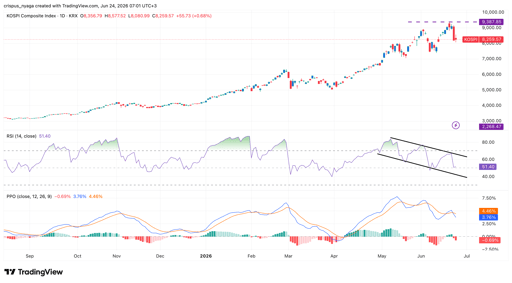
Kospi Composite Index chart | Source: TradingView
Technicals also suggest that the Kospi Composite Index has formed some highly bearish chart patterns. It has formed a small double-top pattern, a common reversal sign in technical analysis.
Most notably, the index has formed a bearish divergence pattern. The Relative Strength Index has formed a descending channel and is about to cross the neutral point of 50.
Also, the two lines of the Percentage Price Oscillator (PPO) have formed a bearish crossover and are pointing downwards. Therefore, there is a risk that the Kospi Index will pullback in the near term, potentially to the psychological level of 7,000.

Why SpaceX stock is up around 1% on Friday

Should you buy the dip in OKLO stock today?

Analyst: Adobe stock's post-earnings dip isn't about AI disruption fears only

Dow surges 500 points after four-day slide as oil prices retreat

Here’s why the Enbridge stock is in a strong downward trend
No results found
Loading articles...
Failed to load articles. Please try again.