
Rocket Lab stock rises as NASA selects Electron for two missions
AI Sentiment: 78/100 Bullish
This score is generated through AI-driven analysis of the article's content.

powered by

Buy RKLB. NASA’s VADR awards (up to $300M over 10 years) validate Electron as the go-to dedicated small-launch option for Earth/solar science, and the article ties it to specific 2027/2027+ launch needs (PolSIR dedicated launches starting no earlier than June 2027; TSIS-2 early 2027). This supports higher visibility on Electron demand while Neutron is still delayed, so near-term revenue quality improves.
Key Risk: Electron launch cadence slips (missed 2027/2028 schedules or mission failures), turning “selected” into “delayed,” and crushing the revenue visibility.
Buy RKLB for the capacity/throughput angle. The news reinforces that NASA is using Rocket Lab’s New Zealand Launch Complex 1 for multiple science missions, and the company’s stated production pace (~one Electron every 11 days) means incremental NASA payloads can be absorbed without major new infrastructure. That combination typically expands margins and reduces execution risk versus a slower-capacity competitor.
Key Risk: A bottleneck at Launch Complex 1 (range/processing constraints, staffing, or regulatory issues) limits how many Electron missions can actually fly, negating the throughput advantage.
- NASA selected Rocket Lab's Electron for two science missions.
- PolSIR and TSIS-2 launches are scheduled for early 2027.
- Electron has completed nearly 90 launches and deployed 260 satellites.
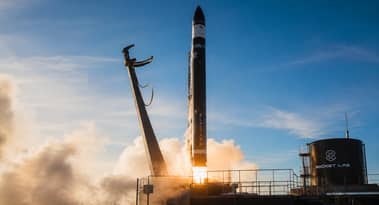
Shares of Rocket Lab NASDAQ:RKLB climbed in premarket trading after the space company announced that NASA had selected its Electron launch vehicle for two Earth and solar science missions.
The missions, known as Polarized Submillimeter Ice-cloud Radiometer Satellite (PolSIR) and Total and Spectral Solar Irradiance Sensor-2 (TSIS-2), will launch from Rocket Lab's Launch Complex 1 in Mahia, New Zealand.
The awards fall under NASA's Venture-Class Acquisition of Dedicated and Rideshare (VADR) program, a contract vehicle with a potential value of up to $300 million over a 10-year period.
NASA selects Electron for Earth and solar science missions
The PolSIR mission is designed to improve scientists' understanding of tropical and subtropical ice clouds.
The project involves two small CubeSat satellites that will measure how these clouds interact with sunlight and heat.
Researchers expect the data to help improve climate and weather forecasting models.
Rocket Lab said the PolSIR project will require two dedicated Electron launches beginning no earlier than June 2027.
The TSIS-2 mission is scheduled for early 2027 and will launch on a separate Electron mission.
The project aims to measure the total amount of solar energy and the different wavelengths of sunlight reaching Earth.
According to NASA, the information gathered from TSIS-2 will help researchers track changes in weather patterns, ocean currents, and seasonal variations.
Both missions will launch from Rocket Lab's New Zealand facility, reinforcing the company's role as a provider of dedicated launch services for scientific payloads and small satellites.
Electron remains the company's primary launch vehicle
Electron is Rocket Lab's small orbital launch vehicle designed specifically for small satellite deployments and science missions.
The company said Electron has completed nearly 90 missions and deployed more than 260 satellites into orbit as of June 2026.
Earlier this week, Rocket Lab highlighted the efficiency of its manufacturing operations, noting that its Electron production system is currently capable of providing a new rocket approximately every 11 days.
The production pace supports Rocket Lab's strategy of offering responsive and frequent launch services to commercial and government customers.
The latest NASA awards add to Electron's growing list of scientific and government missions and demonstrate continued demand for dedicated small-launch capabilities.
Neutron development continues as delays persist
While Electron remains the company's operational workhorse, Rocket Lab continues to develop its larger Neutron launch vehicle.
Neutron is intended to expand Rocket Lab's capabilities beyond the small satellite market and allow it to compete for larger payload missions.
However, development of the rocket has encountered several delays and has yet to complete its inaugural flight.
The vehicle was originally slated to make its first launch in 2025.
Until Neutron becomes operational, Electron remains Rocket Lab's sole active launch vehicle and the company's primary source of launch services revenue.
Investors appeared to welcome NASA's latest selection of Electron, with the stock gaining ground as the awards further strengthened Rocket Lab's position in the growing market for dedicated science and small satellite missions.
BofA warns of another 10% decline in chip stocks

Scotiabank stock has soared to a record high after earnings: more upside?
Oklo stock analysis: Is it a buy or sell as insiders continue selling?

Meta stock wobbly after firm reaches $16.7B settlement in child safety trial

Here’s why the Zoom Video stock is crashing after its earnings report
No results found
Loading articles...
Failed to load articles. Please try again.