
Brent crude oil price jumps after US strikes on Iran, death cross hints at reversal

AI Sentiment: 35/100 Bearish
This score is generated through AI-driven analysis of the article's content.

powered by

Buy Brent exposure (e.g., Brent futures or BCO). The ceasefire is under pressure, US is degrading Iran’s ability to attack shipping, and any Strait-of-Hormuz disruption would tighten supply fast while inventories are still falling. The market already repriced the risk higher; upside can extend if Iran retaliates or if shipping insurance/flows worsen.
Key Risk: Iran shuts the Strait and then quickly de-escalates, causing a sharp reversal and Brent mean-reverting back toward the $70 area.
Buy WTI exposure (e.g., WTI futures or USO). WTI is catching up to Brent on the same geopolitical shock, and US inventories are still dropping into the EIA print—supporting near-term prices even if the ceasefire headlines swing. If the Strait risk persists, US refiners face higher replacement costs and tighter prompt supply.
Key Risk: EIA shows a big inventory build (or demand destruction) that overwhelms the geopolitical premium and drives WTI back below $70.
- Brent crude oil price rose to $76 after US launched attacks against key Iranian sites.
- The US also revoked waivers that allowed Iran to sell its oil.
- Iran will likely retaliate by striking key US sites in the region.
Brent crude oil price jumped to $76 after the US and Iran ceasefire came under substantial pressure overnight. It has risen by 8.45% from its lowest level this month. Similarly, the WTI benchmark rose to $72.38 from this month’s low of $66.50.
US and Iran ceasefire at risk of ending
The ceasefire deal signed between the US and Iran is at risk of ending after a series of recent events. First, the US Treasury Department announced that it would block Iran’s oil sales that have been giving the country millions of dollars a day.
At the same time, the military carried out a series of strikes against key Iranian targets overnight. Officials said that these actions were justified because Iran attacked some oil and gas tankers that were crossing through the Strait of Hormuz. The US Central Command said:
“U.S. forces struck Iranian air defense systems, command and control networks, coastal radar sites, anti-ship missile capabilities, and more than 60 Islamic Revolutionary Guard Corps small boats in and near the strait to degrade Iran’s ability to continue attacking international commerce flowing through the international trade corridor.”
Iran has justified the attacks, noting that they aligned with the ceasefire, which gave it authority to govern the Strait and ensure that traffic goes back to where it was before the war started.
The risk, therefore, is that Iran will also respond to these attacks and the decision to block its oil sales. It may strike US military sites in the Middle East and even shut down the Strait again.
All this is happening ahead of Benjamin Netanyahu’s visit to the United States, where he will meet Trump, and possibly make the case for more attacks against Iran.
A resumption of the war would come at a risky time for the oil market, with inventories in the United States and other countries still falling. A report by the American Petroleum Institute (API) said that US inventories dropped by 399,000 barrels in the week ending July 3. The Energy Information Administration (EIA) will publish its inventory report later today.
Meanwhile, the oil market is reacting to reports from Russia, where Ukraine has striked key refineries in the past few weeks. This week, Ukraine launched attacks against the biggest refinery in the country in Omsk. These attacks have led to a major petrol shortage in several parts of the country.
Still, there are concerns that the oil industry will move towards a supply glut this year as traffic through the Strait of Hormuz jumps. That explains why some top analysts like those from Goldman Sachs and JPMorgan lowered their targets.
Brent crude oil price technical analysis
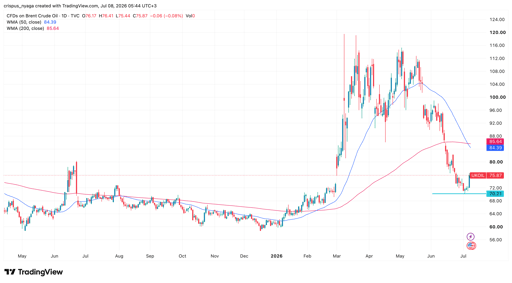
Brent crude oil price chart | Source: TradingView
The daily chart shows that Brent crude oil price has been in a downward trend in the past few months, moving from the year-to-date high of $119 to a low of $70.21.
This downtrend stalled overnight as tensions between the US and Iran rose. Still, despite this, Brent has already formed a death cross pattern as the 50-day and 200-day Weighted Moving Averages (WMA) crossed each other. This pattern is usually followed by further downward movements.
Therefore, there is a likelihood that prices will resume the downward trend in the near term, possibly as tensions between the two sides cool. We saw this happen during the previous ceasefire.

Crypto price predictions: Dogecoin, XRP, Venice Token (VVV)

Zcash price prediction: Here’s why ZEC token has gone parabolic

ARB price prediction: How Robinhood Chain growth is boosting Arbitrum

AMD stock forecast: why this Nvidia rival is on the cusp of a breakout

Blue Owl stock may short squeeze as golden cross emerges amid turnaround
No results found
Loading articles...
Failed to load articles. Please try again.