
Hang Seng Index is soaring as Kospi and Nikkei 225 implode: here’s why

AI Sentiment: 78/100 Bullish
This score is generated through AI-driven analysis of the article's content.

powered by

Buy Xiaomi. The article flags a clear rotation into Chinese tech “bargains” (Xiaomi up ~45% in a month) while the broader AI/memory selloff in Korea/Japan is still unwinding. Xiaomi’s rebound is supported by Hang Seng strength and the idea that investors are willing to pay for China beta again. Upside is continued momentum toward the Hang Seng’s ~26,000 target, with Xiaomi still far below its all-time high.
Key Risk: China’s price-war pressure keeps squeezing profits, so the stock’s rebound fades fast.
Buy Meituan. It’s the best Hang Seng performer in the piece (+~37% in a month) and is benefiting from the same “China tech rotation” while investors look for stimulus. Even with delivery price wars, Meituan’s surge suggests the market is pricing in stabilization and better demand. If Hang Seng continues its bullish push above key levels, Meituan should outperform as a high-beta beneficiary.
Key Risk: Price wars intensify again and force margin compression, breaking the rebound narrative.
- The Hang Seng Index has jumped by 14% from the year-to-date low.
- This retreat happened as the Nikkei 225 and Kospi indices slumped.
- Investors are rotating towards Chinese tech names.
The Hang Seng Index has outperformed its major Asian peers this year, even as the Kospi and Nikkei 225 have come under pressure. The index has rebounded nearly 14% from its lowest level this year, while the Nikkei 225 and Kospi have fallen about 15% and 40%, respectively, from their year-highs.
Investors rotate to Chinese tech giants
The ongoing retreat in the Kospi and Nikkei 225 indices has been driven by semiconductor and memory companies. In South Korea, the Samsung Electronics and SK Hynix stocks have plunged by over 45% and 55% from the year-to-date high.
Similarly, in Japan, companies like Kioxia, Softbank, Tokyo Electron, and Advantest have all plunged during the ongoing unwinding of the artificial intelligence trade.
There are signs that investors are now rotating to Chinese companies that have underperformed the market in the past few months. One reason for this is that many of China’s biggest names like Alibaba, Meituan, and Xiaomi have become bargains.
At the same time, market participants are waiting for a potential Chinese stimulus after the recent macro data disappointed. A report showed that the country’s GDP expanded by 4.3% in the last quarter, the slowest rate in years.
China is also making strong progress in the AI industry. Apple has selected Alibaba’s Qwen to power its AI goals, while Moonshot’s Kimi K3 has become one of the most advanced AI models in globally.
Most recently, China’s CXMT has become one of the top names in the memory industry. Its stock jumped by over 500% when it went public in Hong Kong recently.
Top Chinese technology companies have rebounded
Xiaomi stock has led the recent surge, rising by over 45% in the last month as investors bought the dip. Despite the surge, Xiaomi remains significantly lower than its all-time high as its growth stalled and profits narrowed amid the soaring memory costs.
Meituan stock has soared by over 37% in the last month, making it the best-performing Hang Seng constituent. Like Xiaomi, Meituan has been under pressure because of the ongoing price wars. Top companies like Alibaba and JD are all attempting to take market share in the food delivery industry.
Other top companies like Li Auto, Trip.com, BYD, and Tencent have jumped by double digits in the past few days.
Companies in other sectors have also bounced back in this period. The most notable ones are CSPC Pharmaceuticals, JD Logistics, JD Health, Tingyi, Orient Pharmaceuticals, and Sino Biopharmaceuticals
Only four companies in the Hang Seng Index have dropped in the last month. This includes companies like Laopu Gold, Semiconductor Manufacturing International, Sunny Optical, and Lenovo Group.
Hang Seng Index technical analysis
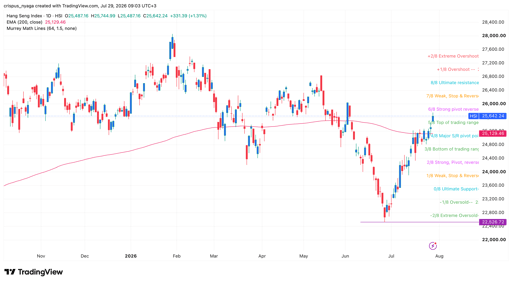
HSI Index chart | Source: TradingView
The daily chart shows that the Hang Seng Index has been in a strong bullish trend in the past few weeks. It has soared from the year-to-date low of 22,526 to the current 25,623.
Notably, the index has already jumped above the 200-day moving average, a sign that bulls are prevailing. It has also jumped above the Major S/R pivot point and is slowly approaching the strong, pivot, reverse level.
Therefore, it will likely continue rising as investors rotate from other Asian indices. If this happens, the next key target to watch will be at 26,000.

Why investors see more upside for SanDisk's 500% rally

USD/JPY signal: forecast as a death cross forms ahead of key US, Japan macro data
DRAM ETF gained 18% last month: can it continue its outperformance

UBS sees two Fed hikes in 2026: what should investors buy

Broadcom stock: Why the AI chipmaker’s growth story is gaining steam
No results found
Loading articles...
Failed to load articles. Please try again.