
Is Pi Network’s robot-payment push finally powerful enough to break $0.10?

AI Sentiment: 78/100 Bullish
This score is generated through AI-driven analysis of the article's content.

powered by

Buy PI. RoboPay partnership adds a new “robot services” payment use case, and Protocol 26.1 rollout is a near-term catalyst that can keep momentum bid into the Aug. 11 deadline. Technically, PI broke out of the $0.082–$0.086 range, OBV is turning up, and price is now pressing the $0.097–$0.100 resistance cluster; a clean hold above ~$0.0973 targets $0.10 and then ~$0.123.
Key Risk: RoboPay integration stays mostly theoretical (few real robot services settle PI), so demand doesn’t rise and PI fades back below the breakout levels.
Buy exposure to the RoboPay/Fabric payment infrastructure theme (via the most liquid available token or, if none, the closest listed proxy in that ecosystem). The second catalyst is that PI’s utility is only valuable if RoboPay services actually launch and start settling payments—those networks should see the biggest “activity premium” as robot/AI task execution scales.
Key Risk: RoboPay adoption stalls or launches without meaningful payment volume, so the ecosystem doesn’t capture value and the theme underperforms while PI-specific hype cools.
- PI price has gained more than 11% in 24 hours.
- Recent ecosystem developments have lifted market sentiment.
- PI is testing key resistance near the $0.10 level.
Pi Network's PI token has climbed more than 11% over the past 24 hours to around $0.094, extending its weekly gain to nearly 14% as traders responded to a new RoboPay payment partnership and the upcoming Protocol 26 Mainnet upgrade.
According to CoinGecko data, PI has risen from around $0.084 to above $0.094 during the past day, touching its highest level in nearly two weeks before easing slightly.
The move has pushed the token back above levels seen earlier this week after it spent several days consolidating between roughly $0.082 and $0.086.
The latest rally comes as two separate developments have drawn market attention.
First, Fabric Foundation has announced that Pi Network has joined RoboPay as an official payment partner, allowing PI to be used for payments across the Fabric network's robotic payment infrastructure.
RoboPay is a payment execution protocol built on Fabric for autonomous robots and AI-powered hardware running OpenMind's physical intelligence stack.
According to the foundation, developers can define execution conditions and pricing for physical tasks, allowing payment-authorised requests to trigger robotic actions before returning structured completion results.
Examples listed in the project's documentation include autonomous deliveries, industrial inspections, security patrols and interactions with humanoid assistants.
The documentation presents those as intended use cases for the platform rather than services already operating at scale for PI holders.
The integration introduces another potential utility route for PI beyond transfers and applications already available within its ecosystem.
Whether it leads to higher transaction activity will depend on how many RoboPay services become available, user adoption, and the volume of payments ultimately settled using PI.
In its announcement, the foundation stated that "Pi will be used to pay for robot services across the Fabric network."
Alongside the payments announcement, attention has also turned toward Pi Network's ongoing infrastructure rollout.
The Pi Core Team has instructed node operators to install Protocol 26.1 through the Pi Node software before Aug. 11.
According to the project's official announcement, nodes that fail to update by the deadline risk losing their connection to the Mainnet consensus.
Protocol 26 is the ninth network upgrade completed as part of Pi Network's 2026 roadmap.
The project has described it as the final prerequisite before Protocol 27.0, which is currently planned as the last upgrade in the present development cycle.
The update is designed to improve several parts of the network, including state management, smart contract security, cross-network interoperability and database migrations.
Protocol 26 also builds on the cryptographic features introduced in Protocol 25, which added BN254 elliptic curve cryptography and Poseidon hashing.
According to the project, those technologies provide the technical foundation for zero-knowledge applications and decentralised exchange liquidity pools on the Pi Mainnet.
Although the technical rollout has supported market sentiment, the upgrades themselves do not guarantee higher demand for PI.
Their long-term effect will depend on whether developers build more applications and users generate sustained activity across the ecosystem.
For now, the Aug. 11 deadline remains one of the events traders are watching closely.
Participation levels during the upgrade process could influence short-term volatility if the rollout differs from market expectations.
PI price analysis: Can PI reclaim $0.1?
PI's recent rally has changed its short-term technical picture after several weeks of persistent selling pressure.
On the 4-hour chart, the token has broken above the middle Bollinger Band, which is currently positioned near $0.0855, while the upper band sits around $0.0926.
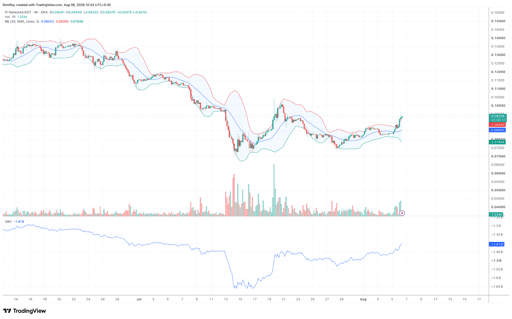
PI/USDT 4-hour price chart. Source: TradingView.
Price has briefly traded above the upper band during the latest rally before stabilizing around $0.094, indicating momentum accelerated alongside expanding volatility instead of remaining trapped inside the previous consolidation range.
Volume has increased during the breakout, adding support to the move rather than showing a low-volume spike.
The On-Balance Volume (OBV) indicator has also turned upward after a prolonged decline, suggesting buying activity has strengthened as the rally developed.
The daily chart shows PI recovering above its 20-day exponential moving average, currently around $0.0877, while the 50-day EMA near $0.1004 has become the next major dynamic resistance.
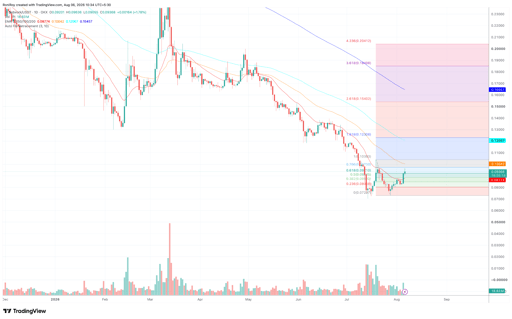
PI/USDT 1-day price chart, Source: TradingView
The 100-day EMA remains much higher around $0.1207, showing that the longer-term trend has not yet fully reversed despite the recent recovery.
Price has also reclaimed several Fibonacci retracement levels measured from the recent swing low near $0.073.
After moving through the 0.382, 0.5, and 0.618 retracements levels, PI is now testing the 0.786 Fibonacci level around $0.0973.
A sustained close above that resistance would place the psychological $0.10 level firmly within reach.
Since the 50-day EMA is positioned almost exactly at $0.1004, the token faces a cluster of resistance in the same area rather than a single technical barrier.
If buyers clear both levels with continued volume, the next upside target sits near the 1.618 Fibonacci extension at approximately $0.123, where another layer of resistance converges with the longer-term moving average structure.
Failure to hold the current breakout would shift attention back toward the $0.090-$0.088 region, where the reclaimed moving average and nearby Fibonacci levels could act as initial support.
A deeper pullback may expose the Bollinger Band midline near $0.0855, which previously acted as resistance before the latest advance.
At the time of writing, the technical setup continues to favor buyers after PI posted an 11% daily gain and nearly a 14% weekly increase.

XRP loses $1.50 after explosive rally: why are traders taking profits now?

Can ZRO hit $1.46 after LayerZero launches ATLAS?

Will TRUMP price crash as team-linked wallets cash out $3.39M?

RAIN hits a record after 7.4B token burn: can bulls push past $0.02?

Bitcoin back at $79K after $81K rejection: why did the rally hit a wall?
No results found
Loading articles...
Failed to load articles. Please try again.