
WTI and Brent oil prices jump as Iran issues demands to reopen Strait of Hormuz

AI Sentiment: 72/100 Bullish
This score is generated through AI-driven analysis of the article's content.

powered by

Buy WTI exposure (WTI futures or USO). The news is a direct Strait-of-Hormuz risk premium: Iran is pushing to reopen only on major concessions (sanctions relief, frozen assets). That keeps supply-risk headlines alive and supports a continuation bounce after the recent dip. Technicals back it: reclaiming the 50-day EMA and filling the July 24 fair-value gap points toward a move toward ~$95.
Key Risk: A real, credible agreement to reopen the Strait quickly (or a sharp de-escalation) that removes the risk premium and sends WTI back below ~$78.30.
Buy Brent and sell WTI (long BZ spread / long Brent vs WTI). Strait-of-Hormuz disruption hits global seaborne barrels more directly, and Brent is the global benchmark that tends to price that risk first. If tensions persist, Brent should outperform WTI as Europe/Atlantic-linked flows tighten while US-linked pricing lags.
Key Risk: The spread mean-reverts because the market shifts to US-specific supply/demand drivers (or the Strait risk fades), making Brent and WTI converge.
- Crude oil price rose slightly on Hyperliquid after Iran issued a list of demand.
- Iran wants the US to end its blockade and all sanctions.
- It also wants the US to release its frozen assets.
Crude oil prices rose on Hyperliquid as Iran issued a list of demands for reopening of the Strait of Hormuz. WTI perpetual futures jumped to $77.67, while Brent, the global benchmark, soared to $83. This rebound may continue in the new week as tensions between the US and Iran remains.
Iran has issued a list of demands
The US-Iran war paused last week as Iran and Oman continued deliberating on the future of the Strait of Hormuz. This happened after the US halted its planned attacks against Iran amid heightened pressure from US Gulf allies like Saudi Arabia and Qatar.
While the US was not directly involved in the talks, its officials were receiving briefs from the negotiators. The US would have removed the blockade against Iranian ports if Iran and Oman reached an agreement.
Now, however, there are concerns on whether the Strait will be reopened any time soon after Iran issued a list of demands. Iran is demanding the US to remove its blockade and all sanctions it has put in place against the country.
At the same time, Iran is demanding for Trump to release all frozen assets and end attacks against its regional allies.
Iran believes that it is in a strong position in all this because of the recent reporting on the US weapons shortages. Media reports suggests that the US has depleted most of its interceptors and ammunitions.
General Dan Caine has also warned the White House about the risks of prolonging the war. In a recent testimony to Congress, he highlighted the difficulties of winning a war from the air. Other experts, including Professor John Mearsheimer and Robert Pape have continually warned about the the risks of escalating the war.
READ MORE: Oil falls below $80 on shipping hopes, but route to normal supply stays dangerous
The other risk facing crude oil prices is the ongoing crisis in Yemen, which is on the verge of a civil war. Ansar Allah, popularly known as Houthis, have continued to block the Bab el-Mandeb Strait, which is affecting oil shipments from Saudi Arabia.
From the demand side, there are signs that Beijing has started making large purchases as its strategic petroleum reserves fall. The country bought an average of over 8.4 million million barrels per day in July, much higher than in the previous month.
Crude oil price technical analysis
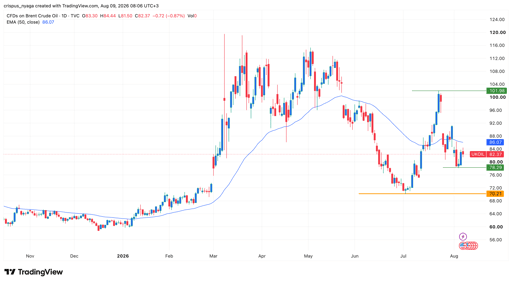
Oil prices chart | Source: TradingView
The daily chart shows that crude oil prices dropped sharply in the final week of last month. It moved from a high of $101.98 on July 23 to a low of $78.29 on August 5.
This retreat happened after Trump made another TACO on his threats against Iran. It now remains below the 50-day Exponential Moving Average (EMA), a sign that bears remain in control for now.
However, this performance happened amid hopes that Iran and Oman would reach a deal to reopen the Strait of Hormuz. As such, there is a likelihood that prices will bounce back soon, potentially as bulls attempt to fill the fair value gap formed on July 24 this year. If this happens, it may hit $95. On the other hand, a drop below the support of $78.30 will invalidate the bullish outlook.

Is it a golden opportunity to buy ServiceNow stock as a rare pattern nears?

Adobe stock analysis: Golden cross pattern takes shape ahead of earnings

Rubrik stock drops as gross margin slips: Is the selloff a buying opportunity?

Figma stock just crossed a crucial price: is the bull run starting?
IREN stock falls as the Nvidia-backed neocloud company hits a key milestone
No results found
Loading articles...
Failed to load articles. Please try again.