
FTSE 100 near record highs, but $90 oil could change the picture fast
AI Sentiment: 42/100 Bearish
This score is generated through AI-driven analysis of the article's content.

powered by

Brent near $90 is a direct tailwind for London’s energy-heavy index. Buy BP and Shell for earnings leverage as crude stays elevated, while the market worries about inflation. These names also tend to hold up better than transport/retail when oil spikes.
Key Risk: Oil reverses fast (Brent falls back toward $80) on a quick Strait of Hormuz resolution or demand shock, crushing the crude-linked earnings boost.
Second-order pressure from $90 oil is margin compression: higher fuel/transport costs feed into food retail and passenger economics. Sell Tesco and Stagecoach ahead of hotter inflation prints that can also keep rates higher and valuations lower.
Key Risk: Oil stays high but companies pass costs through successfully (strong pricing power and wage relief), preventing margin damage.
- FTSE 100 slips as Brent nears $90 before the pivotal US inflation report.
- FTSE 250 stays cautious as Middle East risks cloud UK investor sentiment.
- Stoxx 600 holds near records while energy gains offset weaker car stocks.
The FTSE 100 edged lower on Wednesday as another rise in oil prices and renewed Middle East tensions kept investors cautious ahead of a crucial US inflation report.
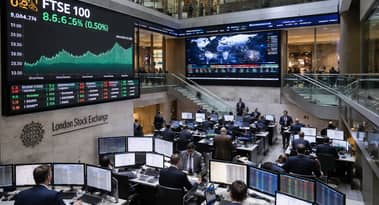
London’s blue-chip index traded around 10,830 in early dealings, extending this week’s subdued run after falling 0.17% on Tuesday.
The move left the FTSE 100 below its July record near 10,991, even as the broader European market continued to hover close to all-time highs.
Germany’s DAX was modestly higher, France’s CAC 40 slipped, while the STOXX Europe 600 was little changed near 661.
Oil gives the FTSE 100 a two-sided problem
Brent crude climbed towards $90 a barrel after fresh attacks on commercial shipping and fading hopes that the US and Iran would quickly agree on reopening the Strait of Hormuz.
Tehran has maintained that the waterway will stay restricted unless Washington accepts its conditions.
That creates a mixed setup for the FTSE 100.
Its heavy weighting towards energy and commodity companies can provide some protection when oil rises, but expensive crude also revives inflation concerns and threatens margins across transport, retail and consumer businesses.
The tension was visible across Europe. Energy shares rose about 0.7%, making them the strongest STOXX 600 sector, while automobiles and parts fell around 0.8%.
The geopolitical backdrop has also broadened beyond Hormuz.
A Houthi attack on a cargo vessel in the Red Sea killed crew members, while North Korea launched another ballistic missile and Taiwan criticised planned Chinese naval drills near its east coast.
Those developments reinforced demand for caution rather than triggering a wholesale equity sell-off.
Europe holds its records better than London
The FTSE 100’s hesitation contrasts with a broader European market that has been able to hold close to recent records.
The STOXX 600 was broadly flat around 661 in early trading, while the Euro STOXX 50 hovered near 6,550. Germany’s DAX gained about 0.1%, although France’s CAC 40 declined roughly 0.3%.
Corporate earnings helped prevent a deeper pullback.
German warship maker TKMS jumped after lifting its outlook for the second time in six months, while K+S advanced after another annual guidance upgrade.
TUI moved the other way after quarterly operating profit disappointed as softer bookings and higher fuel costs weighed on performance.
London also had some company-specific support. Balfour Beatty said full-year results should come in slightly ahead of previous expectations, supported by strong infrastructure demand and an order book of about £22.9 billion.
The contrast leaves the FTSE 250 important as well. Its greater exposure to the domestic UK economy means Thursday’s growth figures could matter more for mid-caps than for the internationally focused FTSE 100.
US CPI and UK GDP become the next tests
Wednesday’s US consumer-price report is the immediate macro catalyst.
Economists expect July headline inflation to rise 0.1% from June and slow to around 3.4% year on year from 3.5%.
Core inflation is expected to remain firmer, keeping the Federal Reserve’s September decision finely balanced. The Bureau of Labor Statistics is due to release the figures at 8.30 am ET.
The latest jump in oil will not be fully reflected in July’s data, but a hotter-than-expected reading could push Treasury yields higher and pressure equity valuations globally.
London then gets its own macro test on Thursday, with second-quarter UK GDP due from the Office for National Statistics.

KOSPI tumbles despite chip buybacks: how much support can they really provide?

Cathie Wood buys $31.6M of Rocket Lab stock: is she betting the selloff went too far?

Samsung, SK Hynix stocks sink 3% as a new risk hits the AI memory trade

Dow falls 400 pts as oil prices surge and Fed rate hike bets rise

Evening digest: US's Iran strikes lift oil, Apple welcomes new CEO
No results found
Loading articles...
Failed to load articles. Please try again.