
The succession and strategy questions facing Tata Sons as N Chandrasekaran resigns
AI Sentiment: 28/100 Bearish
This score is generated through AI-driven analysis of the article's content.

powered by

Buy TCS. The news is a leadership reset at Tata Sons, and the market is already punishing TCS on AI-demand fears. A likely outcome is tighter capital discipline and a clearer focus on cash-generating IT services, which should reduce the probability of further “growth-at-any-cost” spending in loss-making group units. TCS also benefits if Tata Trusts pushes for measurable returns and faster execution on AI-enabled delivery rather than broad, expensive bets.
Key Risk: A real, sustained AI-driven demand collapse for traditional IT services that margin recovery can’t offset.
Sell Tata Sons. The holding company faces a binary catalyst: succession uncertainty plus potential RBI-driven listing pressure. If Tata Trusts wins on capital allocation, the market will re-rate Tata Sons toward lower growth and higher dividend/discipline expectations—bad for a stock priced on long-duration capex stories (Air India, semis, electronics). Leadership fights also raise the odds of delayed decisions and cost overruns during the heaviest investment phase.
Key Risk: A clear, credible successor and a firm capex/strategy plan that removes uncertainty and supports a premium valuation despite listing pressure.
- Reports have attributed the resignation to differences with Tata Trusts.
- The leadership transition comes as Tata Group pursues major investments.
- Tata Sons has also been facing pressure to list by the central bank.
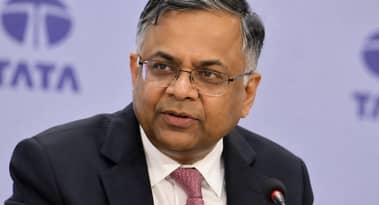
N Chandrasekaran's decision not to seek another term as chairman of Tata Sons has triggered one of the biggest leadership questions in Indian corporate history, opening the door to a succession battle at a time when the 158-year-old conglomerate is navigating some of its most ambitious and capital-intensive projects.
Tata Sons, which is the holding company of its 31 group companies which include Tata Consultancy Services, Tata Steel, and others is also facing pressures to list on the bourses.
The surprise announcement, made earlier this week, comes amid reports of a prolonged disagreement between Chandrasekaran and Tata Trusts over the group's strategic direction, capital allocation and leadership succession.
It also raises uncertainty over the future of investments ranging from Air India and semiconductor manufacturing to electronics and Apple's expanding supply chain in India.
Chandrasekaran cites need for leadership clarity
In a statement issued on Wednesday, Chandrasekaran said his current tenure as chairman ends on February 20, 2027.
He revealed that while the Dorabji Tata Trust and Sir Ratan Tata Trust had unanimously recommended extending his tenure by another five years, one member of the Tata Sons board did not support the proposal.
"It has been 6 months since that Board meeting, and no resolution has been reached till date," Chandrasekaran said.
He added that Tata Sons was overseeing several strategic projects at critical stages of execution and argued that prolonged uncertainty over leadership was not in the interests of the group.
"It is not only necessary to have a leader in place to lead the Group beyond Feb 2027, but also clarity on leadership is important for employees, investors, partners and other stakeholders."
"Under these circumstances, earlier today, I have communicated to the Tata Sons Board, that I have decided not to offer myself for reappointment when my term ends on Feb 20, 2027. I have asked the Board to decide on the succession soon to ensure a proper transition."
The announcement immediately intensified speculation over who will eventually lead India's largest conglomerate, which currently has no deputy chairman or publicly identified successor.
Boardroom differences come into focus
According to multiple media reports, Chandrasekaran's decision follows months of disagreements with Tata Trusts, the charitable entities that control the Tata Group.
The Financial Times reported, citing people familiar with the matter, that the differences culminated after nearly a year of boardroom tensions between Chandrasekaran and Noel Tata, chairman of Tata Trusts.
The report said Noel Tata wants his son, Neville Tata, to assume a more prominent role within the group.
Until early this year, Chandrasekaran had been widely expected to receive another five-year mandate.
However, the FT reported that Noel Tata expressed reservations during a February board meeting despite the trusts having earlier backed Chandrasekaran's extension.
According to people familiar with the matter, Chandrasekaran could also have faced a confidence vote at Tata Sons' annual meeting scheduled for next week.
Leadership change comes during heavy investment cycle
The timing of the succession debate is particularly significant because Tata Group is in the middle of one of the largest investment phases in its history.
Under Chandrasekaran's leadership, Tata acquired Air India in 2022, entered large-scale iPhone manufacturing through the acquisitions of Wistron and Pegatron's India operations, and announced India's first semiconductor fabrication plant in partnership with Taiwan's Powerchip Semiconductor Manufacturing Corp.
The conglomerate has also expanded aggressively into electronics manufacturing and artificial intelligence-related infrastructure as part of India's broader ambition to become a global manufacturing hub.
In his latest shareholder letter, Chandrasekaran described these investments as some of the group's "largest capital commitments" and key building blocks for India's goal of becoming a developed economy by 2047.
However, many of those businesses remain in investment mode and have yet to generate meaningful profits.
Financial pressures have intensified
The group's expansion has coincided with growing financial challenges across several businesses.
According to Tata Sons' latest annual report, consolidated net profit declined 35% to 266 billion rupees during the financial year ended March 2026 as losses mounted at Air India, Tata Digital and Tata Electronics.
Meanwhile, Tata Consultancy Services, traditionally the group's largest profit generator, has come under pressure from the rapid adoption of artificial intelligence.
Shares of TCS have fallen roughly 20% over the past year amid concerns about long-term demand for traditional IT services, with the stock dropping another 5% following Chandrasekaran's announcement.
Air India continues to face operational and financial headwinds after last year's fatal crash that claimed 260 lives.
Separately, Tata Sons is awaiting a decision from the Reserve Bank of India over whether the holding company will be required to list publicly because of its classification as one of the country's largest non-banking financial companies.
Pressure to list has also mounted this year from stakeholders including the second-largest shareholder, Shapoorji Pallonji Group (SP Group).
Reports suggest Tata Trusts has opposed such a listing and has sought additional clarity from Tata Sons on business performance, long-term strategy, capital expenditure and the rationale for remaining privately held.
Experts point to differences over capital allocation
Analysts believe the disagreement reflects differing views on how aggressively Tata Group should continue investing while its most profitable businesses face mounting pressure.
Anil K. Sood, professor and co-founder of Mumbai-based Institute of Advanced Studies in Complex Choices, told CNBC that Tata Trusts, which relies on dividends from Tata Sons to fund its charitable activities, has adopted a more conservative approach toward capital allocation.
He said Air India's turnaround continues to consume significant capital while operational challenges risk damaging the Tata brand.
At the same time, TCS is confronting AI-driven disruption while the group continues investing heavily in businesses that remain largely commoditized or loss-making.
Echoes of the Cyrus Mistry era
Corporate governance experts note that the latest dispute once again highlights the longstanding dual power structure within Tata Group, where Tata Sons manages operations while Tata Trusts ultimately controls leadership decisions.
The arrangement previously led to the dramatic removal of Cyrus Mistry as chairman in 2016 following a public disagreement with the late Ratan Tata.
Ramesh Vaidyanathan, managing director at law firm BTG Advaya, told CNBC that the current episode carries an element of irony.
During Mistry's tenure, he focused on "maximizing return on equity" and adopting a more disciplined investment approach, while Ratan Tata advocated bold long-term investments.
"Now," Vaidyanathan said, "the roles have reversed."
He added that Chandrasekaran's eventual successor will inherit the difficult task of satisfying Tata Trusts' desire for greater financial discipline while simultaneously reassuring investors that the group remains committed to executing its long-term growth strategy.
Focus turns to succession
Attention is now shifting to Tata Sons' annual shareholder meeting on August 18, where succession planning is expected to dominate discussions.
The incoming chairman will inherit responsibility for some of India's most strategically important corporate projects, including the country's first semiconductor fabrication facility, the continued expansion of Apple's manufacturing ecosystem, Air India's turnaround and the group's response to AI-driven disruption across its technology businesses.
Suhel Seth, a former adviser to Tata Group, told the Financial Times that Chandrasekaran took over in 2017 when the conglomerate "needed a lot of hand-holding."
He added that concerns previously raised by Noel Tata over spending on Air India and Tata Digital would likely become key priorities for whoever succeeds Chandrasekaran.
For investors, employees and policymakers alike, the coming months are likely to determine not only who leads India's biggest business house next, but also whether the conglomerate maintains the aggressive investment strategy that has defined Chandrasekaran's tenure or adopts a more cautious approach under new leadership.

Hang Seng Index: Top 3 reasons Hong Kong stocks are falling today

Kospi Index at a crossroads as Samsung, SK Hynix leverage bets reverse
Rolls-Royce stock: The bull case is strong, but these risks could trigger a drop

Here’s why the Alibaba stock is crashing in Hong Kong today
Here’s the top reasons why the Kospi Index is falling today
No results found
Loading articles...
Failed to load articles. Please try again.