
IWM and VOO have hit record highs: What next for S&P 500 and Russell 2000 ETFs?

AI Sentiment: 78/100 Bullish
This score is generated through AI-driven analysis of the article's content.

powered by

Buy Vanguard S&P 500 ETF (VOO). The article points to accelerating earnings growth (over 50% in Q2) plus rising forward guidance, which keeps the earnings engine moving. Valuation is still “bargain” versus history (forward P/E ~20), so upside can come from both fundamentals and multiple support. Key risk: a Fed re-pricing higher (rate-hike odds snap back) that compresses P/E and overwhelms earnings momentum.
Key Risk: Fed rate-hike odds jump back up and crush stock valuations.
Buy iShares Russell 2000 ETF (IWM). Small caps should benefit most if the market keeps dialing back hike expectations, and the article flags that small caps historically underperform during hiking cycles. With money-market inflows rising, the next rotation back into risk assets can disproportionately lift small caps. Valuation is also cheaper (forward P/E ~19). Key risk: the economy actually breaks (job losses/retail slowdown turns into a clear recession), causing earnings to roll over.
Key Risk: Earnings start falling because the economy slows into a real recession.
- The VOO ETF has jumped to a record high this year, led by tech and industrials.
- IWM, which tracks the Russell 2000, has also jumped to a record high.
- There are potential catalysts that will boost their performance.
The Vanguard S&P 500 ETF (VOO) and the iShares Russell 200 Index Fund IWM have jumped to their record highs this year. IWM has jumped by over 21% this year, while VOO is up by 12.50% in the same period. This article highlights some of the top reasons why these ETFs may continue rising this year.
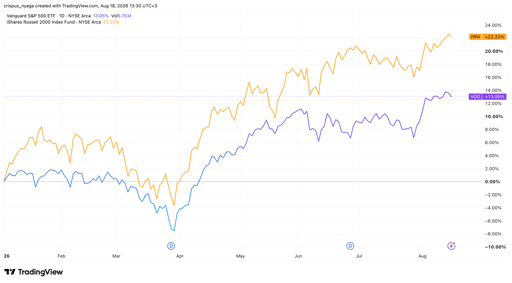
VOO and IWM ETFs YTD performance | Source: TradingView
US corporate earnings growth is still strong
The main catalyst for US stocks is that their earnings growth is accelerating, helped by the artificial intelligence boom, tariff refunds, and energy prices.
A recent report by FactSet shows that nearly all companies in the S&P 500 Index have published their second-quarter earnings. The earnings growth in this period stood at over 50%, much higher than what analysts were expecting. This growth was the fastest one since 2021.
Most importantly, many companies have boosted their forward guidance, a sign that they expect the earnings momentum to continue.
This earnings growth is coming at a difficult time as the US-Iran war continues, and Iran has hinted that it will escalate to push the US to make an agreement. The war has led to higher inflation in the US, with the headline and core CPI metrics remaining above the 2% target level.
There are also signs that the US economy is slowing. The US lost 23,000 jobs last month, while retail sales have slowed substantially. These numbers show a big disconnect between the real economy and Wall Street.
Odds of a Fed hike are falling
The VOO and IWM ETFs may also benefit from the actions of the Federal Reserve. For most part of the year, the consensus was that the Fed would hike interest rates later this year.
Now, however, the situation has changed, and traders are paring back their Fed hike expectations. Polymarket data shows that odds that the Fed will hike rates have dropped below 50%.
Historically, stocks, especially small-cap ones, underperform when the Fed is hiking interest rates. A good example of this is what happened in 2022 when the Fed hiked rates after the Covid pandemic.
US money market fund inflows have soared
Meanwhile, money market funds have seen a surge in inflows this year as their yields jump. Data shows that the amount jumped to $8.28 trillion in the first quarter, and the trend has likely continued.
In most cases, money market fund investors often rotate back to the stock market when its bull run continues. This normally happens because, historically, stock market returns tend to be strong than cash.
VOO and IWM ETFs are undervalued
Despite the ongoing bull run, US stocks are trading at bargain prices. FactSet data shows that the S&P 500 Index trades at a forward 12-month price-to-earnings ratio of 20, slightly higher than its five and ten-year averages. Some of the top companies in the fund like Nvidia and Micron, are all trading at bargain levels.
The same is true with the IWM ETF, which has a price-to-earnings ratio of 19, also lower than its historical averages. As such, there is a likelihood that bargain hunters will continue buying these stocks in the near term.
These metrics explain why top analysts are boosting their estimates for the S&P 500 Index. In a statement on Monday, Evercore analysts boosted their S&P 500 forecast to 9,000 points. Other top analysts from companies like Oppenheimer and Goldman Sachs have also boosted their forecasts this year.

Nvidia stock is 5% below its record: why September 10 suddenly matters

Scottish Mortgage shares hit crucial price amid SpaceX, Anthropic catalysts

Shell share price jumps to record high as crude oil rallies with no end in sight

Here’s why Adani Enterprises share price is surging today (Sep. 9)

KOSPI rockets above 7,000 as AI stocks overpower yen and oil fears
No results found
Loading articles...
Failed to load articles. Please try again.