
Will VVV token rally as Venice AI revenue tops $100 million?

AI Sentiment: 78/100 Bullish
This score is generated through AI-driven analysis of the article's content.

powered by

Buy VVV. Venice AI annualized revenue crossed $100M, and $5 per $100 of AI credits plus subscription burns create recurring open-market buy pressure while shrinking supply. Technicals confirm: VVV is back above the 20/50-day EMA cluster (~$12.16–$12.34) and above the $12.00–$12.20 high-volume support zone; CMF is recovering toward/above zero. Upside targets: $14.00–$14.50 first, then $15.50–$16.00, then $17–$18 if momentum holds.
Key Risk: Venice AI revenue growth stalls or the burn/buy program underperforms, removing the recurring token demand that’s driving the rally.
Sell DIEM or avoid longs. DIEM is minted by locking staked VVV and pays out $1/day of Venice AI credits, so it’s directly tied to VVV staking economics. As VVV issuance is cut (3M→2.5M→2M) and buy-burn tightens supply, the market can reprice toward VVV itself; DIEM can lag because its value is more about access/credits than the token’s burn-driven scarcity. If VVV keeps running, DIEM’s relative demand can soften.
Key Risk: DIEM demand accelerates faster than VVV (more users minting DIEM), keeping DIEM strong even as VVV supply tightens.
- VVV has gained about 10% in the past 24 hours.
- Venice AI has crossed $100 million in annualized revenue.
- VVV burns and higher DIEM supply are supporting the token.
Venice Token has risen about 10% over the past 24 hours to trade near $13.35 on August 18, extending its seven-day gain to roughly 10% as several supply and revenue catalysts support VVV.
Venice AI has crossed $100 million in annualized revenue, up from roughly $70 million about a month earlier, giving VVV fresh momentum as part of the platform's revenue is tied to token purchases and burns.
Since late 2025, Venice has used a portion of its monthly revenue to buy VVV from the open market and permanently remove the tokens from circulation.
The mechanism means higher revenue can increase the amount directed toward VVV purchases, depending on revenue generated through the products covered by the program.
A second burn mechanism introduced in July expanded the link between Venice AI usage and the token.
Under the program, $5 from every $100 spent on Venice AI credits is allocated toward buying and burning VVV, alongside existing burns connected to Pro, Pro+ and Max subscriptions.
With annualized revenue now above $100 million, the two mechanisms have become an important part of the current VVV setup because they create recurring market purchases while reducing circulating supply.
Another catalyst arrived on August 17, when Venice increased the target supply of its DIEM token to 39,000 from 38,500.
The increase was the second stage of a previously announced schedule that raised the target to 38,500 on August 3.
Under the remaining schedule, Venice plans to increase the DIEM target to 39,500 on August 31 and 40,000 on September 14.
DIEM is connected directly to VVV staking because users mint the token by locking staked VVV.
Each DIEM provides $1 worth of Venice AI credits per day, meaning an increase in the DIEM target expands the amount that can be minted through locked VVV.
Supply issuance is also set to change in the coming weeks. Venice plans to reduce annual VVV issuance from 3 million tokens to 2.5 million on September 1 before cutting it again to 2 million on October 1.
VVV initially launched with annual issuance of roughly 14 million tokens. Based on Venice's planned October rate, annual issuance would be about 86% below the original level.
VVV price analysis
VVV's daily chart has started to improve after the token spent much of July and early August consolidating following its decline from the June highs.
At around $13.40 on the chart, VVV has moved above all four exponential moving averages as seen below.
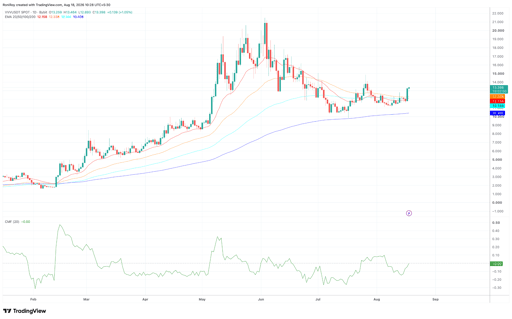
VVV/USDT 1-day price chart. Source: TradingView.
The 20-day EMA stands near $12.16, while the 50-day EMA is around $12.34. The 100-day and 200-day EMAs sit lower at approximately $12.14 and $10.41.
The move above the 20-day and 50-day averages is particularly important because VVV had repeatedly traded around or below them during its recent consolidation.
Holding above the $12.15-$12.35 EMA cluster would keep the latest breakout intact, while a drop back below it would weaken the current setup.
Chaikin Money Flow is also recovering. The daily CMF has climbed from negative territory toward the zero line after falling below -0.10 earlier in August.
A sustained move above zero would show that buying pressure is beginning to outweigh selling pressure, while another rejection below zero would leave the price rally without strong confirmation from capital flows.
On the 4-hour chart, the VPVR shows a major high-volume area around $12.00-$12.20, where VVV repeatedly changed direction during July and August.
The token has now moved decisively above that zone and reached roughly $13.40.
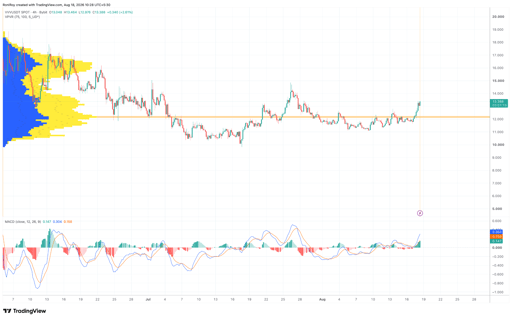
VVV/USDT 4-hour price chart. Source: TradingView.
As long as VVV remains above the $12.00-$12.20 volume area, the former congestion zone could act as support during a pullback.
Losing that level would put the breakout at risk and could expose the $11.00-$11.30 region, followed by the daily 200-day EMA near $10.40.
Momentum on the 4-hour chart has strengthened alongside the breakout.
The MACD line has risen to about 0.30, above the signal line near 0.16, while the histogram has expanded into positive territory at roughly 0.15.
The bullish crossover and rising histogram show that short-term momentum currently favors buyers.
For VVV to extend the rally, the first test sits around $14.00-$14.50, an area where price encountered resistance during late July.
A sustained break above that zone could open a move toward $15.50-$16.00, where VVV traded repeatedly during June.
If momentum remains strong enough to clear $16, the next major area sits around $17-$18, based on the June trading range.
The June high near $21 would remain a more aggressive target and would require VVV to reclaim several resistance zones first.
The bullish case therefore depends on VVV holding above the $12.00-$12.35 area while the 4-hour MACD remains positive and daily CMF moves firmly above zero.
Venice's next scheduled tokenomics event comes on August 31, when the DIEM target is due to increase from 39,000 to 39,500, followed by the reduction in annual VVV issuance to 2.5 million tokens on September 1.

PI coin rises ahead of Protocol 27, can it recover above $0.10?

Solana tests $100 as whale traders bet on a rebound

Zcash eyes further gains, but overbought RSI warns of pullback

Interview: Bitcoin Japan’s big bet on AI economy, from SpaceX to rare earths

Why is XRP falling even as ETF money keeps flowing into the market?
No results found
Loading articles...
Failed to load articles. Please try again.