
Brent nears a four-week high: how high can oil go from here?
AI Sentiment: 68/100 Bullish
This score is generated through AI-driven analysis of the article's content.

powered by

Buy Brent crude futures (or Brent/WTI spread if you can trade it). The floor is Strait of Hormuz risk: shipowners keep avoiding the route, tanker earnings are surging, and the UAE-Iran escalation adds uncertainty. Even with a US inventory build, the market is still paying a geopolitical premium and Brent is holding above $90, keeping the “risk of further restriction” bid alive.
Key Risk: A rapid diplomatic de-escalation that restores confidence and brings shipping back through Hormuz, collapsing the geopolitical premium.
Buy US gasoline crack spreads (long gasoline vs short crude, via crack spread products/ETFs). If crude stays elevated but US gasoline stocks are rising and refinery utilization is high, the market will likely price gasoline less tightly than crude—compressing cracks. That’s the second leg: the article flags gasoline stocks up, meaning refined-product pricing won’t keep up with crude’s geopolitical move.
Key Risk: Gasoline demand re-accelerates or supply disruptions hit refining/logistics, pushing gasoline prices up faster than crude and expanding cracks.
- Brent holds above $91 as Hormuz risks keep global supply fears elevated.
- WTI steadies near $86 after four-day rally as US crude inventories rise.
- Tight fuel supplies offset rising inventories and softer demand signals.
Oil prices held close to four-week highs on Thursday as traders weighed persistent disruption around the Strait of Hormuz against a surprise build in US crude inventories, leaving Brent above $91 a barrel and WTI near $86.
Brent crude futures were around $91.87 in early trade, while front-month WTI was near $85.81.
Both benchmarks had risen for four consecutive sessions through Wednesday, when Brent settled at $91.62 and WTI at $85.83.
The rally has been driven less by stronger demand than by the risk that the US-Iran confrontation could further restrict one of the world’s most important energy corridors.
Hormuz keeps a floor under crude
The Strait of Hormuz remains the dominant driver for oil.
Washington says the waterway is open, while Tehran maintains that restrictions remain in place, and many shipowners continue to avoid the route because of security concerns.
The latest escalation came as the UAE suspended trade and financial dealings with Iran after accusing Tehran of renewed missile attacks, a charge Iran has denied.
The move adds another layer of uncertainty around Gulf commerce and reduces hopes for a quick diplomatic route out of the standoff.
That matters because roughly a fifth of global oil consumption normally passes through Hormuz. Even with alternative pipelines, ship-to-ship transfers and rerouted cargoes helping to soften the disruption, the cost of moving Gulf crude has risen sharply.
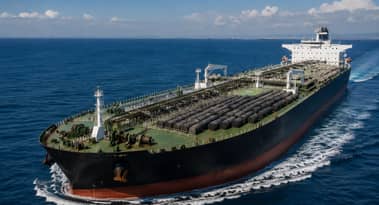
The Financial Times reported that tanker demand has surged, with spot earnings for some supertankers climbing above $550,000 a day.
US inventories cap the rally
The bullish geopolitical story is being offset by signs that physical supply is not tightening as quickly as feared.
US commercial crude inventories rose by 4.4 million barrels last week to 428.8 million, according to the Energy Information Administration, versus expectations for a decline.
Gasoline stocks also increased, while US crude production averaged 13.8 million barrels a day. Refinery utilisation climbed to 97.2%, showing plants are running hard despite the broader supply concerns.
TradeStation’s David Russell sees the inventory build and softer gasoline demand as evidence that US supply conditions are becoming less strained.
Ritterbusch analysts point to low distillate stocks as a counterweight, with diesel and other middle-distillate supplies still well below seasonal norms.
That divergence helps explain why crude has held firm without breaking decisively higher.
Brent above $90 keeps inflation risk alive
Brent’s ability to stay above $90 matters well beyond energy markets.
Expensive crude can feed directly into fuel, freight and manufacturing costs, complicating the inflation outlook just as investors debate whether the Federal Reserve may need to tighten policy again.
For now, the market is paying a sizeable geopolitical premium, but not pricing a full-scale supply shock.
The next move will depend on whether shipping through Hormuz deteriorates further or whether rising inventories and alternative export routes continue to absorb the disruption.

Gold nears $4,420 as Middle East tensions drive haven demand
Brent crude hits $100 a barrel as US strikes Iranian oil tankers

Shell share price jumps to record high as crude oil rallies with no end in sight

Brent is almost $100 and stocks are refusing to panic: what does the market know

Kalshi’s commodities bets outpace crypto as monthly volume tops $400M
No results found
Loading articles...
Failed to load articles. Please try again.