
HP stock slides 5% as memory costs pressure PC margins
AI Sentiment: 28/100 Bearish
This score is generated through AI-driven analysis of the article's content.

powered by

Buy DELL as a relative-value play: if HP’s margin squeeze is driven by memory/commodity costs and pricing elasticity, the better-positioned PC OEM with stronger cost pass-through and mix (commercial + premium) should hold margins up better. HP’s own story—pricing up, units down, margin down—sets up a rotation toward peers that can defend profitability while AI PC demand ramps.
Key Risk: DELL also faces the same memory-cost squeeze and can’t defend margins, so the relative advantage disappears.
HPQ is a sell because the quarter beat on revenue/EPS but margins are deteriorating: Personal Systems operating margin fell to 4.6% and management says memory/commodity cost pressure continues with recovery not expected until fiscal 2027. Guidance relies on tariff-refund EPS add-backs ($0.08 in Q4; $0.19 full-year), while PC shipments are down 16% YoY and pricing is doing the heavy lifting—exactly when demand elasticity risk rises. Sell HPQ outright; avoid the “beat” and focus on the margin path.
Key Risk: Memory/commodity costs fall faster than HP expects, letting margins stabilize sooner than fiscal 2027.
- HP shares fall as memory costs pressure PC margins and shipments.
- HP beats Q3 estimates, but PC shipments decline 16% year over year.
- BofA raises HP price target but keeps an Underperform rating.
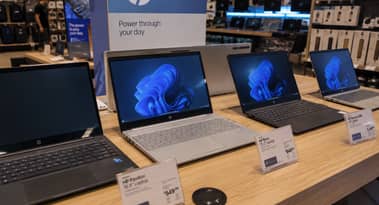
HP Inc. shares HPQ fell 5% in trading after the PC and printer maker reported fiscal third-quarter results that beat Wall Street estimates but raised concerns about margins, PC demand and the sustainability of its earnings outlook.
The company reported revenue of $15.7 billion for the quarter ended July 31, up 12.5% year over year and above analysts' expectations.
Adjusted earnings per share came in at $0.83, also ahead of estimates. However, both results benefited from tariff refunds, while PC unit shipments declined sharply.
Revenue beats estimates despite PC shipment decline
HP's third-quarter revenue increased about 13%, with Personal Systems revenue rising 18% to $11.8 billion.
Commercial PC sales increased 22%, helping offset weaker unit volumes.
PC shipments fell 16% year over year as the company raised prices and focused on premium products, including AI PCs.
The resulting increase in average selling prices helped lift revenue despite weaker unit demand.
Printing revenue declined 2% to $3.9 billion, broadly in line with estimates.
Adjusted earnings of $0.83 per share included an $0.11 benefit from tariff refunds. Analysts had expected adjusted EPS of $0.69, according to LSEG data.
HP has been dealing with rising memory chip costs as AI data center construction absorbs semiconductor capacity.
The company has responded by increasing PC prices and redesigning some products, but higher costs continued to weigh on profitability.
Higher costs pressure personal systems margins
Personal Systems operating margin fell to 4.6% from 5.2% in the previous quarter as memory and other commodity costs increased faster than pricing could offset them.
HP expects those pressures to continue into the fourth quarter, with a recovery not expected until fiscal 2027.
CFO Karen Parkhill said the company expects below-seasonal revenue performance in the fourth quarter because of commodity-driven price increases.
At the same time, she said HP expects revenue to grow year over year, supported by pricing actions, gains in premium categories, higher-margin offerings and increased adoption of AI PCs.
For the fourth quarter, HP forecast adjusted EPS of $0.69 to $0.79, compared with analysts' average estimate of $0.67.
However, the forecast includes an estimated $0.08-per-share benefit from tariff refunds. Excluding that benefit, the midpoint of the company's guidance would fall below market expectations.
HP also raised its full-year adjusted EPS forecast to $3.19-$3.29 from $2.90-$3.10. The annual forecast includes an estimated $0.19 benefit from tariff refunds.
BofA maintains underperform rating
BofA Securities raised its price target on HP to $21 from $18 while maintaining an Underperform rating.
The brokerage identified pricing execution, premium and AI PC adoption, market-share gains and resilient reported printing profitability as positives.
However, it expects rising memory costs and higher PC prices to create demand elasticity.
BofA also pointed to continued pressure on core margins excluding tariff benefits and uncertainty related to HP's leadership transition.
The results highlight the challenge facing HP as it attempts to offset rising component costs through higher prices while maintaining demand.
Investors are also looking for greater visibility into the company's margin trajectory and fiscal 2027 outlook.
Why is AMD stock falling while Intel stock rises after Nvidia's earnings?

These three stocks are must-owns after the PCE data
Affirm stock is compressing: here’s why it may pop after earnings today
Oracle stock has bottomed? Here's what the chart says ahead of earnings

Why Nvidia stock is soaring over 7% today and how high it can go
No results found
Loading articles...
Failed to load articles. Please try again.