
Nikkei 225 Index outlook: top catalysts for Japan stocks this week

AI Sentiment: 18/100 Bearish
This score is generated through AI-driven analysis of the article's content.

powered by

Buy Nikkei 225 exposure via iShares MSCI Japan ETF (EWJ) or Nikkei 225 futures. Japan data (industrial production +3.6% YoY, retail sales +4% YoY) is solid, and that supports earnings. Even with BoJ hike odds rising, the market is already pricing the move; the setup is for a rebound if macro prints stay firm and PMI doesn’t crack. Technicals are weak, so buy after the index tests ~64,653 support and holds.
Key Risk: BoJ hikes faster/more aggressively than expected, pushing Japanese yields up and crushing equity valuations before earnings catch up.
Sell Japan-heavy oil importers using Exxon Mobil ADR (XOM) is not Japan-specific; instead short Japan refiners/utilities via iShares MSCI Japan ETF (EWJ) tilt or short a Japan energy proxy like Inpex (1605.T) / JXTG (ENEOS, 5020.T). US-Iran escalation risk can lift Brent/WTI sharply (toward ~$90/$85), raising costs and hurting margins for companies exposed to crude and demand risk. If crude spikes while PMIs soften, the earnings hit is immediate.
Key Risk: Limited retaliation keeps crude contained (no sustained move higher), removing the margin/cost pressure.
- The Nikkei 225 Index has pulled back in the past few days.
- Recent Japan macro data pointed to BoJ rate hikes.
- Japan stocks will react to the upcoming US NFP data.
The Nikkei 225 Index dropped slightly on Monday as investors boosted the odds of Bank of Japan rate hikes after the recent macro data. It dropped to 65,325, down by 10% from its highest point this year. This article looks at some of the top catalysts for Japan stocks this week.
Nikkei 225 Index to react to key Japan macro data
The Nikkei 225 Index retreated after a report showed that Japan’s industrial production rose 3.6% YoY and 0.1% YoY in July. The monthly increase was better than the expected retreat of 0.7%.
Another report showed that retail sales rose by 4% in July, also higher than the median estimate of 3.2%. These numbers mean that the Japanese economy is doing relatively well.
The reports came two days after the statistics agency released the fairly strong Tokyo inflation numbers. Later this week, S&P Global will publish the latest manufacturing and services PMI numbers.
These numbers will provide more information about the Japanese economy and what to expect. Most analysts now predict that the BoJ will hike interest rates later this year. This partly explains why Japan bond yields have remained at an elevated level this week.
US-Iran tensions
The Nikkei 225 Index is also falling as investors react to the latest developments on the US and Iran. The US launched limited strikes overnight, hitting Iranian rocket launchers near the Strait of Hormuz.
While the attacks were limited, Iran will likely decide to retaliate since officials belive that they are in a strong position militarily. An escalation will lead to higher crude oil prices, with Brent and West Texas Intermediate rising to $90 and $85, respectively.
Japan relies substantially on the Strait of Hormuz and oil imports and the crisis may have an impact on the economy and key companies.
Jackson Hole and key US macro data
The Nikkei 225 Index is also reacting to last week’s Jackson Hole Symposium, in which Kevin Warsh delivered a highly hawkish statement. He maintained that US inflation was still at an elevated level and that the Fed will do its best to bring in to the 2% target.
In the aftermath, most traders boosted their interest rate hike probability. Most analysts now expect that the Fed will hike rates in the December meeting, a move meant to bring inflation to the 2% target.
In line with this, Japan stocks will react to the upcoming macro data from the US, like nonfarm payrolls (NFP) and manufacturing and services PMIs.
Nikkei 225 Index technical analysis
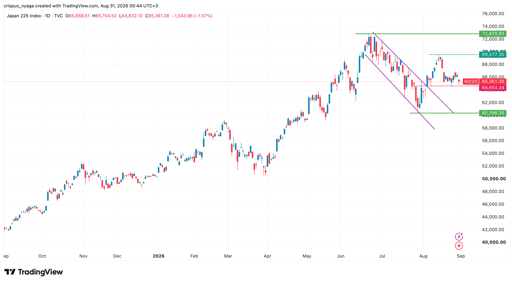
Nikkei 225 Index chart | Source: TradingView
The daily chart shows that the Nikkei 225 Index has come under pressure in the past few days, moving from 69,577 earlier this month to the current 65,361. It has dropped below the 50-day moving average and is about to drop below the key support level of 64,653.
The Relative Strength Index (RSI) and the MACD indicators are all pointing downwards. Therefore, the index will likely drop further, potentially to the psychological level of 65,000.

Crude oil prices retreat: Brent, WTI slip even as rebound risks persist

Kospi Index at a crossroads as Samsung, SK Hynix leverage bets reverse

How Meta’s $18B teen safety settlement could reshape social media regulation

Nvidia is using its balance sheet to fuel the AI boom. Is it a double-edged sword?

Dow holds weekly gain as Warsh inflation warning lifts rate hike bets
No results found
Loading articles...
Failed to load articles. Please try again.