
Stellar price surges 6% before Protocol 28 vote: can XLM break $0.20?

AI Sentiment: 72/100 Bullish
This score is generated through AI-driven analysis of the article's content.

powered by

Buy Stellar (XLM) for a clean catalyst-to-technical setup: Protocol 28 vote is tomorrow, and price is already pressing toward the $0.20 breakout level with improving momentum (VI+>VI-, MFI ~60, PPO positive). A daily close above $0.20 reopens $0.205–$0.21 and then $0.22 where prior selling showed up.
Key Risk: Protocol 28 vote disappoints or triggers a sell-the-news move that fails to hold above $0.20, sending XLM back under $0.185.
Sell/short XLM if it spikes into $0.195–$0.20 ahead of the vote and then rejects (4-hour close back below $0.20 with PPO histogram rolling over). The thesis is that the market is front-running the upgrade and will fade the move if the $0.20 level doesn’t break; downside targets are $0.188 then $0.178–$0.18.
Key Risk: XLM clears and holds $0.20 on a 4-hour close, turning the breakout into a trend toward $0.205–$0.22.
- XLM has gained nearly 6% over the past 24 hours.
- Stellar’s Protocol 28 mainnet upgrade vote is scheduled for Sept. 16.
- XLM is testing resistance around $0.195 to $0.20, with support near $0.185.
XLM has climbed nearly 6% over the past 24 hours to trade around $0.193 on Sept. 15 as traders positioned ahead of Stellar’s Protocol 28 mainnet upgrade vote.
CoinGecko data put Stellar (XLM) at $0.1932 at the time of writing, with the token up 5.8% over 24 hours and 9.1% over the past two weeks.
XLM moved from roughly $0.182 to as high as $0.197 during the latest 24-hour period before pulling back towards $0.193.
The latest move has come a day before Stellar validators are scheduled to vote on the network's Protocol 28 upgrade, while recent developments involving US Bank and MoneyGram have kept attention on the blockchain's payments infrastructure.
Stellar Development Foundation has scheduled the Protocol 28 mainnet upgrade vote for Sept. 16 at 17:00 UTC, following its testnet upgrade on Aug. 27.
Known as Adapter, the upgrade contains changes to Stellar Core and Soroban smart contracts.
Protocol 28 includes CAP-83, which lets validators begin voting before receiving a complete transaction set and provides a way to drop late or invalid sets.
CAP-85 and CAP-86 focus on smart contracts, including contract upgrades and changes to contract data structures.
With the mainnet vote now one day away, the scheduled event has provided the most immediate Stellar-specific development during XLM's latest price move.
MoneyGram's stablecoin-backed Visa card has provided a second catalyst after launching in Colombia on Sept. 10.
The card lets eligible customers hold a stable-dollar balance and spend it at merchants that accept Visa.
It was developed with stablecoin payments firm Rain and uses Crossmint wallet technology and the Stellar network, while USDC is supported at launch. MoneyGram plans to add its MGUSD stablecoin later.
MoneyGram has worked with the Stellar Development Foundation since 2021 on cash-to-USDC and USDC-to-cash services, while the new card extends the use of Stellar infrastructure into card payments.
Institutional activity on Stellar picked up days earlier when US Bank completed its first pilot transaction using USBDC, its proprietary dollar-backed stablecoin.
The transaction moved money between the bank's entities in North America and Europe over Stellar while remaining connected to US Bank's finance, risk, compliance and operations systems, according to the Stellar Development Foundation.
The pilot covered the stablecoin's lifecycle from minting and payment to redemption, freezing and clawback.
US Bank and the foundation are examining other uses including liquidity management, collateral mobility and cross-border treasury operations.
XLM price analysis
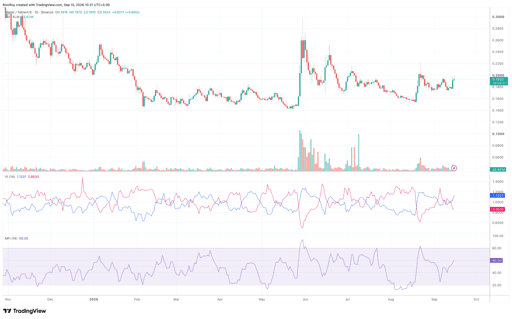
XLM's daily chart shows price pressing back towards $0.20 after recovering from the $0.15-$0.16 area reached in August.
See below:
XLM/USDT 1-day price chart. Source: TradingView.
The latest move has taken the token above its early-September range around $0.175-$0.185, but $0.20 remains the first major level that price needs to clear.
The daily Vortex Indicator has turned in favour of buyers. VI+ has risen to 1.1331 while VI- has fallen to 0.8630, leaving the positive line above the negative line.
The widening gap follows XLM's move towards $0.193 and supports the continuation of the current upward move as long as VI+ stays above VI-.
Money Flow Index has risen to 60 on the same timeframe.
The reading has moved above the neutral 50 level without reaching the 80 area normally associated with overbought conditions, showing that buying pressure has increased without reaching the extreme readings seen during XLM's June spike.
A daily close above $0.20 would put the July swing area around $0.205-$0.21 back in play.
Clearing that zone could open a move towards $0.22, where XLM encountered selling pressure during earlier rebounds.
Failure to break $0.20 would leave $0.185 as the first support area.
Below it, the daily structure puts $0.175-$0.18 back into focus, followed by the August base near $0.16.
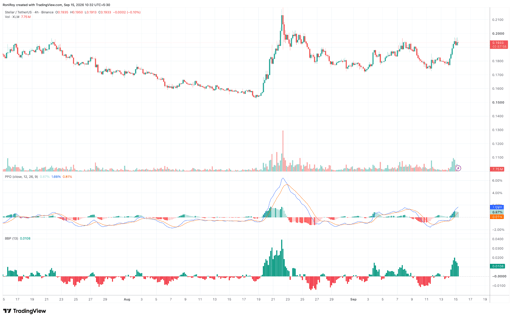
The 4-hour chart has recorded a sequence of higher lows since XLM fell towards $0.175 on Sept. 11, with price reaching $0.195 during the latest move.
See below:
XLM/USDT 4-hour price chart. Source: TradingView.
Trading volume expanded as XLM broke above $0.185 and approached $0.195.
Percentage Price Oscillator has strengthened with the PPO line at 1.68%, above its signal line at 0.81%.
Its histogram has expanded to a positive 0.87%, showing that short-term momentum has accelerated during the latest push.
Bull Bear Power stands at 0.0108 and has remained positive during the move towards $0.195.
The indicator rose sharply as XLM broke out of its Sept. 12-13 range, showing buyers have maintained control over the recent 4-hour candles.
The immediate resistance zone sits between $0.195 and $0.20. A 4-hour close through $0.20, accompanied by a positive PPO histogram and Bull Bear Power staying above zero, would support targets around $0.205 and $0.21.
If XLM is rejected below $0.20, the breakout area around $0.185-$0.188 becomes the first level to watch.
A drop through $0.185 would expose the Sept. 13 area around $0.178-$0.18, while a drop below $0.175 would erase the sequence of higher lows formed since Sept. 11.

Is Ethereum price at risk of a drop below $2,400?

XRP jumps 6% as traders turn bullish, but overheating signals are flashing

Can HYPE reclaim $90 after bouncing from $77?

Zcash price slips from $1,300: could ZEC fall to $850 before targeting $2,500?

CLARITY Act Senate vote on Tuesday: what to expect
No results found
Loading articles...
Failed to load articles. Please try again.