
Nvidia steadies above $200 as valuation, China chip demand draws focus
AI Sentiment: 72/100 Bullish
This score is generated through AI-driven analysis of the article's content.

powered by

Buy NVDA. The stock is holding above $200 and looks supported by slightly cheaper-than-market valuation (forward P/E ~19 vs S&P ~21) plus heavy shareholder returns (about 50% of free cash flow). The China black-market price jump signals real, constrained demand for Blackwell-era gear despite export limits, which should help protect revenue and margins while the next-gen Vera Rubin rollout approaches.
Key Risk: A real demand slowdown shows up in official results (not just gray-market pricing), proving the China pricing spike is temporary or can’t be monetized.
Sell/underweight the PHLX Semiconductor Index versus NVDA. The article highlights NVDA’s relative underperformance while the sector sold off; NVDA’s valuation support and buybacks make it the safer place to be. If the market keeps rotating toward “relative value,” semis ex-NVDA likely lag.
Key Risk: A broad risk-on rally lifts the whole group and NVDA’s relative advantage disappears, making the underweight cost you.
- Nvidia holds above $200 as investors assess trading range.
- Valuation and buybacks seen supporting NVDA downside.
- China black market chip prices surge amid US export curbs.
Nvidia NVDA shares edged higher on Wednesday as the chipmaker stabilized following a broader semiconductor-sector selloff, with market participants assessing whether the stock is establishing a new trading range.
Despite recent volatility, the stock has largely held above the psychologically important $200 level since breaking out of its previous range in April.
Nvidia still trading at cheaper valuation
The move comes as investors weigh Nvidia’s relative underperformance against the broader semiconductor sector.
The stock is up 7.3% so far this year, compared with a roughly 90% gain for the PHLX Semiconductor Index over the same period.
Still, technical and valuation signals suggest some support for the stock at current levels.
Nvidia has only briefly fallen below $200 in recent months and has tended to rebound on dips around that level.
The company is trading at a forward price-to-earnings ratio of 19.34 times, according to FactSet, slightly below the S&P 500 average of 20.77 times.
Analysts suggest this valuation could attract investors looking for relative value, potentially limiting further downside.
Nvidia is also returning significant capital to shareholders through dividends and buybacks, distributing about 50% of free cash flow.
Based on expected free cash flow of $195.35 billion in 2026, the company could return more than $97 billion to investors.
However, expectations for a sustained breakout remain tied to product cycle developments.
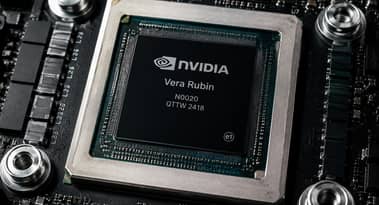
Investors are watching the rollout of Nvidia’s next-generation Vera Rubin chips, which are expected to enter the market in the second half of the year.
Market participants say the company will need to demonstrate continued dominance in artificial intelligence hardware to drive the next leg higher.
China black market pricing highlights strong demand for Nvidia chips
Nvidia’s AI chips have seen sharply higher prices on China’s black market, more than doubling over the past six months, according to a Financial Times report.
The increase comes amid tighter US enforcement of export controls restricting access to advanced semiconductors.
The DGX B300 server, which contains eight Blackwell graphics processing units, has risen in price to more than 8 million yuan ($1.1 million), up from around 4 million yuan, based on interviews with Chinese chip traders.
The system typically sells for about $400,000 in the United States.
Similarly, the RTX 6000 Pro workstation chip, used in large language model development, has increased from roughly 50,000 yuan at the start of the year to as much as 130,000 yuan, according to the report.
Both products are subject to US export restrictions on sales to China.
The surge in unofficial pricing follows a series of enforcement actions.
In March, a Supermicro co-founder, along with a Taiwan-based employee and a contractor, was charged with allegedly smuggling $2.5 billion worth of Nvidia AI servers to Chinese customers in what is described as the largest US enforcement case related to AI chip exports.

Nasdaq futures surge 300 points: 5 things to know before Wall Street opens

Why Nvidia stock is rising today after four straight post-earnings selloffs

SanDisk stock jumps 5% premarket: can Nvidia’s memory warning extend the rally?

SpaceX stock climbs above its IPO price: why Morgan Stanley's $300 call matters now

Nvidia stock after earnings: 3 numbers investors should watch next
No results found
Loading articles...
Failed to load articles. Please try again.