For educational purposes only. Invezz is not registered with the FMA. Consult a qualified financial adviser before investing.
Capital at risk:
Your investments can go up and down, including cryptoassets which are highly volatile and unregulated. You may get back less than you invest. Past performance is not a reliable indicator of future results.
CFD warning:
60–68% of retail accounts lose money trading CFDs due to leverage.
Affiliate disclosure:
We may earn a commission from partner links. This never influences our editorial opinions or evaluates.
Investing in SpaceX depends on whether you want exposure before or after its IPO. Before the listing, direct access is usually limited to accredited investors or indirect exposure through funds and related public stocks. Once public trading begins, retail investors can buy SpaceX shares through supported brokers such as eToro, subject to availability and market pricing.
Public.com: Retail investing app for listed alternatives
Hiive: Secondary marketplace for private-company shares
Forge Global: Pre-IPO marketplace for accredited investors
Robinhood: Simple brokerage app for indirect public exposure
How do you buy SpaceX stock?
The easiest route for most retail investors is to buy SpaceX through a mainstream investing platform once the stock is publicly available. If SpaceX lists on Nasdaq as expected, users should be able to search for the stock on eToro, review the live price, and place an order in the same way they would for other US-listed shares.
Step-by-step process
Create an account: Sign up with your email address and basic personal details to eToro, Public.com, or Robinhood, then choose a username and password.
Complete verification: Upload the required ID documents and complete any investor checks needed before you can deposit and trade.
Add funds: Deposit money into your eToro account using one of the available payment methods in your region.
Search for SpaceX: Once SpaceX is listed and available on eToro, search for the expected ticker, SPCX, or the company name.
Review the stock page: Check the live price, chart, market information, and any trading restrictions before placing an order.
Choose how much to invest: Enter the amount you want to invest. If fractional shares are supported, you may not need to buy a full share.
Place your order: Choose whether to buy at the current market price or set a limit order at the price you are willing to pay.
Monitor your position: After buying, track your SpaceX investment through your eToro portfolio and keep an eye on IPO volatility, earnings updates, and any share-release dates.
Investors who want direct SpaceX exposure before public trading begins may need to use a private-market route instead.
This usually means buying shares through a secondary marketplace such as Hiive or Forge Global, where existing shareholders may list private-company stock.
Access is typically limited to accredited investors, minimum investments can be high, and deals may involve extra paperwork, approval checks, resale restrictions, or SPV structures. This route is closer to true pre-IPO ownership, but it is less simple, less liquid, and less accessible than buying SpaceX through eToro once it is publicly listed.
Key things to double-check before you invest
You know whether it is direct or indirect: Many readers think they are buying pre-IPO SpaceX when they are actually buying broader exposure through another vehicle.
You understand the minimum and exit limits: Private-market deals can lock up capital for longer than expected, and even listed-market exposure may not behave the way you expect if the vehicle trades at a premium.
You are not relying on headlines alone: A well-known name like SpaceX can tempt investors to skip the details, but in this case the structure of the investment matters just as much as the company itself.
You have matched the route to your situation: For many retail investors, waiting for cleaner IPO access may make more sense than forcing a complicated pre-IPO route today.
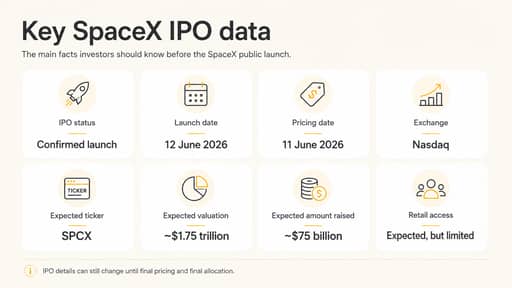
Key SpaceX IPO data
Item
Details
IPO launch date
12 June 2026
Expected pricing date
11 June 2026
Expected exchange
Nasdaq
Expected ticker
SPCX
Expected valuation
Around $1.75 - $2 trillion
Expected amount raised
Around $75 billion
Expected launch price
To be confirmed at final pricing
Retail availability
Expected, but allocation may be limited
Can you buy SpaceX stock today?
Not until public trading begins
Best direct route before launch
Private secondary marketplaces for eligible investors
Best retail route before launch
Wait for IPO access or buy indirect exposure
Main risk
High valuation, limited allocation, and possible post-IPO volatility
What does SpaceX do?
SpaceX is a private space technology company best known for reusable rockets, satellite launches, crewed space missions, and Starlink satellite internet.
Its main business areas include:
Rocket launches through Falcon 9, Falcon Heavy, and Starship
Starlink satellite broadband
Dragon spacecraft missions for cargo and crew transport
NASA and government space contracts
Commercial satellite launches
Long-term plans for Moon and Mars missions
SpaceX is popular because it sits at the centre of several major growth themes: private space exploration, reusable launch technology, satellite internet, defence infrastructure, and the commercialisation of low-Earth orbit.
For investors, the biggest attraction is Starlink. While rockets made SpaceX famous, Starlink gives the company a recurring revenue story through satellite internet, which makes the business easier to compare with large technology and telecom companies.
SpaceX also benefits from scarcity. Because it has stayed private for so long, many retail investors have never had a direct way to buy the stock. That makes the IPO one of the most anticipated listings in years.
When can I buy SpaceX?
The SpaceX IPO is now scheduled for 12 June 2026, with final pricing expected on 11 June 2026. This means from 12 June 2026 you will be able to buy SpaceX shares on platforms like eToro.
Important things to understand
Still private until 12 June 2026: You cannot buy SpaceX like a normal listed stock until it starts trading.
The IPO date is now the key event: Investors no longer need to treat the IPO as distant speculation. The focus is now on final pricing, allocation, and the first day of trading.
The valuation being discussed is huge: The current reported target is up to $1.75 trillion, which would make this one of the biggest stock-market debuts ever if it happens on those terms.
The IPO price and opening price may differ: Even if shares are priced on 11 June, the price available to most investors on 12 June could be higher or lower once public trading begins.
Retail access may improve at IPO: Reuters reports that SpaceX could allocate up to 30% of the deal to retail investors, which is unusually high by IPO standards.
“Close” does not mean guaranteed: Even after a confidential filing, a company still has to go through regulatory review, bank syndication, investor marketing, and final pricing before shares actually begin trading.
Timing can still change: IPO plans can shift because of market conditions, valuation demands, or company decisions, so readers should treat current timelines as reported targets rather than fixed dates.
How will the SpaceX IPO work?
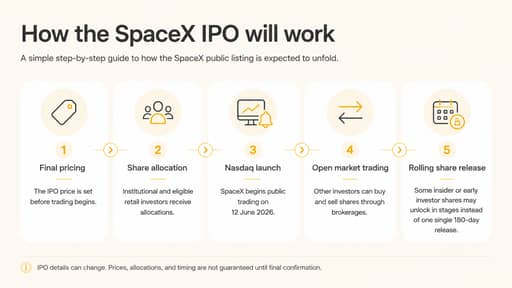
On 12 June 2026, the SpaceX IPO will turn the company from a private business into a publicly traded stock. Once trading begins, investors will be able to buy SpaceX shares through supported brokerages, just like other listed US stocks.
The process is expected to work in stages:
SpaceX confirms the IPO price range and final launch price
Investment banks market the deal to institutional and retail investors
Eligible investors request or receive share allocations
Final pricing is confirmed before the stock starts trading
SpaceX shares begin trading on Nasdaq under the expected ticker SPCX
Public investors can then buy and sell shares through normal brokerage accounts
Retail investors may get access through brokers that support IPO participation, but allocation is not guaranteed. Popular IPOs often receive more demand than available shares, which means some investors may receive fewer shares than they request, or none at all.
Once SpaceX starts trading publicly, investors will no longer need private-market access or accredited investor status to buy shares. However, the opening price may move sharply if demand is high, so investors should avoid assuming the IPO price and first trading price will be the same.
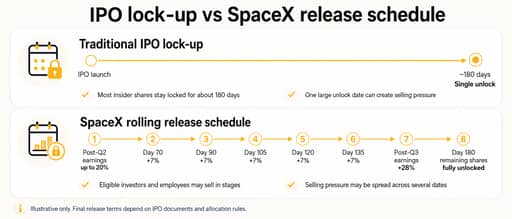
SpaceX expected rolling release schedule
The rolling release schedule is expected to let eligible pre-IPO investors and employees sell portions of their holdings in stages, rather than waiting for one large 180-day unlock.
Release point
Shares sales eligible
Potential unlock
What it means
Post-Q2 earnings
Up to 20%
Up to 20%
First possible insider and employee selling window after SpaceX reports its second quarterly results as a public company.
Day 70
+7%
Up to 27%
A further portion of shares may become available for sale.
Day 90
+7%
Up to 34%
Another staged unlock could add more supply to the market.
Day 105
+7%
Up to 41%
Selling pressure may continue to appear gradually rather than all at once.
Day 120
+7%
Up to 48%
More pre-IPO shares may become eligible for sale.
Day 135
+7%
Up to 55%
The rolling schedule continues before the traditional 180-day mark.
Post-Q3 earnings
+28%
Up to 83%
A larger release may follow SpaceX’s first quarterly earnings period ending in September.
Day 180
Remaining shares
100%
Any remaining pre-IPO shares become fully unlocked and eligible for sale.
This structure is different from a traditional IPO lock-up, where most insider shares are usually restricted until one major unlock date around 180 days after listing. SpaceX’s staged approach may spread selling pressure across several dates, although each release could still affect the share price if demand is not strong enough to absorb the extra supply.
How SpaceX’s rolling share release is different from a normal IPO lock-up
Most IPOs use a traditional lock-up period. This usually means insiders, employees, and early investors cannot sell their shares for around 180 days after the company goes public.
SpaceX is expected to use a more flexible rolling share release instead.
That means some existing shareholders may be able to sell portions of their stock before the full six-month lock-up ends, rather than waiting for one large unlock date.
The main difference is simple:
A traditional lock-up creates one big selling window after around 180 days
A rolling release allows shares to become available in stages
This can reduce the risk of one sudden wave of insider selling
It may also create several smaller periods of price pressure after the IPO
For investors, this matters because post-IPO selling can affect the share price. If more shares become available, supply increases, and that can weigh on the stock if demand is not strong enough.
A rolling release does not remove this risk. It simply spreads it across several dates instead of concentrating it around one major lock-up expiry.
What do you need before you buy SpaceX?
Before you invest in SpaceX, you need to be clear about which route you are actually pursuing, because the requirements are very different.
Direct private-share access usually requires accredited investor status, substantial capital, and patience with a slower transaction process, while indirect exposure through a fund or listed stock is much easier to access through a regular brokerage account.
What you should have ready
A clear route in mind: Decide whether you want direct private-share ownership or indirect exposure through a fund or related public company. These are not the same thing, and they come with very different access rules and risks.
A regular brokerage account: If you are using a mainstream investing app such as eToro, Public.com, or Robinhood, the setup is much more familiar: identity checks, a linked funding method, and access to the relevant listed fund or stock.
Accredited investor status if you want direct access: In the UK, this often means net worth above £1 million excluding a primary residence, or income above £200,000 individually or £300,000 jointly in each of the past 2 years, with a reasonable expectation of the same this year.
Enough capital for private-market minimums: Pre-IPO platforms and deal structures often involve large minimums, and competitor coverage commonly points to thresholds around £50,000 to £100,000+ depending on the marketplace, seller, or SPV structure. Exact minimums vary by deal, so this is something you need to verify before starting.
A realistic view of liquidity: Private shares are not easy to buy or sell on demand. Even if you secure an allocation, you may have limited exit options until a later liquidity event or public listing.
Basic risk tolerance: This is still a high-risk part of the market. Private-company investing usually comes with less disclosure, harder pricing, and a greater chance that your money stays tied up for longer than expected
How to buy SpaceX stock before it goes public?
There are really 2 broad routes here: direct private-market access and indirect public-market exposure. Direct access is the closer match to true pre-IPO investing, but it is usually limited to accredited investors and depends on actual share availability. Indirect exposure is easier for ordinary investors, but it usually means buying a fund, portfolio, or listed company with some connection to SpaceX rather than owning SpaceX shares themselves.
Common ways to get exposure
Private secondary marketplaces: These are platforms where existing shareholders may sell private-company shares, subject to availability and company restrictions. This is the route most people mean when they talk about buying SpaceX before the IPO.
Brokerage apps with IPO access: Some mainstream brokers focus less on private secondary trades and more on helping users request shares when a company is actually going public. This is not the same as true pre-IPO ownership, but it can still matter if the IPO is getting close.
Indirect exposure through public markets: This usually means buying a listed fund, basket, or related public company that may hold or track pre-IPO businesses. It is simpler to access, but it is one step removed from owning SpaceX stock itself.
Popular platforms to know
eToro: Better thought of here as a mainstream investing platform for IPO tracking and possible indirect public-market exposure rather than a direct route into private SpaceX shares.
Hiive: A private-share marketplace that is relevant if you are looking for direct secondary-market access to companies such as SpaceX. Availability can vary, and listings do not guarantee a completed transaction.
Forge Global: One of the best-known secondary marketplaces for private-company shares. Forge says accredited investors may be able to buy pre-IPO SpaceX stock through its marketplace, depending on availability and company approval processes.
Public.com: More relevant for IPO participation and listed-market access than for direct private SpaceX ownership. Public explains that buying into an IPO depends on whether a brokerage supports IPO ordering and whether shares are actually allocated.
Robinhood: Similar to Public.com, Robinhood is more useful for IPO access than for buying private SpaceX shares today. Its IPO Access feature is designed for requesting shares at the IPO price when available, not for buying pre-IPO stock on a private secondary market.
Platform options for getting exposure to SpaceX
Platform
Route
Direct or indirect exposure?
Best suited for
Key limitation
Route
Mainstream investing platform
Direct or indirect exposure?
Indirect
Best suited for
Retail investors who want listed-market exposure or IPO tracking
Direct and indirect are not the same: Buying through Forge Global or Hiive is fundamentally different from using Robinhood, Public.com, or eToro to buy a listed fund or request IPO shares later.
Availability is the real constraint: Even on a private-share marketplace, you still need an actual seller, the right deal structure, and in some cases company approval before anything happens.
Retail investors usually end up taking the indirect route: For most readers, the realistic path is not direct private ownership today. It is indirect exposure now, or waiting for actual IPO access through a brokerage later.
How can accredited investors buy SpaceX shares on the secondary market?
For an accredited investor, the usual route into pre-IPO SpaceX is the private secondary market. In practical terms, that means using a marketplace that connects eligible buyers with existing shareholders or private-market deal structures, then completing verification, reviewing the deal, and waiting for the transfer process to clear. It is the closest route to true pre-IPO ownership, but it is also slower, more restrictive, and far less liquid than buying a public stock.
How the process usually works
Confirm that you qualify: In New Zealand, accredited investors can qualify through tests such as net worth above $1 million excluding a primary residence, or income above $200,000 individually or $300,000 jointly in each of the last 2 years, with a reasonable expectation of the same this year.
Join a secondary marketplace: Platforms such as Forge Global and Hiive are part of the private-market route most often used for pre-IPO access. These platforms are marketplaces, not guaranteed inventory lists, so access depends on seller availability, deal terms, and buyer eligibility.
Review the deal structure carefully: Some transactions involve direct share purchases, while others use an SPV or similar structure. That matters because the structure affects fees, rights, transparency, and what the investor actually owns.
Complete investor checks and paperwork: Private-market deals usually involve more documentation than a normal brokerage trade, including accreditation verification, transaction documents, and disclosure review.
Wait for transfer approval: A private-company sale can still be subject to company restrictions, including a right of first refusal, which means the company may have the ability to step in before the transfer is completed.
Fund the purchase and hold the position: Once the deal closes, the shares or SPV interest are issued or transferred. At that point, the investor usually needs to be prepared to hold an illiquid asset until a later sale, tender offer, or public listing.
Important things to understand
Access does not guarantee execution: Seeing SpaceX on a secondary platform does not mean you can buy it instantly. A transaction still depends on an actual seller, workable pricing, and a transfer path that closes successfully.
Minimums can be high: Competitor coverage and private-market discussions commonly point to deal minimums in the $50,000 to $100,000+ range, though the exact threshold depends on the listing, platform, and structure.
Pricing is less transparent: There is no continuous public exchange book for private shares, so pricing can be harder to benchmark and may already reflect scarcity or demand premiums.
Liquidity is limited: Even if you successfully buy pre-IPO SpaceX, selling later may not be easy. Private-company stock is not designed for routine daily trading, and exit windows can be limited.
This is the closest route to real pre-IPO ownership: For readers who specifically want actual SpaceX private shares rather than indirect exposure, this is usually the clearest route. It is also the one with the highest friction.
How can retail investors get indirect exposure to SpaceX?
Most retail investors cannot buy SpaceX shares directly before the IPO, so the more realistic route is indirect exposure. In practice, that usually means using a regular brokerage app to buy a fund, trust, or listed company that has some economic link to SpaceX, or waiting for a broker-supported IPO allocation if the deal opens up to ordinary investors. It is easier and more accessible than the private secondary market, but it is still not the same as owning actual SpaceX shares.
Common indirect routes
Listed funds with private-company exposure: Some funds and vehicles hold stakes in late-stage private companies, including SpaceX, either directly or through structures such as SPVs. This is often the closest retail investors can get before a listing.
Related public companies: Some investors use listed companies with historical or economic ties to SpaceX as a proxy. This is a looser form of exposure, but it is easier to access through a normal brokerage account.
IPO access through a mainstream broker: Platforms such as Robinhood and Public.com are more relevant once a company is nearing an actual IPO. They do not offer private SpaceX shares today, but they may help retail users request IPO shares if the deal opens to ordinary investors.
General investing apps for listed exposure: A platform such as eToro can be useful for buying listed funds or related public stocks, but again, that is indirect exposure rather than true pre-IPO ownership.
Popular platforms for retail investors to know
eToro: Best understood here as a mainstream investing platform for buying eligible listed assets that may provide indirect exposure to SpaceX, rather than a route into private secondary-market shares.
Public.com: More relevant for IPO-stage access and listed-market investing than for true pre-IPO ownership. Retail investors may use it to access public-market routes if available.
Robinhood: Similar to Public.com, Robinhood is more useful if SpaceX actually reaches the public offering stage and retail allocations are offered through supported brokers.
Important things to understand
Indirect does not mean ownership: Buying a fund or related stock may give you some exposure to SpaceX, but it does not mean you own actual private SpaceX shares.
Fund structures matter: Some vehicles hold private-company exposure through layered structures such as SPVs, which can affect fees, transparency, and how closely the investment tracks the underlying stake.
Premiums can distort value: Some publicly traded vehicles with private-company exposure can trade at a significant premium to their underlying net asset value, which means investors may pay more than the underlying holdings are worth on paper.
This route is easier, but less precise: Retail-friendly access is simpler and more liquid than the private market, but it is also a less direct way to invest in SpaceX specifically.
Waiting for the IPO may be simpler: If reported plans hold and retail allocation really is larger than usual, some investors may decide that waiting for actual IPO access is cleaner than paying up for indirect exposure now.
SpaceX alternatives: public stocks to consider instead
If you cannot buy SpaceX shares before the IPO, you may still be able to get exposure to similar themes through public stocks.
These alternatives are not the same as owning SpaceX, but they can give investors exposure to space, satellites, defence, aerospace, or related technology markets.
Public stocks to consider include:
Alphabet: indirect exposure through its reported SpaceX stake
Rocket Lab: listed space launch and satellite company
Lockheed Martin: defence, aerospace, and space contracts
Northrop Grumman: defence and space technology exposure
Intuitive Machines: lunar and space infrastructure exposure
The best option depends on what part of the SpaceX story you want exposure to.
For example, Rocket Lab is closer to the rocket launch theme, AST SpaceMobile and Iridium are closer to satellite communications, while Lockheed Martin and Northrop Grumman offer more traditional defence and space exposure.
Alphabet is different because it may offer indirect financial exposure through its SpaceX stake, but buying GOOGL is still mainly a bet on Google, AI, advertising, cloud, and the wider Alphabet business.
Can you get SpaceX exposure through Alphabet or Google stock?
Alphabet is one of the most common public stocks investors look at for indirect SpaceX exposure.
Google invested in SpaceX years before the IPO, and recent reports suggest Alphabet still owns a meaningful stake in the company.
Buying Alphabet stock is not the same as buying SpaceX. GOOGL is still mainly driven by:
Google Search
YouTube
Google Cloud
AI
Digital advertising
Android
Alphabet’s wider investment portfolio
The SpaceX stake could become more visible if the IPO gives it a clear public market value. That may be positive for Alphabet, especially if SpaceX lists at a very high valuation.
However, investors should not treat Alphabet as a pure SpaceX proxy. Even if the SpaceX stake is valuable, Alphabet’s share price will still mostly depend on its core technology, advertising, cloud, and AI businesses.
For investors who want direct SpaceX exposure, waiting for the IPO is cleaner. For investors who want a large, liquid stock with some indirect SpaceX upside, Alphabet may be worth considering.
Can ETFs give you exposure to SpaceX?
Some funds and ETFs may offer indirect SpaceX exposure, but most will not give investors a pure SpaceX position.
Because SpaceX has been private, ordinary space ETFs have usually focused on public companies in areas such as:
Aerospace
Defence
Satellite communications
Space infrastructure
Launch technology
Telecom and connectivity
Some specialist funds may hold private SpaceX exposure directly or indirectly. Examples mentioned by market commentators include funds such as XOVR, DXYZ, ARK Venture Fund, and selected Baron funds.
However, investors should check each fund carefully before buying. Important details include:
How much SpaceX exposure the fund actually has
Whether the fund owns SpaceX directly or through another structure
Whether it trades at a premium or discount to net asset value
Fees and expense ratios
Liquidity and redemption rules
Whether the fund mostly owns other companies instead
For most retail investors, an ETF or fund can be a convenient way to get space-sector exposure, but it is not the same as owning SpaceX shares directly.
After the IPO, SpaceX may eventually appear in major indexes or space-themed ETFs, but timing and inclusion are not guaranteed.
What will it cost to buy SpaceX stock?
The cost of buying SpaceX stock depends on when and how you buy it. Once SpaceX is publicly listed, most retail investors should be able to buy shares through a normal brokerage account, such as eToro, where the main cost is the share price plus any platform spreads, FX costs, or account fees that apply.
Buying SpaceX before the IPO is different. Direct pre-IPO access usually means using a private secondary marketplace, which can involve higher minimums, extra paperwork, platform fees, and resale restrictions.
Typical costs and restrictions to know
Route / platform
Typical access type
Who can use it?
Typical minimum
Main costs or restrictions
Typical access type
Indirect listed-market exposure
Who can use it?
Standard retail brokerage users
Typical minimum
Often much lower than private-market minimums
Main costs or restrictions
Not a direct route to private SpaceX shares; exposure depends on what listed assets are actually available on-platform
Buying after the IPO should be simpler: Once SpaceX starts trading publicly, investors should be able to buy it through supported brokers like eToroor Robinhood in the same way as other US-listed stocks.
The share price is the main cost: After listing, the biggest factor is the live SpaceX stock price. The first public trading price may be different from the official IPO price.
Platform costs can still apply: Depending on the broker, investors may need to consider spreads, FX conversion costs, withdrawal fees, or account charges.
Pre-IPO minimums are much higher: Direct private-market routes often require minimum investments of $25,000, $50,000, or even $100,000+, depending on the platform and deal structure.
Private-market fees can be harder to see: Pre-IPO costs may include platform fees, transaction fees, SPV costs, or spreads built into the deal price.
Restrictions matter before the IPO: Private SpaceX share purchases may be limited by accredited investor rules, seller availability, company approval rights, resale restrictions, and lower liquidity.
IPO access is not guaranteed: Even if a broker offers SpaceX IPO access, high demand may mean investors receive fewer shares than requested, or no allocation at all.
What risks should you understand before buying SpaceX stock?
Buying SpaceX stock could be exciting, but it is not risk-free. Whether you buy after the IPO through eToro or try to get pre-IPO exposure through a private-market platform, the main risks are valuation, volatility, limited allocation, and the possibility that investor hype runs ahead of the company’s financial results.
Important risks to understand
IPO volatility: Newly listed stocks can move sharply in their first few days and weeks of trading. The price available to most retail investors may be very different from the official IPO price.
Valuation risk: SpaceX is expected to launch at a very high valuation. Even if the company is strong, paying too much can reduce future returns.
Allocation risk: If demand is high, retail investors may not receive the number of IPO shares they request. Some may need to wait until normal market trading begins.
Share-release risk: SpaceX’s rolling release schedule may allow some early investors and employees to sell in stages after the IPO. This could create periods of extra selling pressure.
Business execution risk: SpaceX depends on complex, capital-intensive projects such as Starship, Starlink, launch services, and government contracts. Delays, technical issues, or margin pressure could affect investor sentiment.
Market risk: SpaceX may trade like a high-growth technology stock, which means it could be sensitive to interest rates, risk appetite, and wider market conditions.
Extra risks with pre-IPO access
Liquidity risk: Private SpaceX shares are harder to sell than public stock. Investors may need to wait for a later sale, tender offer, or public listing before exiting.
Limited transparency: Private companies do not provide the same level of public reporting as listed companies, making valuation and performance harder to judge.
Transfer and approval risk: Private share transactions can be delayed or blocked by transfer restrictions, seller availability, or company approval rights.
Structure risk: Some private-market deals involve SPVs or other wrappers rather than direct share ownership, which can add fees and make ownership rights less clear.
Higher minimums and fees: Pre-IPO access can require much larger investment minimums and may include platform fees, transaction costs, or less visible pricing spreads.
Why this matters
For most retail investors, buying SpaceX after it starts trading should be simpler than chasing private shares before the IPO. A normal brokerage route is easier to understand, easier to exit, and usually cheaper to access.
The trade-off is price. By the time SpaceX is available to buy through platforms like eToro, early demand may already be reflected in the share price. Investors should avoid buying purely because of IPO hype and instead ask whether the valuation still leaves room for long-term returns.
What mistakes should beginners avoid when buying SpaceX stock?
The biggest beginner mistake is assuming every route into SpaceX gives the same exposure. Buying SpaceX through eToro after the IPO, applying for IPO shares, buying private shares before the IPO, and buying a related fund or stock are all different routes with different risks, costs, and outcomes.
Common beginner mistakes
Confusing indirect exposure with ownership: Buying a fund, ETF, Alphabet stock, or another space-related company is not the same as owning SpaceX shares directly.
Ignoring the IPO price vs opening price: The official IPO price may not be the same price available to most retail investors once public trading begins.
Buying purely because of hype: SpaceX is a high-profile company, but a strong business does not automatically make every entry price attractive.
Using a market order too quickly: IPO stocks can be volatile at launch. Beginners may prefer to check the live price carefully or use a limit order instead of buying blindly.
Overlooking share-release dates: SpaceX’s rolling release schedule may create periods where more early investor or employee shares become available, which could affect the stock price.
Misunderstanding private-market access: Buying SpaceX before the IPO usually means using a secondary marketplace, which may require accredited investor status, high minimums, extra paperwork, and limited liquidity.
Skipping the structure check: Some pre-IPO deals may involve SPVs or other wrappers rather than direct share ownership, which can affect fees, rights, and transparency.
A better way to think about it
Start with the route, not the brand. Decide whether you are trying to buy SpaceX after it lists, apply for IPO access, get indirect exposure, or pursue private-market shares before the IPO.
For most beginners, the simplest route is likely to be waiting until SpaceX is publicly tradable, then buying through a normal brokerage platform such as eToro if the stock is available in their region.
What is the SpaceX stock price prediction before its IPO?
The expected SpaceX launch price is $135 per share, although this is not yet confirmed.
Potential buyers should look at recent private-market valuation reports, expected IPO pricing, and how much scarcity or hype may already be reflected in pre-IPO deals.
That matters because a famous private company can attract aggressive pricing long before public investors get a chance to buy the stock.
Important things to understand
There is no public market price yet: Because SpaceX is still private, there is no continuously traded stock price to model in the same way analysts would model a listed company.
Private valuation is not the same as IPO pricing: A reported valuation can give a rough anchor, but the final IPO price can still differ depending on demand, market conditions, and how the offering is structured.
Pre-IPO pricing can include scarcity premiums: In private markets, buyers sometimes pay extra simply because access is limited. That can make pre-IPO prices look stronger than the eventual public-market result.
Any prediction is really a valuation estimate: For a private company like SpaceX, “price prediction” usually means estimating what the market might accept at listing, not forecasting a normal live stock chart.
Retail investors should be careful with headline numbers: A huge valuation does not automatically mean the stock will perform well after listing. In some cases, it can mean expectations are already very high.
SpaceX’s IPO is expected to be priced at a huge valuation, which means investors should separate the company’s quality from the price they are being asked to pay.
The bull case
SpaceX has leading positions in rocket launches, reusable space technology, Starlink satellite internet, government contracts, and long-term space infrastructure. If investors value SpaceX like a rare mix of defence, telecom, AI, and frontier technology, demand could be extremely strong when the stock starts trading.
The bear case
A reported valuation near $1.75 trillion already prices in years of future growth. Morningstar has valued SpaceX much lower, at around $780 billion, which shows how wide the gap is between the IPO target and some analyst estimates.
Our analysts
Our base case is that SpaceX could see strong early demand, especially if retail allocation is limited and the IPO becomes one of the biggest market events of the year. However, that does not mean the stock is automatically cheap. Investors should expect volatility after launch, especially around early earnings, share unlocks, and any updates on Starlink growth, Starship progress, margins, and capital spending.
For long-term investors, the better question is not whether SpaceX is an exciting company. It clearly is. The question is whether the IPO price leaves enough room for future returns after so much growth has already been priced in.
Should you buy pre-IPO exposure now or wait for a SpaceX IPO?
For most ordinary investors, waiting for the actual IPO is likely the cleaner and more practical option. Pre-IPO exposure can offer earlier access, but it usually comes with higher minimums, lower liquidity, more complicated deal structures, and a greater chance of paying up for scarcity. If recent reporting is right that SpaceX may reserve up to 30% of its IPO for retail investors, the case for waiting becomes even stronger for anyone who does not specifically need private-market exposure today.
Reasons to consider waiting
Retail access may be better than usual: Reuters reported that SpaceX could allocate up to 30% of its IPO to retail investors, which is unusually high by normal IPO standards. That makes waiting a more realistic option than it would be for many other private companies.
The process is simpler: Buying at or after the IPO through a mainstream broker is usually much more straightforward than navigating private-market documentation, seller matching, and transfer restrictions.
You avoid some structure risk: Waiting for the public listing reduces the chance that you end up in a complicated SPV or wrapper arrangement that is harder to understand and value.
Liquidity should improve: Once shares are publicly listed, investors usually have much easier entry and exit options than they do in the private market.
Reasons some investors still buy before the IPO
They want direct pre-IPO ownership: Some accredited investors specifically want actual private-market exposure rather than waiting for a public debut.
They expect the IPO price to be higher: The basic pre-IPO argument is that earlier buyers may get in before the public market fully reprices the company. That may or may not work in practice, especially when private valuations are already aggressive.
They can tolerate illiquidity and complexity: Investors using platforms such as Forge Global or Hiive are usually accepting a much higher-friction process in exchange for earlier exposure.
A practical rule of thumb
Wait if you are a typical retail investor: If you do not qualify as an accredited investor, or you simply want a cleaner and more transparent route, waiting for the IPO is usually the better fit.
Consider pre-IPO access only if you understand the trade-offs: The private-market route makes more sense for investors who understand the structure, can meet the minimums, and are comfortable with limited liquidity.
Do not treat earlier access as automatically better: With a company as high-profile as SpaceX, getting in earlier does not automatically mean getting better value. In some cases, it just means paying more for a harder-to-exit position.
Our view: what could happen when SpaceX launches publicly?
SpaceX is likely to attract huge demand when it starts trading. It has the kind of story public markets like: a dominant private company, a global brand, a powerful founder, a fast-growing Starlink business, and exposure to space, defence, satellites, and frontier technology.
The risk is that a lot of this excitement may already be priced in. If SpaceX launches at a very high valuation, investors may be buying an exceptional company at a demanding price. That can still work over the long term, but it leaves less room for disappointment.
The first few trading days could be volatile. Limited IPO allocations, retail demand, media attention, and early share-release rules may all affect the price. A strong opening does not guarantee a smooth first year as a public company.
Our view is that SpaceX deserves attention, but investors should avoid chasing the stock at any price. Waiting for the first wave of IPO excitement to settle may be a better option for anyone who cannot get shares at the official IPO price.
FAQs
Not as a normal public stock until trading begins on 12 June 2026. Before then, access is mainly through private-market platforms or indirect exposure.
Reports suggest SpaceX plans to set the IPO price at $135 per share, though final pricing should be checked before launch.
Users should be able to search for SpaceX once it is publicly listed, but availability depends on eToro adding the stock and on the user’s region.
Yes. SpaceX is expected to go public on Nasdaq on 12 June 2026 under the ticker SPCX, with final pricing expected before trading begins.
SpaceX is expected to begin trading on Nasdaq on 12 June 2026, with pricing expected before the debut.
Open a brokerage account such as eToro, deposit funds, search for SpaceX or SPCX, then place a buy order once trading is available.
SpaceX may be one of the most exciting IPOs of 2026, but the expected valuation is very high. Investors should compare the IPO price with their risk tolerance and avoid buying purely because of hype.
The ticker for SpaceX is SPCX.
Yes, but mostly indirectly. Morningstar has highlighted large ETFs that may eventually hold SpaceX, including QQQ, IWB, and VOO if index rules and inclusion requirements are met.
No. Elon Musk does not own 100% of SpaceX. He remains the company’s most important individual shareholder and is expected to retain significant control, but SpaceX also has other investors and shareholders.
Alphabet has been linked to SpaceX through earlier investment, but buying GOOGL is not the same as owning SpaceX stock.
Harry is a Financial Writer for Invezz. He has more than a decade of experience writing, editing, and managing content for blue-chip companies, with a background spanning high street and investment banks, insurance companies, and trading platforms.