
Why is Sapporo stock sliding 6% after selling its US beer unit?
AI Sentiment: 25/100 Bearish
This score is generated through AI-driven analysis of the article's content.

powered by

Buy 2501.T. The selloff is execution-risk priced in (6% drop) despite a relatively small $23m transfer gain versus $80m impairments—market is extrapolating “US failure” into permanent earnings damage. The plan to consolidate US production into Richmond and stop Escondido by end-2026 is a clear path to lower fixed costs and simpler operations; that should re-rate the multiple once restructuring costs are absorbed and guidance stabilizes.
Key Risk: US beer demand keeps deteriorating faster than cost savings, forcing additional impairments and delaying profitability recovery.
Sell 2501.T and/or avoid new longs until closing. The transaction is framed as strategic focus, but the market is treating it as confirmation that the Stone integration thesis failed. The impairment/expense overhang ($80m) plus governance/capital-allocation scrutiny (3D Investment Partners) can keep a discount on any “efficiency” narrative until management proves capital discipline post-close.
Key Risk: Management credibility breaks—further asset sales/real estate actions or additional restructuring are needed, extending the earnings drag.
- Sapporo shares fell up to 6.4% after it announced the sale of Stone Brewing.
- The deal transfers IP and hospitality assets, with closing expected in May.
- Richmond will anchor US output, while Escondido halts brewing by end-2026.
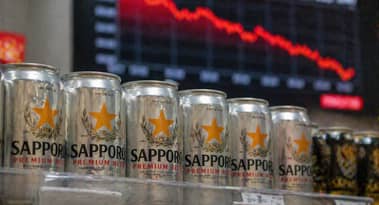
Sapporo Holdings stock slid as much as 6.4% on Wednesday after the Japanese brewer said it would sell Stone Brewing to Firestone Walker and Duvel Moortgat.
The move is being read less as a clean strategic exit than as evidence that its US expansion has been costly and slow to pay off.
The stock dropped to ¥1,712.5 before trimming losses, underscoring how the market is responding to execution risk, not just the transaction itself.
A sale that confirms the slowdown
Sapporo said on Tuesday that it would transfer the Stone brand’s intellectual property and hospitality assets, with closing expected in late May.
As part of the restructuring, Sapporo plans to make its Richmond, Virginia, plant the core production base for Sapporo-branded beer in the US, while the Escondido plant in California will stop making Sapporo- and Stone-branded beer by the end of 2026.
The company said the deal should produce an estimated gain on transfer of about $23 million, but also trigger impairment losses and related expenses of about $80 million.
That is the heart of the investor unease as Sapporo is narrowing its focus and concentrating resources on the brand that still has traction.
In practice, the sale highlights how far the original US strategy drifted from its promise.
Sapporo bought Stone in 2022 as a way to accelerate the growth of its own beer brand in the United States and use Stone’s two production bases to widen its North American reach.
The company’s latest filing says that US beer demand then moved steadily lower, pressured by inflation, shifting consumer preferences, and higher costs.
Why the market is punishing Sapporo stock
The selloff reflects a verdict on timing as much as direction.
Sapporo is making the right-sounding move only after the environment deteriorated and the asset required further restructuring.
That leaves investors with a less flattering narrative: the company expanded aggressively into the US craft beer market, then had to unwind part of that bet after the market weakened.
Even though Sapporo says the reorganization should improve efficiency and reduce fixed costs, the immediate market reaction suggests investors are focusing on the path that led here.
The Stone brand was supposed to be a platform for growth.
Instead, it has become another reminder that overseas beer acquisitions have been difficult to integrate and harder to justify in earnings terms.
Sapporo’s own filing says the latest changes are intended to “concentrate resources” and improve profitability.
The language is simply read as retreating to a simpler operating model after a more ambitious plan failed to gain momentum.
The stock move also sits against a longer-running governance story.
In March 2025, 3D Investment Partners, Sapporo’s largest shareholder, had been pressing the company for greater transparency on capital allocation and real estate sales.
3D said that Sapporo had been marked by poor results and ineffective capital allocation.

Reddit stock rises 6% as August user growth hits 2026 high

iPhone Duo: analyst explains how big of a revenue opportunity it really is

Why Wall Street is split on Meta’s Muse AI agent and stock outlook

Why a 'beat and raise' isn't driving Macy's stock higher?

Pinterest stock crashes below key price: Is it a bargain or a value trap?
No results found
Loading articles...
Failed to load articles. Please try again.