
Hindustan Aeronautics Limited Q4 profit rises 5.5% on surge in other income
AI Sentiment: 72/100 Bullish
This score is generated through AI-driven analysis of the article's content.

powered by

Buy HAL. Q4 profit rose 5.5% largely because “other income” jumped 76.6%, and the stock still held a +1.9% move after paring gains—market is treating the earnings as a signal, not a one-off. The bigger catalyst is fiscal 2027: easing engine supply constraints should lift Tejas Mk1A deliveries, and India’s defence push keeps order visibility improving. Key risk: the 76.6% other-income surge is temporary (one-time accounting/receipts) and Tejas Mk1A delivery growth fails to materialize into sustained earnings by fiscal 2027.
Key Risk: Tejas Mk1A delivery growth doesn’t improve and the profit boost was mostly one-time other income.
Buy BEL and Bharat Dynamics alongside HAL. The news reinforces a sector-wide theme: policy-driven domestic manufacturing plus improving supply chains should lift multiple state-run defence names, not just HAL. If Tejas/engine constraints ease, procurement and production planning across avionics, electronics, and munitions ecosystems typically benefits. Key risk: defence spending or procurement timelines slip, and the sector rerates lower even if HAL’s operational story improves.
Key Risk: Government defence procurement slows or gets delayed, dragging the whole PSU complex down.
- HAL Q4 profit rose 5.5% year-on-year to 41.96 billion rupees.
- Other income jumped 76.6%, supporting overall quarterly profitability.
- HAL shares climbed after results despite rising material costs.
Hindustan Aeronautics Limited reported a 5.5% year-on-year increase in fourth-quarter profit on Thursday, supported by a sharp rise in its other income segment.
The state-run aerospace and defence company posted a net profit of 41.96 billion rupees ($438.32 million) for the quarter ended March 31.
This compared with 39.77 billion rupees reported during the same period last year.
The company’s other income rose 76.6% year-on-year to around 11.51 billion rupees.
The company did not specify the reason behind the sharp increase in this category.
The rise in other income helped lift overall profitability during the quarter.
Revenue from operations increased 1.7% to 139.42 billion rupees during the reporting period.
Expenses rise on higher material costs
Despite the improvement in profit, HAL’s total gross expenses rose about 5.4% year-on-year.
The increase was mainly driven by higher material costs.
The rise in expenses partially offset the gains from higher other income and modest revenue growth.
Following the earnings announcement, HAL shares rose as much as 4.1% in trade.
The stock later pared some gains but remained 1.9% higher in afternoon trading.
The company’s shares have gained around 6% so far this year.
Analysts see fiscal 2027 as key growth phase
Analysts at Antique Stock Broking said fiscal 2027 could become an inflection point for HAL.
The brokerage said the expected improvement could be driven by a pick-up in deliveries of the Tejas Mk1A aircraft as engine supply issues begin to ease.
The easing of supply-side constraints could support production and deliveries over the coming years, according to the analysts.
India’s defence manufacturing push supports sector growth
India’s aerospace and defence sector is witnessing rapid policy-driven expansion as the government pushes for higher domestic manufacturing under the Atmanirbhar Bharat initiative.
The country is targeting nearly 70% self-reliance in defence manufacturing by 2026.
The sector is gradually shifting away from heavy import dependence towards indigenous production and advanced manufacturing capabilities.
The sector is also witnessing rising investments in unmanned aerial vehicles (UAVs), defence electronics, space technology, and maintenance, repair, and overhaul (MRO) services.
State-run companies continue to play a dominant role in the industry.
Major public sector defence firms include Hindustan Aeronautics Limited, Bharat Electronics Limited, Bharat Dynamics Limited, Garden Reach Shipbuilders & Engineers, and BEML Limited.
At the same time, private sector participation is increasing steadily.
Companies such as Tata Advanced Systems, Adani Defence & Aerospace, Mahindra Defence, and Solar Industries India are expanding their presence in the sector.
The government-backed iDEX (Innovations for Defence Excellence) initiative is also supporting defence-focused startups and encouraging innovation across the industry.
HAL remains key player in India’s aerospace sector
HAL is one of India’s largest state-owned aerospace and defence companies.
Headquartered in Bengaluru, Karnataka, the company was established in 1940 and remains among Asia’s oldest aerospace manufacturers.
The company is involved in the design, development, manufacturing, repair, and overhaul of aircraft, helicopters, engines, and avionics for military and civil customers.
HAL operates 11 dedicated research and development centres and 21 manufacturing divisions across India.
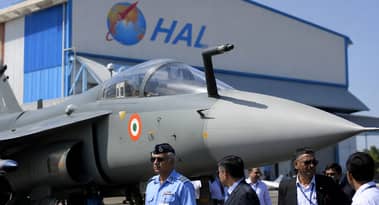
Its flagship products include the Tejas Light Combat Aircraft, Su-30MKI fighter jets, Hawk trainers, and helicopters such as Dhruv, Rudra, and Prachand.
The company operates as a Maharatna Public Sector Undertaking under India’s Ministry of Defence.
Originally founded as Hindustan Aircraft Limited in 1940, the company was renamed Hindustan Aeronautics Limited in 1964 after merging with Aeronautics India Limited.

Why is American Eagle stock plunging over 11% despite crushing earnings?

Why did Lululemon stock crash 20% after earnings, and is the brand in trouble?

Why Snowflake stock is soaring 22% premarket after its latest earnings

Broadcom’s AI revenue surged 221%, so why did the stock tumble 5%?

Salesforce stock surges 12%: did earnings just kill ‘SaaSpocalypse’ fears?
No results found
Loading articles...
Failed to load articles. Please try again.