
DAX Index analysis as hedge funds place huge short bets against German automakers

AI Sentiment: 35/100 Bearish
This score is generated through AI-driven analysis of the article's content.

powered by

Buy DAX exposure (e.g., DAX ETF such as iShares Core DAX UCITS ETF) for the technical setup: inverted head-and-shoulders, price above the 50/100-day EMAs, and a clear trigger at €25,460. Even with auto shorts, the index can rally on oil easing and broad risk-on flows, forcing hedge funds to cover.
Key Risk: The €25,460 breakout fails and the index rolls over as auto-credit stress spreads into the broader market.
Short the most-targeted German automaker bonds: Volkswagen investment-grade bonds and BMW/Mercedes 2032–2035 maturities (e.g., BMW 2035). The article shows heavy hedge-fund shorting in these specific issues, tied to fears that China-driven price pressure destroys long-run earnings power. If earnings don’t recover, credit spreads widen and perpetual/riskier paper underperforms first.
Key Risk: A sharp rebound in auto demand or a credible EU/industry pricing protection plan that restores margins fast enough to squeeze shorts.
- The DAX Index has rebounded after the US-Iran ceasefire deal.
- The risk is that hedge funds have placed short trades against German automakers.
- The index has formed an inverted head-and-shoulders pattern.
The DAX Index jumped this week, reaching a high of €25,000, its highest point since June 2nd. This rebound happened as crude oil prices retreated after the US deal with Iran. Still, the index faces a major risk as hedge funds continue shorting German car companies.
Hedge funds are shorting German automakers
Top hedge funds are shorting German automakers, a sign that they expect their shares and bonds will struggle over time. They are mostly doing this as investors remain concerned about the rising competition from the cheaper Chinese cars from companies like BYD, Nio, and XPeng.
Data shows that bonds issued by companies like Volkswagen, Mercedes-Benz, and BMW being among the most shorted. Some of the top funds that are shorting these bonds and equity are Marshall Wace and Two Sigma. In a note, a top analyst said:
“China has become a source of competition rather than profits. Investors are increasingly questioning whether the industry’s earnings power can ever return to pre-China-slowdown levels.”
Hedge funds have also shorted other European automakers like Stellantis, the parent company of Jeep and Fiat, and Renault.
Data shows that Volkswagen was the third-most shorted investment-grade bond in Europe, with Stellantis being number 1. For example, its risker perpetual bonds have attracted substantial short bets, with the short interest rising to over 750 million euros.
Hedge funds are also shorting BMW’s 750 million euros 2035 bond and its two 500 million bonds due in 2032 and 2033. The same trend is happening with Mercedes-Benz.
German automakers are facing major challenges
German automakers, which are crucial parts of the economy and the DAX Index have struggled in the past few months. BMW stock has dropped by 26% this year, making it one of the worst-performing companies in the index.
Porsche Automobil, Mercedes-Benz, and Volkswagen Group have fallen by over 21%, 17%, and 12%, respectively, this year.
These companies have retreated amid the ongoing short-selling among investors and the fear of Chinese competition. Just recently, top companies like Stellantis, Volkswagen, and Renault have called for a “Made in EU” target that rewards manufacturers who keep their production in the bloc.
Still, the challenge is that some Chinese companies are opening plants in Europe, a move that will bring them closer to customers and avoid the costly tariffs. BYD is spending about 2 billion euros this year to develop charging infrastructure in the bloc. A Federated Hermes analyst said:
“If they - Chinese manufacturers - continue combining rapid innovation cycles with lower price points, that creates a difficult backdrop for the established European carmakers.”
The German DAX index has also underperformed the market because of the lack of exposure to the AI industry. Indeed, a closer look at the best gainers in the index this year have some exposure to the industry. Infineon Technologies, a top semiconductor company, has jumped by 114% this year. Siemens Energy, which provides power items has also soared by 18% this year.
DAX Index technical analysis
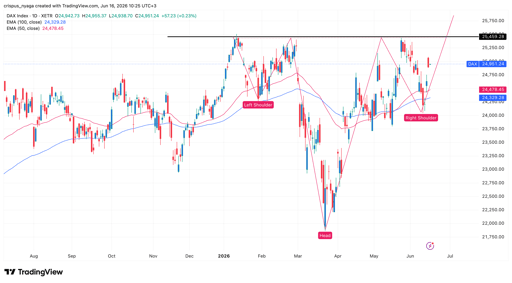
DAX Index chart | Source: TradingView
Technicals suggest that the DAX Index may rebound despite these risks. For one, it has now formed an inverted head-and-shoulders pattern, a common bullish reversal sign in technical analysis. The neckline is at €25,460.
The stock has also jumped above the 50-day and 100-day Exponential Moving Averages (EMA). That is a sign that bulls have prevailed.
Therefore, a strong bullish breakout will be confirmed if the stock jumps above the key resistance level at €25,460.

More details of the mega Anthropic IPO are coming out: here’s what we know

Crypto price predictions: Dogecoin, XRP, Venice Token (VVV)

Zcash price prediction: Here’s why ZEC token has gone parabolic

ARB price prediction: How Robinhood Chain growth is boosting Arbitrum

Software stocks are back from the dead as AI fuels growth: can the rally continue?
No results found
Loading articles...
Failed to load articles. Please try again.