
South Korean stocks: KOSPI seen hitting 10,000 by year-end
AI Sentiment: 78/100 Bullish
This score is generated through AI-driven analysis of the article's content.

powered by

Buy iShares MSCI South Korea ETF (EWY). The article says the KOSPI rout is “temporary,” with a policy-friendly mix and a likely rebound in 2H 2026; the index is down >20% from its high and still up ~65% YTD, so sentiment is overshot. This gives you broad exposure while the market rotates back from panic to fundamentals.
Key Risk: Samsung/SK Hynix guidance turns structurally weak (AI memory demand disappoints for more than one cycle), so the “temporary setback” call breaks.
Buy Samsung Electronics (005930.KS) and SK Hynix (000660.KS) as a pair. The sell-off is tied to AI spending fears and leveraged single-stock ETF unwind losses; Citi expects a technical correction and wants next-gen AI memory demand to validate the dip. Pairing reduces single-company execution risk while staying focused on the index’s core drivers.
Key Risk: Next-gen AI memory demand fails to re-accelerate in upcoming earnings, forcing further de-rating and more ETF-driven selling.
- South Korean stocks have come under pressure in recent weeks.
- Citi still sees a sharp recovery in KOSPI in the back half of 2026.
- Here's what could drive the benchmark index to 10,000 this year.
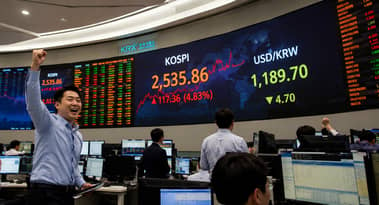
South Korea’s benchmark index, KOSPI, has been under immense pressure in recent weeks – down over 20% from its all-time high on June 22nd.
Still, analysts at Citigroup remain convinced the rout is “temporary” and South Korean stocks will recover sharply in the second half of 2026.
In a note published Monday, the investment firm maintained its 10,000-point year-end target for KOSPI, implying more than a 40% upside from current levels.
What has triggered the sell-off in South Korean stocks?
South Korea outperformed the major stock markets in 2025 – and the momentum continued in the first half of this year as well.
But then came the fears of excessive artificial intelligence (AI) spending that have crashed KOSPI in the trailing four weeks.
Plus, concentration risks (Samsung and SK Hynix currently make up more than 60% of the index’s market cap) and speculative trading among domestic retail investors have added to pressure on the benchmark.
Following the launch of single-stock leveraged exchange-traded funds (ETFs) tied to Samsung and SK Hynix on May 27, retail investors have parked a net 14 trillion won ($9.4 billion) in these funds.
Those retail investors are now sitting on steep losses as the semiconductor trade unwinds.
Why Citi expects the KOSPI index to recover
Despite the sharp pullback, Citi analysts believe the “sell-off” in South Korean stocks has already peaked.
According to them, strong fundamentals, paired with a market-friendly policy mix, will catalyze a meaningful recovery in KOSPI in the second half of 2026.
Much of it will be related to the semiconductor sector – which the firm believes is experiencing a temporary setback, not a structural failure.
“We think the recent share price pullback of KOSPI equities, led by KR memory suppliers, is more of a technical correction driven by market-wide profit-taking and therefore may represent a buying opportunity,” the analysts wrote.
Despite recent weakness, the benchmark KOSPI index remains up roughly 65% versus the start of this year.
What investors should watch in the back half of 2026
For Citi’s rather aggressive 10,000 year-end target to materialize, the market needs a swift stabilizing shift in tech sentiment.
Key catalysts to monitor in the near-term include upcoming quarterly earnings calls from Samsung and SK Hynix, where guidance on next-gen AI memory demand could either validate buying the dip or extend the tech drag.
Moreover, watch domestic retail flows to see if local investors double down or capitulate, as well as foreign capital movements returning to balance single-stock concentration.
If global chip demand holds firm through the final two quarters, recent turbulence in South Korean stocks may actually prove a brief detour in a broader rally – and that’s what Citi analysts are betting on in the second half of 2026.

Robinhood stock rises as Morgan Stanley upgrades HOOD to overweight

Nvidia stock analysis: top reasons why the shares may go parabolic soon

Broadcom stock falls to a key support: is it about to surge after earnings?

Can AI manage your portfolio? InvestorAI's Bruce Keith answers on 'Zero Sum'
Meta stock looks undervalued: settlement and AI could unlock up to 40% upside
No results found
Loading articles...
Failed to load articles. Please try again.