
Tilray Brands stock continues its downward spiral: buy the dip or sell the rip?

AI Sentiment: 35/100 Bearish
This score is generated through AI-driven analysis of the article's content.

powered by

Buy Tilray Brands (TLRY). The stock is at a 52-week low, broke key support near $5.96, and RSI is near oversold—classic setup for a sharp mean-reversion bounce. The catalyst is rescheduling momentum: Schedule III clarity would unlock U.S. medical/compliant pathways and validate Tilray’s U.S. “medical platform” blueprint. Expect a relief rally back toward the $5.96 resistance area.
Key Risk: The judge/DEA process delays or rejects Schedule III, keeping U.S. expansion and investor confidence frozen for months.
Sell short the cannabis basket via Curaleaf (CURLF) or Green Thumb Industries (GTBIF) on any bounce. The article shows TLRY’s slide is broad across cannabis names, driven by the same rescheduling uncertainty. If the market rallies on “dip-buying,” it will likely fade because fundamentals (losses, slow growth, regulatory timing) don’t improve until the final ruling.
Key Risk: A clear, fast Schedule III outcome lifts the whole sector and forces shorts to cover.
- Tilray Brands stock has tumbled and is hovering at its lowest level since June last year.
- Progress on the reclassification of marijuana in the US has been slow.
- The company’s beverage business is growing at a slow pace.
Tilray Brands stock continued its strong downtrend and is hovering at its lowest level since June last year. TLRY has slumped by 57% this year, mirroring the performance of other cannabis stocks like Green Thumb Industries, Truelive Cannabis, and Curaleaf. So, is it safe to buy the Tilray stock dip?
Why Tilray Brands stock has plunged
The TLRY stock has been in a strong sell-off this year as investors wait for more details on cannabis reclassification in the United States.
President Donald Trump signed an executive order directing the Department of Justice (DoJ) to expedite the rescheduling of marijuana from Schedule 1 to Schedule III of the Controlled Substances Act.
A few months later, in April, Acting Attorney General Todd Blanche, issued the final order moving FDA-approved marijuana products and state-licensed medical marijuana to Schedule III. The DEA, on the other hand, held an administrative hearing to decide whether marijuana should move to Schedule III. The post-hearing briefs are now due on August 17, after which a judge will issue the final recommendation.
Tilray Brands, a Canadian company, has maintained that it will be open to expanding its business to the United States if the regularity clarity emerges. Such a move would be bullish for the company because its international business is one of the fastest growing ones. In a statement, the company said:
“Tilray has already developed a blueprint for a U.S. Tilray Medical platform that is focused on research, education, cannabinoid-based medicine development, patients and compliant medical cannabis access rather than adult-use retail.”
Tilray’s beverage business continues struggling
The TLRY stock price has dropped as the growth of its beverage business slows. The most recent results showed that its total revenue jumped by 11% in the fourth quarter, helped by some of its acquisitions. It acquired companies like BrewDog and Lyphe, which likely contributed to its growth.
The beverage business made $254 million, up by 6% YoY, while its cannabis jumped by 6% to $268 million. Its distribution revenue rose by 21% to $327 million, while the wellness division jumped by 9%. The company made a net loss of $105 million, driven mostly by non-cash charges.
On the positive side, the management expects the adjusted EBITDA for the year ending May next year to be between $68 million and $75 million. That will represent a double-digit growth rate compared to the last fiscal year.
TLRY stock technical analysis
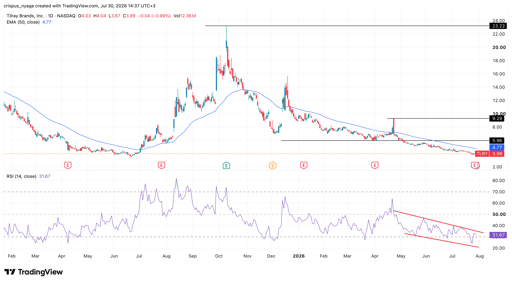
Tilray Brands stock chart | Source: TradingView
The daily chart shows that the Tilray Brands stock has been in a strong sell-off in the past few months and is now at its lowest level in over 52 weeks. It recently dropped below the key support level of $5.96, its lowest level in March this year.
It has slumped below the 50-day Exponential Moving Average (EMA). Also, the Relative Strength Index (RSI) has continued falling, forming a descending channel. It is hovering slightly above the oversold level.
Therefore, the most likely scenario is where the stock rebounds in the coming months as investors start buying the dip. If this happens, it will likely rebound to the key resistance at $5.96, which is about 52% above the current level.

Why SpaceX stock is up around 1% on Friday

Should you buy the dip in OKLO stock today?

Analyst: Adobe stock's post-earnings dip isn't about AI disruption fears only

Dow surges 500 points after four-day slide as oil prices retreat

Here’s why the Enbridge stock is in a strong downward trend
No results found
Loading articles...
Failed to load articles. Please try again.