
Ethereum price slips: could a staking cap push ETH toward fresh yearly lows?

AI Sentiment: 35/100 Bearish
This score is generated through AI-driven analysis of the article's content.

powered by

Buy stETH vs ETH (long stETH, short ETH). If staking rewards are capped, the market will price in lower native staking income for ETH, while liquid staking tokens like stETH can hold up better on perceived yield/market structure. This is a direct play on the “ETH yield loses appeal” narrative.
Key Risk: The governance outcome preserves meaningful staking rewards (or stETH depegs/underperforms due to protocol or liquidity stress), causing the stETH/ETH spread to compress against you.
Sell Ethereum (ETH-USD). The draft staking cap threatens lower staking yields and raises the odds of yield rotating to stablecoins/tokenized dollars, while also increasing centralization risk via large staking operators. Price is still capped below key resistance (~$1,888 then $1,950) and support is fragile ($1,826–$1,830).
Key Risk: The proposal gets softened/removed or clearly scheduled with strong demand support, and ETH reclaims $1,888 then breaks above $1,910–$1,950.
- Ethereum has fallen nearly 2% over the past week.
- A draft proposal is expected to gradually reduce ETH staking issuance.
- The proposal remains under community review.
Ethereum has remained under pressure after falling nearly 2% over the past seven days, now a draft proposal to cap staking issuance has sparked renewed concerns.
The discussion has emerged as Ethereum has traded under pressure.
CoinGecko data shows ETH changing hands around $1,870 after declining roughly 1.7% over the last seven days, having fallen from the $1,920 area at the end of July before stabilising between approximately $1,840 and $1,880 during the past several sessions.
According to the draft proposal, Ethereum would no longer continue issuing validator rewards indefinitely as staking participation grows.
Under Ethereum's existing proof-of-stake model, staking rewards gradually decline as more ETH enters the validator set, but issuance never completely stops.
Even if the entire ETH supply were theoretically staked, validators would still receive newly issued ETH, producing an annual issuance rate of roughly 1.5%.
The new proposal replaces that model with a dynamic burn mechanism tied directly to staking participation.
Researchers propose a saturation point of 60.25 million ETH, representing roughly 50% of Ethereum's circulating supply.
As staking approaches that threshold, an increasing share of validator consensus rewards would be burned instead of distributed.
Once staking reaches the proposed cap, consensus issuance would effectively fall to zero.
Instead of continuously increasing issuance alongside staking participation, annual ETH issuance would peak near 0.5% when roughly one-fifth of the supply is staked before gradually declining as additional ETH enters staking.
To avoid abrupt changes, the proposal outlines an implementation period lasting approximately 18 months, spread across 64 incremental stages over about 548 days.
Supporters of the proposal argue Ethereum's existing issuance schedule encourages too much staking over time.
According to the proposal authors, continuous issuance creates what they describe as a dilution cost for ETH holders who choose not to stake because newly minted ETH continuously expands the supply held by validators.
The researchers also argue that staking participation above one-third of the network increases the influence of centralised exchanges, custodians, and liquid staking providers.
With Ethereum's staking ratio already exceeding 33%, they warn that continued growth could place more of Ethereum's security under large intermediaries instead of independent validators.
Further, the proposal states that combining reduced staking issuance with Ethereum's existing EIP-1559 fee-burning mechanism and blob fee burns would strengthen the network's deflationary characteristics over time.
Critics warn proposal could weaken ETH demand
Community members responding on Ethereum governance forums have questioned whether the proposed reward reduction could produce unintended consequences for ETH itself.
One of the most frequently raised concerns focuses on staking yields.
Several critics argue that if staking rewards gradually approach zero, ETH would lose one of its primary investment characteristics as a productive digital asset capable of generating native yield.
According to opponents, stablecoins and tokenized dollar products currently offering yields near 4% to 5% could become more attractive than holding ETH.
Validators operating independently have also raised concerns over how lower rewards would affect participation.
Critics argue that large staking operators such as Coinbase or institutional node providers can continue operating with significantly lower costs than home validators because of economies of scale.
According to feedback published during community discussions, reducing validator rewards by nearly half at today's staking participation levels could force smaller operators to leave first while allowing large institutions to maintain market share.
Some participants argue such an outcome would produce the opposite result from the proposal's stated objective by concentrating staking among regulated entities instead of preserving decentralisation.
Critics are also concerned that materially reducing staking income would compress returns across multiple DeFi applications, leaving less room for lending spreads, staking derivatives and other yield-generating strategies that contribute to Ethereum's total value locked.
The proposal currently remains in draft form and has not been accepted or scheduled for any Ethereum network upgrade.
ETH price analysis
Ethereum's recent price action suggests the market remains cautious and is yet to turn decisively bearish.
Nevertheless, charts indicate that sellers still retain the advantage unless buyers reclaim higher resistance levels.
On the daily chart, ETH continues trading below the 20-day Bollinger Band midpoint near $1,888, showing that the recovery from June's lows has yet to regain stronger momentum.
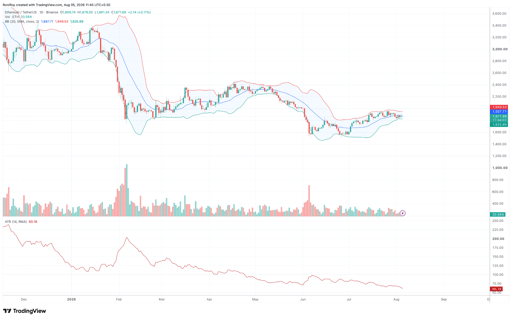
ETH/USDT 1-day price chart. Source: TradingView.
The upper Bollinger Band around $1,950 remains the next dynamic resistance zone, while the lower band near $1,826 continues to provide immediate support.
Volatility has also continued to cool. The Average True Range (ATR) has declined to around 60, extending a months-long downtrend that suggests price swings have become progressively smaller.
Such volatility compression often precedes a stronger directional move, although the indicator itself does not signal which direction that move will take.
On the 4-hour chart, Ethereum is trading close to the middle of the Keltner Channel, with the upper boundary near $1,911 acting as the first resistance and the lower boundary around $1,827 serving as nearby support.
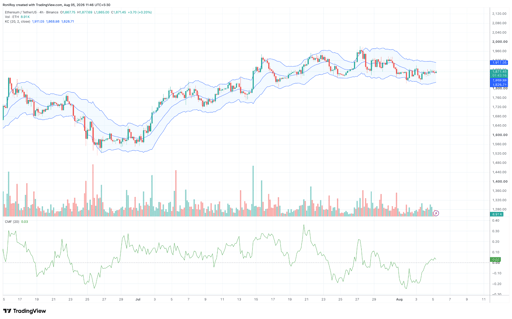
ETH/USDT 4-hour price chart. Source: TradingView.
Price has spent the past several sessions moving within that range, indicating buyers and sellers remain evenly matched.
Meanwhile, the Chaikin Money Flow (CMF) has climbed back into slightly positive territory around 0.03, suggesting fresh buying has returned after recent outflows.
However, the reading remains close to the neutral line, indicating capital inflows have not yet strengthened enough to confirm sustained accumulation.
If uncertainty surrounding the staking proposal grows and ETH loses support around the $1,826-$1,830 region, the recent consolidation could give way to another leg lower toward psychological support near $1,800.
A sustained recovery above $1,888 followed by a move through the $1,910-$1,950 resistance area would instead indicate buyers are regaining control despite the ongoing governance debate.
For now, ETH will likely trade within a relatively tight range as traders await more clarity as the proposal moves through community discussion.

Will TRUMP price crash as team-linked wallets cash out $3.39M?

RAIN hits a record after 7.4B token burn: can bulls push past $0.02?

Bitcoin back at $79K after $81K rejection: why did the rally hit a wall?

Interview: Aptos CEO on AI agents, stablecoins and the future of machine commerce

Will POL rally another 47% to $0.18, or is a correction coming first?
No results found
Loading articles...
Failed to load articles. Please try again.