
Can Ethereum price break $2,000 after Fidelity’s latest staking move?

AI Sentiment: 72/100 Bullish
This score is generated through AI-driven analysis of the article's content.

powered by

Buy Fidelity Ethereum Fund (FETH). Fidelity filing to add staking turns a pure price bet into an income/total-return bet if SEC approves. FETH can stake most holdings, keep 85% of gross rewards, and distribute net rewards quarterly—supportive for flows and valuation even if ETH chops. Technicals are mildly constructive: ETH above 20/50-day EMAs with a bullish MACD setup; a break above the 100-day EMA (~$1,922) can accelerate toward $2,172 then $2,431.
Key Risk: SEC rejects or delays staking approval, removing the income catalyst and triggering ETF outflows.
Buy ETH/USD exposure via a spot ETH ETF (e.g., ETHA or FETH) on a sustained close above the 100-day EMA near ~$1,922. The news improves the bid, but the trade is the follow-through: once staking becomes a credible “yield” narrative, momentum traders typically chase the technical breakout, pushing ETH through $1,961 toward $2,172 and $2,431.
Key Risk: ETH fails the breakout and falls back below the 20/50-day EMAs, invalidating the momentum shift.
- Fidelity has filed with the SEC to permit staking in the Fidelity Ethereum Fund.
- ETH is consolidating between key moving averages as market remains choppy.
- ETH is facing resistance near $1,922 and support around $1,884 and $1,864.
Fidelity has filed with the US Securities and Exchange Commission (SEC) to add staking to its Fidelity Ethereum Fund (FETH), which manages more than $898 million in net assets.
The proposed change would allow the spot Ethereum exchange-traded fund to generate staking rewards from its ETH holdings.
If approved, FETH could stake almost its entire portfolio under normal conditions, excluding assets reserved for redemptions, expenses and liquidity requirements.
The filing represents the latest effort by a major asset manager to incorporate Ethereum’s native yield into a regulated investment product.
FETH could stake nearly all its Ethereum holdings
Fidelity said the fund would not be subject to a minimum staking requirement. The percentage of ETH staked would instead depend on the ETF’s liquidity, redemption and operational needs.
The fund plans to conduct staking through its custodians, including Anchorage Digital Bank, BitGo Bank and Fidelity Digital Assets.
These providers would support the staking process while helping the fund maintain sufficient liquidity to meet investor redemptions and other obligations.
Staking involves locking ETH to support Ethereum’s proof-of-stake network. In return, validators receive rewards for processing transactions and maintaining network security.
However, the activity carries risks such as slashing penalties, technical failures, delayed withdrawals, and fluctuating reward rates.
Under the proposed structure, FETH would retain 85% of the gross rewards generated through staking.
The remaining 15% would be treated as staking fees and divided among the fund’s sponsor, custodians, and node operators.
Net staking rewards would first be used to cover the ETF’s expenses. Any remaining amount would then be distributed to investors in cash on a quarterly basis, following IRS Revenue Procedure 2025-31.
The structure could provide shareholders with income from Ethereum staking without requiring them to manage wallets, validators or private keys directly.
However, final returns would depend on Ethereum’s staking yield, the percentage of the portfolio staked, fund expenses and fees charged by the service providers.
US spot Ethereum ETFs recorded net outflows totaling $16.3 million on Monday and Tuesday.
However, the funds recorded an inflow of $7.38 million on Wednesday, led by BlackRock’s ETHA.
Ethereum ETFs collectively held approximately $10.48 billion in net assets. Adding staking could make FETH more attractive to investors by introducing a potential income component.
However, the proposed amendment remains subject to SEC approval.
Ethereum consolidates below the 100-day EMA
The ETH/USD 4-hour chart remains bullish and efficient despite the current choppy price action.
On the 4-hour chart, ETH is trading around the 20-day EMA of $,1884 but above the 50-day EMA of $1,864. Holding above these levels suggests a mildly constructive short-term outlook.
However, the cryptocurrency continues to face resistance at the 100-day EMA near $1,922.
Momentum indicators remain neutral. The Relative Strength Index stands near 47, approaching the neutral level, while the MACD lines are set to cross into the bullish zone.
A sustained move above the 100-day EMA could allow ETH to challenge the horizontal resistance level at $1,961.
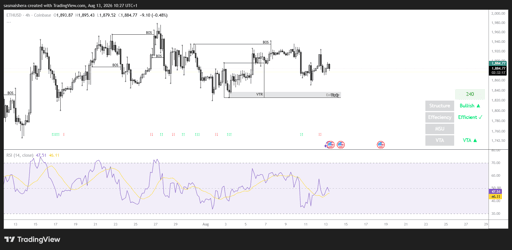
If buyers clear that barrier, the next major upside targets are located around $2,172 and $2,431.
On the downside, the 20-day and 50-day EMAs provide immediate support. A break below those moving averages could send ETH toward $1,809, followed by $1,701.
In the event of a deeper market correction, additional support may emerge near $1,507 and $1,415.

XRP dips to $1.32 despite 11-day spot ETF inflow streak

How high can PI price go as Protocol 27 upgrade nears?

Bitcoin’s $82,000 test is coming as one major market signal turns bullish

Ethereum slips toward $2,400: key ETH levels to watch if support breaks

Can ARB price reach $0.14 after 30% rally powered by Robinhood chain?
No results found
Loading articles...
Failed to load articles. Please try again.