
Nvidia H200 chips approved for China, but Beijing limits mainland use: report
AI Sentiment: 58/100 Bullish
This score is generated through AI-driven analysis of the article's content.

powered by

Buy NVDA. Beijing is allowing H200 shipments (small batches now, potentially more as “control loosens up gradually”), and Nvidia has ~500,000 H200 chips stuck in inventory that partners can restart selling into China via approvals. This turns export-control overhang into near-term revenue visibility, even if advanced Blackwell-class parts remain blocked.
Key Risk: China tightens the mainland-use limits again or approvals stall, leaving Nvidia’s H200 inventory unsold.
Buy Lenovo (and similar China server integrators). The news says partners can resume orders for products containing H200, but each order needs NDRC-style approval—so demand is real yet bottlenecked. As approvals normalize, integrators should see a step-up in server shipments and service attach (deployment, maintenance), not just chip sales.
Key Risk: Regulators stop granting approvals for H200-based server orders, so integrators can’t convert chip access into revenue.
- ByteDance and Tencent have reportedly received about 10,000 Nvidia H200 chips.
- Beijing wants most of those chips to remain outside mainland China.
- Chinese AI firms still rely heavily on Nvidia chips for training.
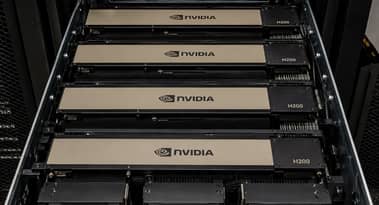
Small batches of Nvidia's H200 artificial intelligence chips have been allowed into mainland China as Beijing attempts to balance support for its leading AI companies with its push to build a domestic semiconductor industry, the Financial Times reported.
ByteDance and Tencent have each received roughly 10,000 H200 processors in recent weeks, while several other Chinese technology companies could receive approval for shipments of a similar size, according to people familiar with the matter cited by the newspaper.
The developments highlight the complicated position Nvidia occupies in China.
Beijing wants its technology companies to have enough computing power to compete with US AI developers, but it also wants to reduce the country's dependence on foreign semiconductor technology.
The H200 is already at least two generations behind Nvidia's most advanced processors, which remain unavailable to Chinese customers because of US export restrictions.
Beijing seeks to limit mainland use
Chinese technology groups have received US approval to purchase as many as 100,000 H200 processors each.
However, Beijing wants most of those chips to remain outside mainland China, according to the Financial Times report.
Chinese regulators have also told companies they can ship H200 processors to Hong Kong and use them there.
The US licences cover shipments of H200 chips to both mainland China and Hong Kong, giving Chinese companies an additional route to access Nvidia's technology.
But Hong Kong presents its own infrastructure challenge.
The territory does not have enough data-center capacity to accommodate the large volumes of chips that Chinese technology companies could potentially receive.
Power supply constraints are also expected to limit how quickly that capacity can expand.
“It’s a dilemma. Everyone needs the chips but struggles to find a way to use them in Hong Kong,” said a person familiar with the situation.
“The hope is for the control to loosen up gradually.”
Nvidia has chips waiting for Chinese customers
The restrictions have also left Nvidia with a substantial inventory of H200 processors intended largely for Chinese customers.
The company has about 500,000 H200 chips in stock, mainly for the Chinese market, according to people familiar with the situation cited by the Financial Times.
Sales of the processors had been held up by Beijing's restrictions.
Some Nvidia partners are now preparing to resume sales.
Lenovo and other partners told Chinese customers last week that they could begin placing orders for products containing H200 chips, according to one person cited in the report.
The partners integrate Nvidia processors with CPUs, networking equipment and other components to create AI servers.
However, orders would still require individual approval through an application process overseen by China's National Development and Reform Commission, according to a person with direct knowledge of the matter, said FT.
Domestic chipmakers remain Beijing's priority
China's continued restrictions on Nvidia hardware reflect Beijing's broader effort to strengthen domestic semiconductor companies, particularly Huawei.
Huawei and other Chinese chipmakers are seeking to capture a larger share of the country's semiconductor market as Nvidia faces increasingly tight restrictions on sales of its most advanced processors.
But China's domestic industry still faces technological constraints.
The country lacks access to some of the most advanced chipmaking equipment, limiting its ability to rapidly increase production of cutting-edge processors.
That means Nvidia chips are likely to remain necessary for parts of China's AI industry, particularly for training advanced models.
Chinese AI developers are increasingly using domestic chips for inference, the stage in which AI models generate responses to users.
Nvidia processors remain more widely used for training, which requires significantly greater computing power to build models and identify patterns.
AI race keeps pressure on Beijing
Chinese regulators have recently begun easing some restrictions on US chips as they seek to ensure that leading domestic AI developers have sufficient computing resources to train increasingly sophisticated models.
Chinese companies are attempting to narrow the gap with leading US AI developers.
Moonshot released its K3 model last month, with performance reportedly approaching that of the most advanced US systems.
Alibaba, DeepSeek and Z.ai subsequently released models with comparable levels of capability, suggesting that Chinese developers are making rapid progress.
The limited H200 shipments therefore represent a compromise for Beijing.
China needs access to Nvidia's processors to maintain momentum in the AI race, particularly for training, but it also wants to prevent US chips from undermining its long-term effort to establish a self-sufficient semiconductor ecosystem.
For Nvidia, the developments offer a potential outlet for hundreds of thousands of processors already allocated to Chinese customers.
But the company remains caught between Washington's export controls and Beijing's efforts to steer demand toward domestic chipmakers.
Micron stock: Could doubling HBM capacity create an oversupply headwind?

Jensen Huang sees AGI arriving with OpenAI's Astra: 3 stocks investors should watch

MiniMax jumps 6%, Baidu gains 5%: why OpenAI’s Astra is fuelling China’s AI surge

Why SpaceX stock is rocketing over 5% on Thursday
Nvidia stock wobbly after Hugging Face deal, but analysts see over 30% upside ahead
No results found
Loading articles...
Failed to load articles. Please try again.