
Kioxia share price on edge as it plans a $10 billion ADR US listing
AI Sentiment: 35/100 Bearish
This score is generated through AI-driven analysis of the article's content.

powered by

Buy Kioxia. The company is raising up to $10B via a US ADR listing to expand and improve liquidity, while fundamentals are still strong (revenue/profit surge tied to AI data-center storage demand). The stock is also technically washed out—below the 50-day EMA and in a bearish triangle—so the risk/reward favors a rebound if the listing narrative gains traction.
Key Risk: US listing execution disappoints (pricing/size/timing) and triggers a sharp de-rating before fundamentals reassert.
Buy SK Hynix. Kioxia’s US ADR is a second foreign-memory name, which typically pulls more global index/ETF attention into the whole memory complex. SK Hynix is the HBM leader and should benefit from any broad “AI memory” inflow, especially after its earlier ADR volatility stabilized.
Key Risk: HBM demand or pricing weakens faster than expected, crushing the “AI memory inflow” trade.
- Kioxia Holdings stock has remained inside a narrow range this week.
- The company is planning to raise $10 billion in an ADR listing in the US.
- It joins SK Hynix, which debuted in the US in July this year.
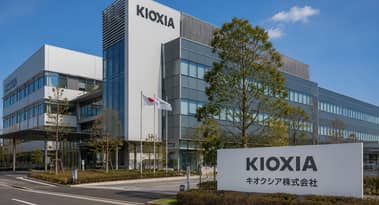
Kioxia share price remained under pressure on Tuesday as companies in the artificial intelligence (AI) industry slip. It was trading at ¥51,720, down modestly from last week’s high of ¥61,300. This stock will be in the spotlight as the company plans to follow in SK Hynix’s footsteps by launching a US listing.
Kioxia could raise $10 billion for expansion
Kioxia Holdings, the fourth biggest company in Japan, has been one of the top beneficiaries of the artificial intelligence boom. This boom has led to a surge in data center buildup, which has led to more demand for storage solutions as the amount of data rises.
Kioxia has benefited from this demand because of its strong presence in the industry, where it sells storage devices. Its top clients, including companies like Apple, Microsoft, and Google have all committed to keep spending.
Now, the company is plotting to raise $10 billion by listing its shares in the United States. To do that, it is working with companies like Bank of America, Goldman Sachs, and JPMorgan on an offering that may happen next year.
The firm plans to use the funds to build its balance sheet and gain liquidity in the United States. One way that this listing will help it is by letting it be listed in key semiconductor indices. The company told Bloomberg:
“Kioxoa is preparing to list American Depositary Shares representing its common shares on a US stock exchange to steadily and sustainably increase corporate value.”
Kioxia will become the second big foreign name to list in the United States. SK Hynix, the biggest company in the high bandwidth memory (HBM) industry, raised $26.5 billion in a listing in July. Its US stock initially dropped to $124.6 and then bounced back to nearly $200 last week.
Kioxia’s business is thriving
Kioxia Holdings’ business is doing well as demand for its memory devices continues to grow. Its most recent results showed that its revenue soared to over ¥1.76 trillion from ¥1 trillion in the first quarter of the year. Most of this revenue came from its SSD and storage business, which made ¥1.17 trillion, while its smart devices made over ¥525 billion.
As a result, the company’s profit jumped to ¥842 billion. This growth mirrored that of other top companies in the memory industry, including SanDisk, which it has a joint venture with. As a result, the company has started to repurchase its shares. It announced a 30 million share buyback, which is equivalent to 5.47% of its outstanding shares.
Kioxia stock price technical analysis
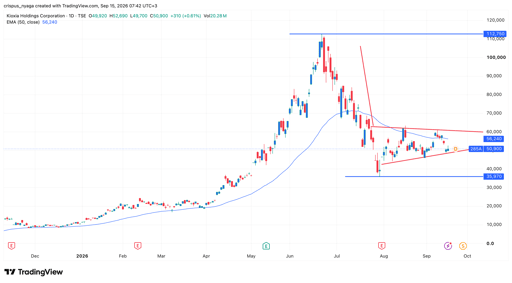
The daily chart shows that the Kioxia stock has retreated substantially in the past few months. It slumped from a high of ¥112,750 in June to the current ¥51,350.
The stock has slumped below the 50-day Exponential Moving Average (EMA). Also, it has formed a symmetrical triangle whose two lines are now nearing their confluence. This triangle formed after the stock made a big drop, a sign that it is part of a bearish pennant pattern.
Therefore, the stock will likely remain under pressure, with the next key target to watch being at ¥35,970, its lowest level on July 30. A move above the upper side of the triangle will invalidate the bearish outlook.

KOSPI vs Nikkei: Asia’s AI trade fractures ahead of Fed and BOJ decisions

Why calls to slow AI may actually be good news for ServiceNow stock

Samsung and SK Hynix defy a 6% US chip rout: what is Korea seeing differently

HPE stock declines 8% on Monday: here's why

Netflix stock rises as Evercore raises price target to $110
No results found
Loading articles...
Failed to load articles. Please try again.