
Dubai Property: Has The Bull Started To Run Again?

- Dubai's property market plummeted in 2008, with villa prices down 19% and apartment prices down 30%.
- Property prices fell by two-thirds, severely impacting developers and banks.
- From 2008 to 2012, Dubai and Abu Dhabi stock markets lost $102 billion, with $59 billion in Dubai.
When the boom was lowered on the super-heated Dubai property market in the second half of 2008, it came down hard and fast.
By November of that year, Reuters was reporting that villa prices in October had fallen by 19 percent on the previous month, with apartments in the Dubai International Financial Centre, heart of the banking and investment sector, plunging by as much as 30 percent month on month.
By the time the dust had cleared, overall Dubai property prices were down by two-thirds on pre-crisis levels.
Property development companies across the city and elsewhere in the United Arab Emirates had the rug pulled from under already-committed bank finance as the banks themselves found their liquidity suddenly under threat. And the publicly-traded UAE developers – and there were many – were quickly gouged as rattled stock markets took flight.
There has since been some recovery but in the words of the IMF, in its latest look at the UAE (published in June this year):
Valuations in the Abu Dhabi and Dubai equity markets have not recovered since September 2008, notwithstanding some improvement in 2009. The combined market capitalization losses in the Abu Dhabi and Dubai stock exchanges were $102 billion between September 1, 2008 and March 31, 2012, of which the capitalization loss in the Dubai stock exchange was $59 billion.
The very great bulk of those stock market losses were Dubai property related. Of course, not just residential – Dubai had for a number of years prior to 2008 gone hell for leather in establishing itself as pretender for the fourth capital of the global economy, after New York, London and Tokyo, with no expense spared in the race to build a vast array of commercial buildings and attendant infrastructure.
The pace was spectacular and the energy released in the process of converting the city-state from oil-soaked desert backwater to global financial hub attracted foreign white- and blue-collared workers in their hundreds of thousands.
But by late 2008 all of the UAE’s property development companies knew they were in serious trouble.
According to the Reuters story, the share price of Emaar Properties, the region's largest property developer by market value at the time, fell 5.6 percent early in November to mark a staggering drop of over 80 percent for the year while another major developer, Union Properties, fell 6.7 percent in a single day, some 78 percent off its price at the beginning of the year.
Mass Exodus of White and Blue Collars – Minus Motors
As property development went into a sudden and largely unanticipated freefall, many of those thousands of ex-patriate workers left Dubai and other parts of the UAE – some of their own accord but many others with a less than ceremonious shove from a less than grateful UAE government.
Yet the real estate constructed to that point of course remains, with much of the newly-built residential and office accommodation destined to be lying empty four years later.
The question then is whether Dubai can once again present attractively to investment in residential real estate. Back in 2008, according to the Reuters piece from November that year, until the bubble burst it’d been a seller’s market.
Marketers of upmarket gated villa communities out on the edge of the desert or lavish multi-storied apartment blocks closer to downtown could barely keep up with the off-plan purchase demand, with buyers queuing up to lay their money down for a slice of the Dubai property boom.
Most, it must be noted, being foreign. Indeed, in a city of some two million, until the collapse of the construction boom in 2008 less than 20 percent of Dubai’s population – as few as 15 percent by some estimates – were Emirati citizens.
The vast bulk of the population comprised ex-patriate workers from Asia, primarily unskilled or semi-skilled construction labourers and primarily from India and Pakistan, with smaller numbers from Bangladesh, The Philippines and Sri Lanka.
Additionally of course, there were the tens of thousands of white-collar – and mostly European and North American – professionals in accountancy, law, the TMT sector, engineering and other disciplines supporting the UAE’s booming oil, construction and tourism industries, incentivised to bear up to the region’s debilitating temperatures, and the strictures of Sharia law, by the very high incomes and low-to-zero taxes on offer.
And, since 2002, by the real estate law promulgated across the Emirates which removed all restrictions on foreigners buying property.
For free-wheeling Dubai – and to a lesser extent its more conservative neighbour Abu Dhabi down the coast – domestic oil-money melded with huge globs of inbound hard currencies to generate one of the biggest property churns in history, certainly the history of this hot and dusty part of the world which till barely 40 years earlier had been an economic backwater.
But the Dubai property market crashed, as we all know, and a great many white-collar ex-pats departed, abandoning in their wake – if the stories are to be believed – large numbers of near-new, and heavily hypothecated, luxury automobiles in the carparks of Dubai International Airport.
A phenomenon, according to a piece in The Telegraph of 10 September, which continued for a number of years, with some 3,000 vehicles being abandoned in 2011.
You Can’t Keep A Good Emirate Down
So going back to the question posed earlier: given the notoriety attaching to the UAE’s – and Dubai’s particularly – fall from grace since 2008, is there any reason to suppose that the times, they are a-changin’? It seems there is. In a report on 1 August this year, the Financial Times said oversupply still hangs over Dubai’s housing market, with half-empty buildings punctuating the skyline. But recent earnings results and the latest house price data show a steadily improving picture.
The earnings in question were for listed property development companies which had either survived or been reconstructed from the train-wreck of 2008-09.
Notably, Nakheel, the state-owned company which severely frightened international financial markets by nearly defaulting on its enormous debt in 2009, only to be rescued in the nick of time by neighbouring emirate Abu Dhabi, reported a 36 per cent increase in net profit in H1 of 2012.
Other stories in a similar vein are appearing in the business and financial media heading into the UAE’s winter – and prime tourist season, as the blistering heat of the Arabian summer moderates to more summer-like conditions for pretty much everyone else. Writing in an ex-pat blog for The Telegraph on 10 September, journo and long-time Dubai resident Annabel Kantaria opens her piece with this piece of whimsy –
Albeit, counsels Kantaria, back to a different Dubai than the frenetically flashy city of the early 21st Century. It seems a more subdued, less frothy version is taking shape.
And it needs to be asked, why are they going back? If, as the IMF concludes, the UAE economy remains exposed to external shocks emanating from the European Union, or the United States for the matter, what sort of recovery is going on which would see renewed demand for skilled foreign workers from the UK and other ‘western’ countries, quite apart from construction workers from East Asia?
It’s All About The Money
The short answer appears to be, not to put too fine a point on it, a money recovery. It may be that the Dubai Stock Exchange shed billions in market capitalisation from late 2008, but the fact is that it had billions to shed, and many more billions which have remained intact, much of it solidly invested around the world.
The UAE’s oil supply – the world’s fifth largest – has continued unabated and oil prices, though volatile, have remained at levels which produce very abundant returns across the OPEC cartel, the UAE included.
And as the demand for Emirati oil has continued unabated so, apparently, has interest in its second largest hard currency earner, contributing over 30 percent of 2011’s GDP - tourism. According to website emirates247.com, the Dubai Department of Tourism and Commerce Marketing reported in early April this year that in January the city topped the world in terms of hotel occupancy levels and average revenue per available room (RevPAR). New resort projects which went on hold post-2008 are being revived, not least the building of a replica – and over-sized – Taj Mahal.
As well as gathering in more than its fair share of the world’s tourism market, Dubai has thrown its arms wide open to value added industries across the IT and TMT sectors, creating business zones modelled on the successful DIFC – Dubai International Financial Centre - and which offer virtually untrammelled – and untaxed – operations for multinational corporations choosing to set up shop there. Many are so choosing.
Money, as the old adage has it, attracts money and nowhere is that truism more evident than in the UAE, and Dubai in particular. As 2011’s ‘Arab Spring’ roiled around the Middle East, the Emirates remained stable and secure – the proverbial safe haven, with Dubai and Dubai property in particular attracting huge amounts of the capital fleeing from the turbulence elsewhere in the region.
And from other parts of the world also, with India being a prime example. With its already strong historical representation in Dubai, the world’s second largest country has invested deeply in the city’s economy. In July this year, the India Times reported that Indians had bought up to 150 of the 900 apartments in Burj Khalifa, the world’s tallest building, and that its citizens had become the largest group buying Dubai property generally. Followed, according to emirates247.com, by Iranian and British buyers, with actual Emirati citizens coming in fourth.
Are They Really Coming?
But is all this positive energy enough to attract back the highly paid ex-pats who left Dubai in the wake of the 2008 meltdown – and attract others of their ilk – so reviving and then underpinning a market for residential property investment? If local observers like Annabel Kantaria are to be given due credit, the answer seems to be yes.
And the Dubai government is taking measures to hasten the process. The Financial Times reported at the beginning of this month that the emirate is extending from six months to two years the length of the residence visa stapled to a property purchase.
A nice and potentially very useful bonus in a Dubai property investment. Doubtless part of the motivation is to counteract the move taken earlier in the year by neighbouring – and investment-wise competing – emirate Abu Dhabi to link entitlement to work in that city, the UAE’s capital, with proof of actual residence there. The Financial Times cited government statistics suggesting that some 23,000 ex-pat professionals may need to relocate from Dubai to Abu Dhabi to comply with the edict.
So to wrap up this overview, Dubai has been through some turbulent times since 2008 but whichever way you cut it, the emirate is no Greece, or Spain, or UK for that matter. Austerity has entered the local vocabulary but it’s of a different order. It’s downgrading from Hermes to Louie Vuitton, from a Maybach to an S-Class Merc. Quite a fall but you still land gently in the lap of luxury. With austerity like that, who needs excess?
A Flutter On A Villa?
Coming back down to earth, where most of us live, let’s take a quick look at the Dubai property market. We’ve used as our source the real estate portal propertyfinder.ae, which from outside observation, and usage, seems to justify its claim to be the leading property listing website in the Emirates. At time of writing, in mid-October 2012, there were nearly 15,400 apartments and 5,700 villas listed for sale in Dubai, a mix of new-build and resale and most within dedicated residential complexes of greater or lesser degrees of luxury.
Narrowing it down a little, there were 4,373 two-bedroom apartments, of all sizes, and a much smaller number of three-bedroom villas – some 250-odd – when the latter were filtered into a range of up to 2,600 sq ft (roughly 240 sqm).
According to the handy data produced with every search, the portal showed an average asking price for those apartments of £374,000, while the villas averaged £448,000.Turning to rental property, the portal produced an average rent for a two-bedroom apartment in Dubai, with a fitted kitchen but otherwise unfurnished, of £1,950 per month. For a three-bedroom villa, the average rent was shown as £2,650/month.
From which we can deduce a gross yield for apartments of 6.26% and for villas slightly better at 7.1%. Put another way, using these data, Dubai apartments have a price-rent (again, gross) ratio of just under 16 and villas of 14.
Requisite Cautionary Note
Of course, such broad-brush calculations on the Dubai property market need to be taken with a degree – several actually – of circumspection. As with all property markets, there can be a very significant shift in value between top and bottom end, and from one part of a city to another. We can and should take it that Dubai property is no different in this respect, except for one factor - the high level of homogeneity in its residential property, or at least that part of it likely to be of interest both to white collar renters and offshore investors.
Virtually all of Dubai’s residential property offerings in this range are, if not new, of very recent vintage, unlike a London or a New York, for example, where residential real estate built half a century or more ago competes for buyer attention with property built in the past five years.
As with property investment anywhere, there’s no substitute for getting down and dirty – or in Dubai’s case, sandy - and seeing for oneself exactly what is there. But these basic calculations from a distance represent a promising start to the process. Price-rent ratios of under 20 ordinarily justify further investigation of the relevant market.
Global doom and gloom notwithstanding, it’s hard not to see a realistic prospect of a rebound in Dubai’s property market in the short term. There’s simply too much money salted away – and making new money - in the emirate to think otherwise. Perhaps it will be rather longer before the pre-2008 heights are again scaled but this is largely academic to a first-time Dubai property investor looking to enter the market now.
Having said that, Dubai’s recent history of boom to bust in residential property plainly needs to be kept in mind by a prospective new investor in that market. What goes around can of course come around – especially where there’s lots of money looking for a home.
And indeed, it can’t totally be discounted that in Dubai – unlike in post-bubble America for example, where housing price recovery is proving to be painfully slow – a re-inflation of the bubble is under way. Just last week, on 18 October, Abu Dhabi-based newspaper The National ran a story under the banner “Investors 'flipping' Dubai properties a worrying sign, brokers warn”.
The worry in question is that short memories and fresh money are combining to reheat a market unused to spending any length of time in the cold. According to data compiled by The National, Dubai villa prices are up 22.9 percent year on year, with apartment prices lagging with a ‘modest’ 5.7 percent gain.
And separately, the paper reported that Nakheel, the now state-controlled Dubai property developer behind the mammoth Palm Jumeirah man-made island residential resort and which nearly went bust in 2009, has racked up profits of AED1.1 billion (£186.8 million) for the first nine months of 2012, an increase of 126 percent on the same period in 2011.
In August, the company reported the sale of a 28,400 sqm (305,700 sq ft) plot on the ‘trunk’ of Palm Jameirah to a ‘local developer’ for AED400 million (£67.8 million) – that’s over £220 for a square foot of what not so long ago was the shallow waters of the Persian Gulf – and in its latest profit announcement says that prices out on the ‘fronds’ have "crossed pre-crisis levels".
Conclusion
The conclusion? It seems that once again there is liquidity to spare in the Dubai’s property market, making it definitely worth a look. But long-distance buys – especially off-plan – should be eschewed in favour of an in-country visit and selection.
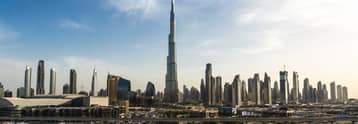
Dubai strikes back: premium real estate is already rebounding, Ali Sajwani reveals

Is China's economic resilience masking a real estate collapse?
Persimmon share price at risk as key challenges converge

US home loan demand rises 1.8% as mortgage rates ease

Interview: Dubai realty set for 30% dip if war escalates, says ANAROCK's Thakur
No results found
Loading articles...
Failed to load articles. Please try again.