
Uniswap price forecast: Standard Chartered sets $100 target, but there is a caveat

AI Sentiment: 72/100 Bullish
This score is generated through AI-driven analysis of the article's content.

powered by

Buy UNI. The catalyst is Standard Chartered’s $100/2030 path tied to tokenised RWAs flowing into DeFi venues; UNI already broke above the 7D ($2.626) and 30D ($2.945) SMAs and is testing $3.10. This is a momentum + narrative setup: if UNI holds above the $2.97 pivot, it can run toward $3.10 and potentially extend higher as volume stays elevated.
Key Risk: Tokenised RWAs grow, but trading liquidity fragments across chains/DEXs so UNI doesn’t capture meaningful volume and protocol revenue—UNI’s “venue” advantage never materializes.
Sell UNI (or buy a UNI put) for a quick pullback. RSI14 is above 78 (overbought), and price is near the $2.97 pivot with a clear downside magnet at $2.75 if it can’t hold. This trade monetizes profit-taking after the news-driven spike rather than betting on the long-term $100 story.
Key Risk: UNI sustains bids and breaks above $3.10, turning the overbought reading into a trend continuation instead of a reversal.
- UNI jumps 13.8% on Standard Chartered's bullish forecast.
- The bank sees tokenized assets reaching $4 trillion by 2028.
- UNI must clear $3.10 resistance to confirm a bullish breakout.
Uniswap UNI token has returned to the spotlight after Standard Chartered initiated coverage of the decentralised exchange token with a long-term price target of $100 by 2030.
The bank’s forecast immediately grabbed the market's attention, helping UNI surge 13.8% in 24 hours to $2.99 and outperform the broader cryptocurrency market.
The move was accompanied by a sharp increase in trading activity, with the daily trading volume climbing to more than $404 million, while UNI briefly touched $3.01 before pulling back slightly.
Why Standard Chartered sees major upside for UNI token
The Standard Chartered forecast was issued by Geoffrey Kendrick, Head of Digital Assets Research at the bank.
His thesis centers on the rapid expansion of tokenised real-world assets (RWAs) and the growing role of decentralised finance in global capital markets.
According to the bank's estimates, tokenised assets could grow from approximately $340 billion today to around $4 trillion by 2028.
That figure includes stablecoins as well as tokenised versions of traditional financial products such as government bonds, money market funds, equities, and real estate.
The bank also expects the share of those assets actively used within decentralised finance applications to rise significantly.
Current estimates place DeFi participation at roughly 3.5% of tokenised assets, but Standard Chartered projects that figure could reach 30% by 2030.
If that scenario plays out, assets actively deployed across DeFi platforms could approach $2.7 trillion by the end of the decade.
That would represent a 37-fold increase from current levels.
For Uniswap, the implication is straightforward. As one of the largest decentralized exchanges in the market, the protocol could become a key venue where tokenized assets are traded, creating higher liquidity, larger trading volumes, and stronger protocol revenues.
The bank's forecast outlines a gradual appreciation rather than an immediate jump.
Its projected path places UNI at $6.50 in 2026, $20 in 2027, $40 in 2028, $65 in 2029, and eventually $100 by 2030.
The caveat that investors should not ignore
The biggest challenge for the $100 forecast is that it depends heavily on future adoption rather than current fundamentals.
Standard Chartered's thesis is built around the assumption that traditional finance will increasingly migrate on-chain over the next several years.
While tokenisation has gained momentum, there is no guarantee that institutions will adopt decentralised finance at the pace the bank expects.
Another factor is liquidity fragmentation. Tokenised assets can be issued across multiple blockchains and use different standards, which may spread trading activity across various platforms instead of concentrating it on a single protocol.
There is also a significant difference between tokenising assets and creating active markets for those assets.
A bond or equity can exist on a blockchain without generating meaningful trading volume.
For Uniswap to benefit fully from the projected growth in tokenisation, those assets must also attract sustained trading activity.
This is the key caveat in the bullish narrative.
The forecast assumes not only that tokenised assets will grow into a multi-trillion-dollar market, but also that a meaningful share of that activity will flow through decentralised exchanges such as Uniswap.
Uniswap price analysis
As the Uniswap price rose, it broke above its 7-day simple moving average (SMA) of $2.626 and its 30-day simple moving average (SMA) of $2.945.
These technical breakouts helped reinforce the bullish momentum generated by the Standard Chartered report.
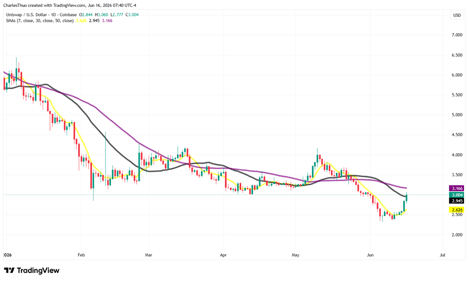
However, momentum indicators suggest that the market may be getting ahead of itself in the short term.
UNI's RSI 14 has climbed above 78, pushing the token into overbought territory.
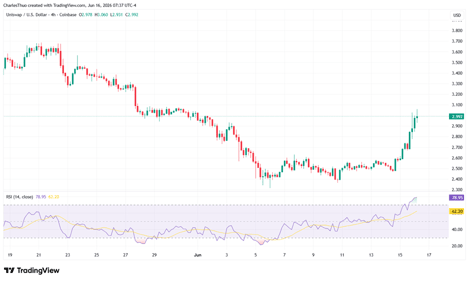
Historically, RSI readings above 70 often signal strong buying pressure, but they can also indicate that a period of consolidation or profit-taking is becoming more likely.
In the near term, traders should focus on the immediate pivot level near $2.97.
Holding above $2.97 could allow the token to challenge resistance around $3.10, where a major descending trendline currently intersects with price action.
Further, a successful break above $3.10 would strengthen the case for a broader trend reversal after months of weakness.
On the other hand, failure to hold current levels could open the door for a retracement toward the $2.75 support zone.

Crypto price predictions: Dogecoin, XRP, Venice Token (VVV)

Zcash price prediction: Here’s why ZEC token has gone parabolic

ARB price prediction: How Robinhood Chain growth is boosting Arbitrum

Why is Bitcoin price struggling around $80,000?

Zcash price breaks above $1,000 as institutional and privacy demand rise
No results found
Loading articles...
Failed to load articles. Please try again.