
Brent and WTI crude oil prices target $100 as analysts warn of a forever war

AI Sentiment: 82/100 Bullish
This score is generated through AI-driven analysis of the article's content.

powered by

Buy UKOIL (Brent) outright. The article points to a “forever war” risk, depleted spare inventories (~400m bbl down to near nothing), and weakening supply buffers (Hormuz traffic collapsing). Price action confirms upside momentum: breakout above $83.25, above the bullish pennant, and above the 50-day EMA—setting up a clean path toward $100.
Key Risk: A sudden de-escalation that restores spare supply (Iran backs off and Hormuz traffic normalizes), collapsing the inventory-and-shipping fear premium.
Buy USOIL (WTI) for the same macro shock, but with tighter linkage to US inventory draws. The EIA shows inventories falling and the market is already pricing escalation with no easy off-ramp (MoU failed). Technicals show strong recovery and momentum, making WTI likely to keep catching up as physical tightness worsens.
Key Risk: US inventories stop falling fast (or imports surge) and WTI decouples downward from Brent as the market realizes the supply shock is smaller than feared.
- Crude oil prices jumped to the highest point since June 12.
- The surge happened as the US-Iran war escalated.
- Technical analysis suggests that prices will continue rising.
Crude oil prices continued rising on Hyperliquid as investors reacted to the ongoing escalation between the US and Iran. Brent jumped to $88.7, with its 24-hour volume soaring to $59 million. West Texas Intermediate (WTI), the US benchmark, rose to $83.62, with the volume rising to $111.2 million.
Crude oil prices jump on US-Iran war escalation
Brent and WTI prices continued their recovery this weekend as the US-Iran war escalated. The US launched the eighth round of attacks against key Iranian assets, with officials hinting that more attacks will be likely. According to Axios, the US has sent more air refueling planes to Israel in preparation for more attacks.
The current phase of attacks seems to be more severe, with the US focusing on key civilian infrastructure projects like roads and bridges. Iran, on the other hand, has warned that it would no longer abide to the terms of the agreement made with the US.
It has also warned its Gulf neighbors of more sustained attacks in the coming weeks. It attacked a key desalination plant in Kuwait during the weekend, with officials warning that airports and other essential infrastructure projects will be hit. As a result, there are concerns that this is turning into a forever war.
US oil inventories have plunged
All this is happening at a time when analysts are warning that the buffers that prevented a more dramatic surge in oil prices in the first phase of the war were no longer there. A recent FT report cited Energy Aspect’s Amrita Sen, who warned that the roughly 400 million barrels of excess inventories at the start of the war have largely been depleted. She said:
“Now we have close to nothing. complacency around Hormuz flows is being severely tested.”
Recent data from the US shows that oil inventories have continued falling. A report by the Energy Information Administration (EIA) showed that inventories fell by 1.7 million barrels in the previous week.
At the same time, ship tracking data shows that traffic through the Strait of Hormuz has continued to dwindle this month. Just ten ships were sailing through the Strait in the last 24 hours, with 444 of them waiting.
The worst part about all this is that there is no easy way out for the current phase of the war since the memorandum of understanding (MoU) signed three weeks ago has failed.
Iran will not have an incentive to restart talks with the US as the country has attacked it at least three times during negotiations. It did that in June last year, February, and now during the MoU.
Iran will also have the incentive to prolong the war, and possibly close the Red Sea, a move that will dramatically reduce the amount of oil coming to the market. It has also warned that it will target Fujairah, another location where oil is still flowing to the market.
Crude oil price technical analysis
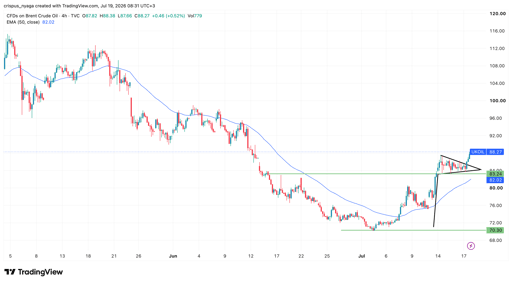
Brent crude oil price chart | Source: TradingView
The four-hour chart shows that Brent crude oil price jumped to its highest level since June 12. It has soared by over 25% from its lowest level in June.
Most notably, it has moved above the bullish pennant pattern, which is made up of a vertical line and a symmetrical triangle. It also moved above the key resistance at $83.25, its highest point on June 17.
Oil has also formed a cup-and-handle pattern and moved above the 50-day Exponential Moving Average (EMA). Therefore, the price will likely continue soaring, potentially to the key resistance level of $100.

Is it a golden opportunity to buy ServiceNow stock as a rare pattern nears?

Adobe stock analysis: Golden cross pattern takes shape ahead of earnings

Rubrik stock drops as gross margin slips: Is the selloff a buying opportunity?

Figma stock just crossed a crucial price: is the bull run starting?
IREN stock falls as the Nvidia-backed neocloud company hits a key milestone
No results found
Loading articles...
Failed to load articles. Please try again.