
Pi Network price forecast: Will Protocol v25 boost overcome token unlock pressure?

AI Sentiment: 35/100 Bearish
This score is generated through AI-driven analysis of the article's content.

powered by

Buy PI only on a daily close above $0.10, targeting $0.12 then $0.135. Protocol v25 is a real network upgrade (privacy/ZK tooling + developer readiness), and momentum indicators are improving (CMF positive, Aroon Up stronger). The trade is about forcing a regime change: sustained acceptance above the psychological $0.10 wall.
Key Risk: Unlocks keep hitting and price fails to hold above $0.10, turning the breakout into a sell-the-news fade.
Sell/short PI on a rejection wick at $0.10–$0.102, targeting a move back toward $0.091 then $0.085. The article flags persistent unlock pressure over the next 30 days and lingering bearish MACD, so rallies into $0.10 are likely to be supply-driven. This is a tactical fade until PI proves it can absorb daily unlocks.
Key Risk: PI breaks and holds above $0.10, triggering momentum buyers and squeezing shorts/sellers.
- Protocol v25 improves Pi Network's privacy and developer features.
- PI coin must break $0.10 to strengthen its recovery.
- Token unlocks could limit further upside in the near term.
Pi Network has staged a notable recovery after falling to a fresh all-time low earlier this month, but the next phase of its price action may prove far more difficult.
At the time of writing, PI is trading at $0.09119, down 1.9% over the past 24 hours but still 10.7% higher over the last seven days.
The launch of Protocol v25 has given the Pi Network community a fresh catalyst, helping PI rebound from its recent lows.
Even so, persistent token unlocks, strong resistance at $0.10, and renewed security concerns continue to shape the outlook for the cryptocurrency.
Protocol v25 strengthens the network, but price still faces resistance
The release of Protocol v25 marks one of Pi Network's most important technical upgrades in recent months.
The update introduces improvements designed to enhance network stability, strengthen privacy, and improve the platform's readiness for developers building decentralised applications.
Among the most significant additions are support for BN254 cryptography and Poseidon hashing, two technologies commonly associated with privacy-preserving applications and zero-knowledge proof systems.
The update also includes improvements aimed at making the ecosystem more efficient as the network continues to mature.
🚨 Pi Protocol v25 is LIVE - July 22
— open mainnet (@openmainnet) July 21, 2026
The biggest upgrade of 2026 just dropped:
✅ Network stability + speed improvements
✅ Privacy-preserving smart contracts
✅ Foundation for Pi DEX + open source dev
Price is down today, but the tech is building.
This is how we get to…
While the upgrade has generated renewed optimism within the Pi community, the market has yet to deliver a decisive bullish confirmation.
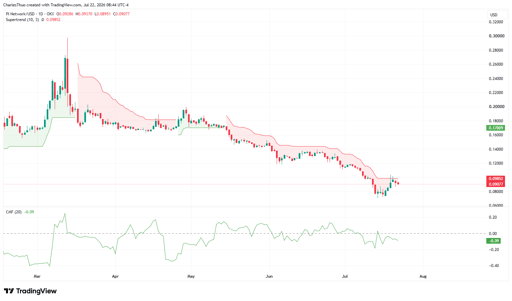
PI recently recovered nearly 30% from its all-time low of $0.07059, recorded on July 14, 2026.
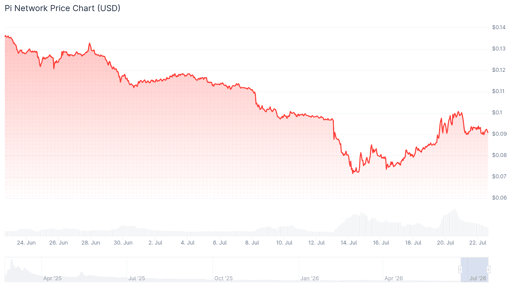
However, the rebound has slowed as the token approaches the psychologically important $0.10 level.
That price has become a key technical barrier. Previous recovery attempts have struggled to establish sustained trading above it, making it an important level to watch in the coming sessions.
A successful move beyond $0.10 could expose the next resistance around $0.12, while additional resistance sits near $0.135 and $0.15.
Token unlocks remain a major challenge
Although Protocol v25 has improved the project's technical foundation, supply dynamics remain one of the biggest obstacles to a stronger recovery.
Over the next 30 days, approximately 127.5 million PI tokens are scheduled to be unlocked, averaging about 4.25 million PI per day.
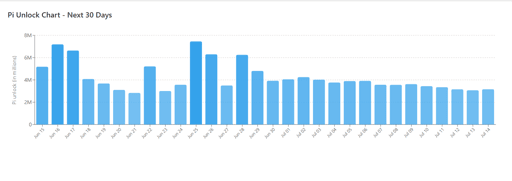
Every unlock increases the amount of PI that holders can sell, creating additional pressure on the market.
For buyers to absorb that additional supply, demand needs to remain consistently strong. Otherwise, each wave of newly unlocked tokens has the potential to slow or reverse upward price momentum.
This supply overhang helps explain why many traders remain cautious despite the recent rebound from the July lows.
Technical indicators show improving momentum
Several technical indicators suggest that bearish pressure has eased compared with earlier this month, although they do not yet point to a confirmed breakout.
The Relative Strength Index (RSI) has moved back toward neutral territory after previously approaching oversold conditions.
That indicates selling pressure has moderated, but it does not yet signal a strong bullish trend.
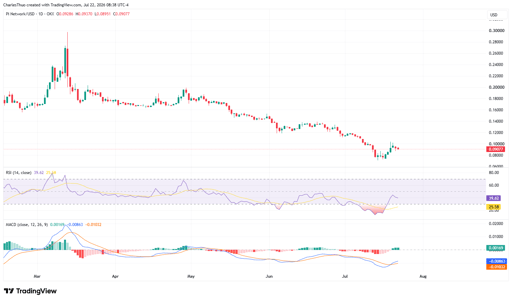
The Moving Average Convergence Divergence (MACD), however, continues to reflect lingering bearish momentum, suggesting that buyers still need stronger follow-through before sentiment can shift decisively.
Other indicators paint a more constructive picture.
The Aroon Up indicator has strengthened while Aroon Down has weakened, a sign that buyers have regained some control after the recent decline.
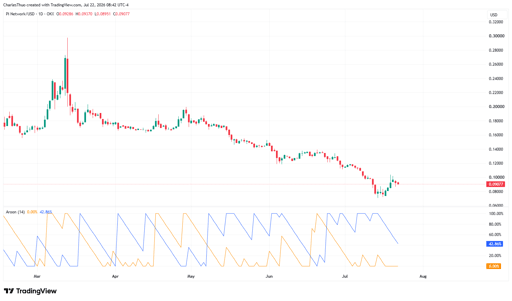
Meanwhile, while the Supertrend indicator is yet to turn bullish, the Chaikin Money Flow (CMF) has moved into positive territory, pointing to improving capital inflows.
The Average Directional Index (ADX) also remains elevated, indicating that the current market trend is relatively strong, even if its long-term direction has yet to be fully established.
Taken together, these indicators suggest momentum has improved, but the market still needs confirmation through a sustained move above resistance.
Security concerns add another layer of uncertainty
Away from price action, Pi Network users are also paying close attention to wallet security after reports emerged from the community involving missing balances following token migration.
One Pioneer claimed that after a three-year lockup period ended, an attempted migration of 143 PI resulted in a wallet showing a zero balance alongside multiple failed transactions.
🚨 Strange scam activity reported involving a Pi Wallet.
— Rizo (@RizoWeb3) July 19, 2026
A user's 3-year lockup period ended yesterday. When he went to migrate his 143 $PI, he discovered his wallet balance was 0 PI, along with an unlimited number of failed transactions.
It's time for Google Authenticator… pic.twitter.com/OWN4G0J2NV
The report has not been confirmed as a network-wide issue, and there is currently no public evidence linking the incident to a flaw in the protocol itself.
The case nevertheless renewed calls within the community for stronger wallet protection, including mandatory two-factor authentication.
Pi Network has repeatedly warned users to remain cautious of phishing attempts, unofficial wallet tools, and anyone requesting recovery phrases or private keys.
As interest in PI increases following Protocol v25, scammers may also become more active, making wallet security an important issue for users.

XRP price slips despite 10-day ETF inflow streak: is a breakout still coming?

Bitcoin price rises, but why is $80K proving so hard to break?

HYPE price near all-time high: could Hyperliquid's US entry spark $100?

Strategy (MSTR) stock gains after resuming Bitcoin purchases after 10 weeks

Ethereum price holds near $2,450 despite Fed pressure: Is $2,500 next?
No results found
Loading articles...
Failed to load articles. Please try again.