
Nikkei 225 Index on edge as foreigners buy, odds of BoJ rate hike jump

AI Sentiment: 35/100 Bearish
This score is generated through AI-driven analysis of the article's content.

powered by

Buy Mitsubishi UFJ (MUFG). The article says foreigners are rotating into Japanese stocks and also buying Japanese bonds, while BoJ hike odds are near-term high. A higher-rate path typically lifts bank net interest margins and improves earnings visibility for domestic lenders. MUFG also rose on the day, signaling relative strength versus exporters that get hit by a stronger yen.
Key Risk: BoJ delays or reverses the hike path, crushing rate-spread expectations and bank margin upside.
Sell Toyota (TM) / short via Toyota exposure. The yen is “parabolic” (USD/JPY down), which narrows the currency spread and hurts exporters’ translated profits. The article explicitly flags exporters like Toyota as negatively impacted by a stronger yen, while Kioxia and other exporters are already down.
Key Risk: The yen strengthens but global demand and pricing power offset the FX hit, so earnings hold up and the stock rebounds.
- The Nikkei 225 Index has remained inside a narrow range in the past few days.
- Crude oil prices jumped as geopolitical risks jumped.
- Polymarket traders are betting that the BoJ will hike interest rates.
The Nikkei 225 and Topix dropped a bit on Thursday as investors focused on the rising oil prices and Japan bond market. The blue-chip Nikkei dropped to 64,717 points, down by 11.2% from its highest point this year. This is happening as energy prices and odds that the BoJ will hike interest rates rise.
BoJ interest rate hike odds jump as energy prices soar
The Nikkei 225 Index dropped as investors focused on the rising crude oil prices. Brent, the global benchmark, rose to $101 for the first time since July this year. West Texas Intermediate also moved past $97 as the crisis in the Middle East continued.
This increase has an impact on Japanese stocks because of its impact on inflation. Higher energy prices means that the country’s consumer and producer inflation will remain at at an elevated level for longer. The most recent data showed that the headline CPI jumped 1.9% in July from 1.6% in the previous month.
Therefore, Polymarket places odds that the BoJ will hike interest rates in its September 18 meeting at 98%. This also explains why the Japanese yen has gone parabolic this month. After rising to 163.96 in July, the USD/JPY pair has dropped to 153 today, partly because traders expect the BoJ to hike rates. This hike will narrow the spread between the US and Japanese interest rates.
A stronger Japanese yen is a double-edged sword in the stock market. It mostly benefits domestic companies that don’t focus on selling too much goods abroad. On the other hand, it hurts some of the biggest exporters like Kioxia and Toyota.
Meanwhile, data released today showed that foreigners are rotating to Japanese stocks. These investors bought shares worth over 690 billion yen after selling 35 billion yen a week earlier. Investors also bought Japanese bonds worth over 111.9 billion yen.
The biggest Japanese companies were mixed today. Mitsubishi UFJ, the biggest Japanese company, rose by 1.83%, while Softbank Group dropped by 0.68%. Kioxia and Tokyo Electron stocks dropped by over 0.5%.
Looking forward, the next important catalyst for the Nikkei 225 Index will be the Japanese PPI and US consumer inflation data. These numbers will come a week before the Fed and BoJ deliver their interest rate decisions.
Nikkei 225 Index technical analysis
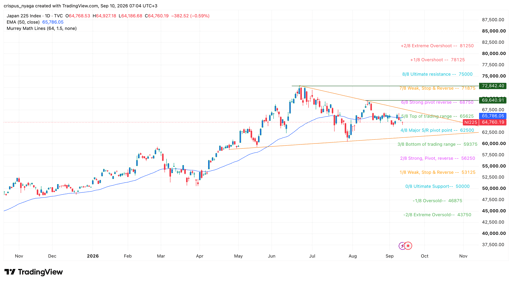
NI225 chart | Source: TradingView
The daily chart shows that the Nikkei 225 Index has slumped from a high of 72,842 in June to the current. It has now slipped below the 50-day Exponential Moving Average (EMA) and the top of the trading range of the Murrey Math Lines tool.
The index has formed a symmetrical triangle pattern whose two lines are about to converge with each other. The Relative Strength Index (RSI) and the MACD indicators have all continued their downward trend.
Therefore, the index will likely remain in this range in the coming days. The initial target to watch will be the Major S/R pivot point at 62,500. A drop below that level will point to more downside towards 60,000. On the other hand, a rebound above the upper side of the triangle will point to more gains.

KOSPI loses 7,000 in 24 hours as oil and yields hammer Korean stocks

Amazon’s $40 billion Ohio AI bet faces a tax shock: what it means for the stock

Samsung stock plunges as Apple enters foldables: is its seven-year lead at risk

Dow falls 400 pts as oil tops $100 and treasury yields hit 2023 high

Evening digest: Apple unveils iPhone Duo, oil tops $100
No results found
Loading articles...
Failed to load articles. Please try again.