
Analysis: Crude oil price hits lowest levels since 2001 as supply overwhelms demand


- IEA projects that demand for oil will hit a new 25-year low in April as a result of the COVID-19 outbreak
- TankerTrackers data shows that oil exports from Saudi Arabia to the U.S. skyrocketed in February and March
- Crude oil price trades at the lowest levels since 2001 as sellers threaten to break below the $17 mark
Crude oil price hit a new 18-year low this week as investors continue to punish OPEC+ countries for failing to meet their expectations in the size of the production cut. A claim from a group of analysts that Saudi Arabian oil exports to the U.S. more than doubled made waves in the commodity and energy community.
IEA projects the lowest demand for oil in decades
The gloomy demand for crude oil amid the COVID-19 outbreak has proved to be a stronger factor in impacting the crude oil price compared to a historic OPEC+, consisting of OPEC and its allies (including key player Russia), agreement from last week.
Invezz already wrote that the OPEC+ agreement may have arrived too late, despite the fact that it is the single-largest cut ever. The agreement foresees a production cut by 9.7 mb/d.
“This will provide some immediate relief from the supply surplus in the coming weeks,” notes a report issued by the International Energy Agency (IEA) last Wednesday.
The IEA is projecting that demand will hit a new 25-year low in April, with estimates being centered around a drop by 29 millions of barrels per day (mb/d), followed by a plunge of 26 mb/d in May.
“There is no feasible agreement that could cut supply by enough to offset such near-term demand losses. However, the past week’s achievements are a solid start and have the potential to start to reverse the build-up in stocks as we move into the second half of the year,” it is noted in the report.
IEA notes that the recent measures from OPEC+, central banks and governments around the world won’t rebalance the market, however “by lowering the peak of the supply overhang and flattening the curve of the build-up in stocks, they help a complex system absorb the worst of this crisis, whose consequences for the oil market remain very uncertain in the short term”.
Accordingly, these measures will impact the oil market in three ways:
- Provide immediate relief from the supply surplus in the coming weeks, lowering the peak of the build-up of stocks;
- At least four countries - China, India, Korea, and the United States - may take advantage of the low market prices to build up their strategic storage;
- Countries such as US and Canada could witness a drop in output by around 3.5 mb/d in the coming months due to the impact of lower prices
Overall, the IEA projects that global oil demand in 2020 will fall by 9.3 million barrels a day (mb/d) compared to 2019. Even this projection is based on an optimistic scenario which assumes the easing of travel restrictions around the world in the second half of the year.
TankerTrackers.com - Saudi Arabian oil exports to the U.S. more than doubled
TankerTrackers.com data shows that oil exports from Saudi Arabia to the U.S. skyrocketed in February and March. According to the website's analysts, the export figure is on track to surpass March’s number.

Looking at the figures, we note a nearly four-fold increase in exports in April, compared to February. These exports are likely to cause problems for the U.S. shale firms when the surge in exports from Saudia Arabia are reflected.
“Towards the end of March I saw massive boosts in gas flaring in the fields in the Eastern Province, so they went pedal to the metal and pumped out as much as possible. It lit up like a Christmas tree, the whole Eastern Province, all the flares just came back online,” said Samir Madani, founder of TankerTrackers.com, to CNBC.
Saudia Arabia quickly moved to dismiss claims from TankerTrackers. An unnamed official, who talked to CNBC, denied a surge in exports from Saudi Arabia to the United States, saying that the kingdom aims to deliver around 600,000 barrels per day to the U.S.
“I am guessing that [increased exports to the U.S.] was in the immediate aftermath of the failed OPEC+ meeting at the beginning of March. That’s when Saudis promised to increase production and exports significantly, and cut OSP by several dollars,” said Tamas Varga, an oil analyst at PVM Oil Associates.
Crude oil price hits the lowest levels since 2001
Following the unprecedented drop in demand for oil in March, crude oil prices are trading under an extensive selling pressure. The OPEC+ agreement provided only a modest rebound, but the crushing demand keeps coming back to haunt the buyers.
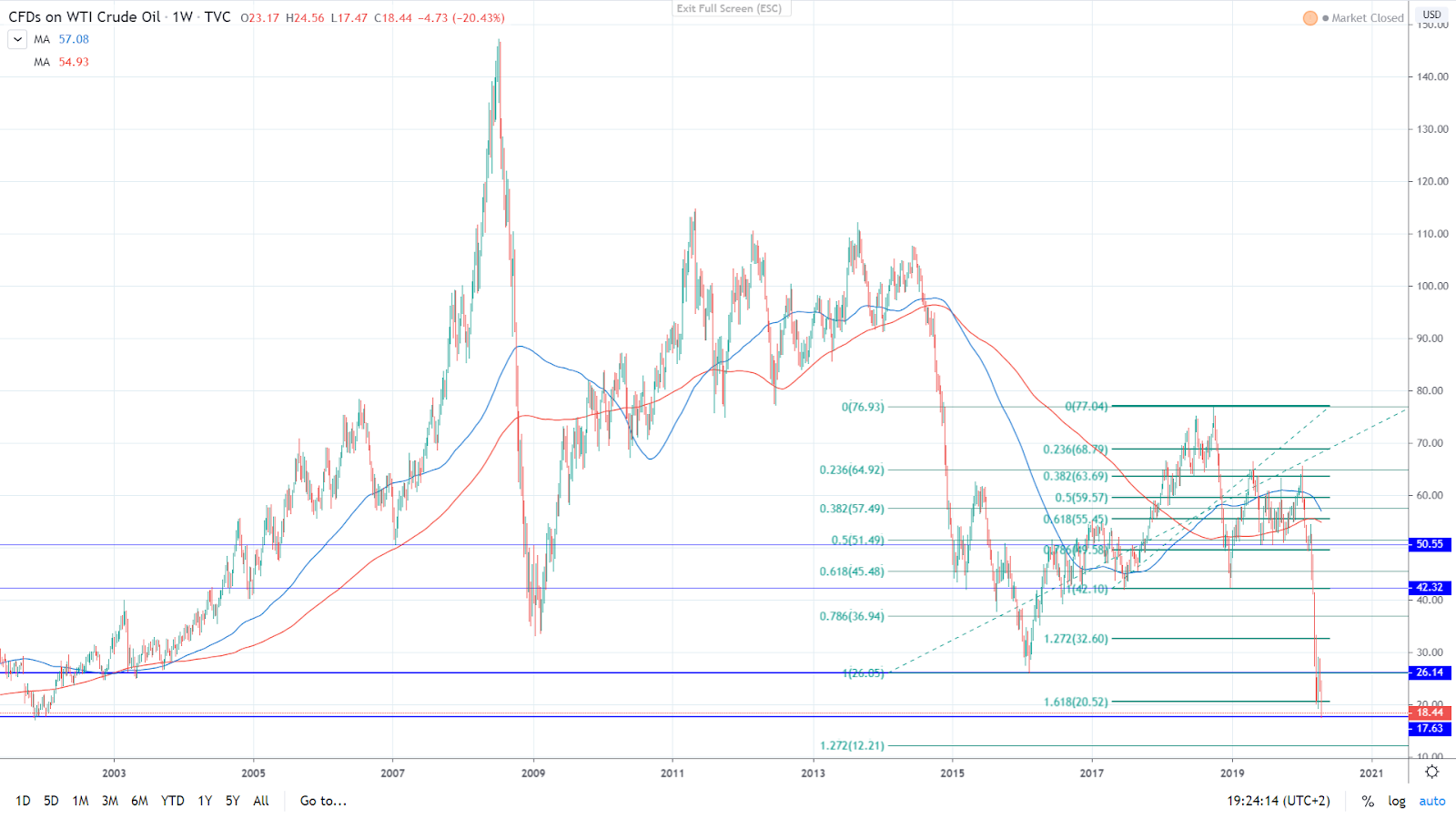
As seen in the chart above, the price action crashed almost vertically from levels above the $40 mark. Yesterday’s low of $17.47 marks the lowest level the crude oil traded since November 2001.
The price action was capped by an important horizontal support (the lowest blue line on the chart), which reflects the 2001 support for oil price. The lowest price recorded in that month was $17.12, which may be the next intraday target for the sellers, before the low $16s come into the picture as the lows from May 1999.
On the upside, the buyers have to push the price movements above the $26 mark in the first place, before thinking about returning to the “magnet level” of $42.
Summary
The IEA projects the lowest demand for oil products since 1995 as the global economy faces the biggest challenge since the Great Depression of the 1930s. The crash in demand has made the OPEC+’s historic cut almost irrelevant as the sellers continue to exercise full control of the price action.
It seems that the United States is taking advantage of the extremely low oil prices by building up their strategic reserves after a huge spike in oil exports from Saudi Arabia to the United States was noticed in February and March.

Amos Hochstein dubs oil prices 'wrong and too low': find out more

IREN, Nebius, CoreWeave: Here’s why these neocloud stocks are falling

VOO & Chill: What's fueling the S&P 500 ETF's relentless run?

RUM Group stock jumps on $13.7 billion Anthropic deal: will the gains hold?

SanDisk stock is at risk of a deep dive as alarming patterns emerge
No results found
Loading articles...
Failed to load articles. Please try again.