
Is Israel's economy heading towards a collapse as Gaza war drags on?


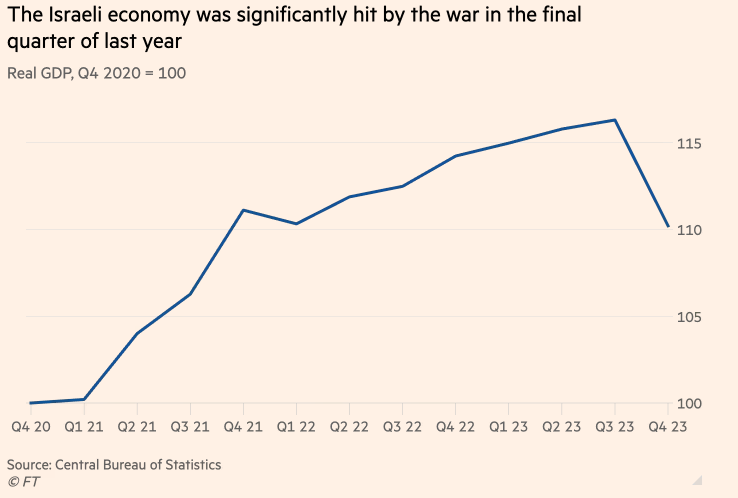
- Israel's economy has suffered a severe downturn, with a 19.4% contraction in GDP in the last quarter of 2023.
- Crippled productivity, business bankruptcies and credit downgrades are sinking the nation's economy.
- A mass exodus of human capital is occurring as other countries are calling for sanctions to be imposed.
The ongoing conflict between Israel and Hamas, which erupted on October 7, 2023, has taken a tragic toll not only on human lives but also on Israel’s economy.
As the war continues with no clear end in sight, Israel’s financial stability is teetering on the edge.
The combination of prolonged military operations disrupted daily life, and halted economic activities has left the nation on the brink of economic collapse.
This situation is a stark reminder of how ongoing conflicts can devastate a nation’s economy and threaten its future stability and prosperity.
Israel: A nation under siege
In the immediate aftermath of the October 7 attacks, Israel mobilized 300,000 reservists, pulling a significant portion of its workforce away from their jobs and businesses.
While necessary for national defence, this massive call-up has intensified the Israel economic crisis, crippling the nation’s productivity.
With hundreds of thousands of citizens suddenly absent from the workforce, productivity plummeted, leading to a sharp contraction in Israel’s GDP.
By the end of the fourth quarter of 2023, the economy had shrunk by an alarming 19.4% on an annualized basis—a downturn far steeper than anyone had anticipated.
Source: Financial Times
The economic fallout was further exacerbated by the evacuation of more than 120,000 Israelis from areas near the northern and southern borders, disrupting communities and local economies.
Restrictions on Palestinian workers from the West Bank, who play a crucial role in Israel’s construction sector, led to labour shortages that stalled projects and further dragged down economic growth.
As government spending skyrocketed by 88% in the final months of 2023 to support military efforts and displaced citizens, consumer spending, a vital component of economic activity, collapsed by 27%.
This combination of soaring expenses and plummeting revenues set the stage for a deep and prolonged economic crisis.
The beginning of the end: global repercussions
The full impact of the conflict on the nation’s finances was laid bare in February 2024, when Moody’s downgraded Israel’s sovereign credit rating from A1 to A2.
The downgrade was a stark warning sign, reflecting growing concerns about Israel’s ability to manage its rising debt and maintain economic stability amid ongoing conflict.
Fitch followed suit shortly thereafter, lowering Israel’s long-term debt rating from A+ to A with a negative outlook, citing the continued war, increased geopolitical risks, and a ballooning debt-to-GDP ratio that had surged past 70%.
This summer has highlighted that tourism, a significant contributor to Israel’s economy, has all but collapsed since the onset of the war.
The sector, which brought in billions annually, has been decimated, with international visitors steering clear of a country embroiled in conflict.
According to the Hebrew newspaper Maarivover, over 46,000 businesses have gone bankrupt, while foreign investments, which had already declined by 60% in the first quarter of 2023 due to the far-right policies of Israel’s government, show no signs of recovery.
The majority of the money invested in Israeli investment funds is rapidly being diverted to investments abroad because Israelis do not want their own pension funds, insurance funds, or their savings to be tied to the fate of the state of Israel.
Now, those business closures may just be the beginning. According to an estimate cited by The Times of Israel, up to 60,000 businesses are expected to close before 2024 is over.
Investor confidence, already shaken by the prolonged conflict, took a further hit. The cost of borrowing for Israel increased, complicating efforts to finance the war and other government expenditures.
Prime Minister Benjamin Netanyahu’s reassurances that the economy would recover once the war was won did little to alleviate concerns, particularly as the conflict showed no signs of ending.
The downgrades underscored the reality that even a nation with a historically strong economy could face severe financial distress if dragged into a prolonged and costly conflict.
A worst-case scenario: Stagflation
By mid-2024, it was already clear that Israel’s economy was struggling to regain its footing.
The second quarter of the year saw a mere 1.2% growth in GDP, well below the expectations of analysts and insufficient to offset the heavy losses sustained in the previous months.
This sluggish growth highlighted the depth of the economic damage inflicted by the war.
Supply-side issues, particularly the ongoing shortage of Palestinian workers who had been crucial to the construction sector, continued to stymie economic recovery.
Source: Tradingeconomics
Inflation, which had been relatively controlled in the early stages of the conflict, began to rise as well.
By July 2024, the inflation rate had climbed to 3.2%, surpassing the government’s target range and adding another layer of complexity to Israel’s economic challenges.
The Bank of Israel found itself in a difficult position, unable to cut interest rates to stimulate growth due to persistent geopolitical tensions and rising price pressures.
Source: Tradingeconomics
Israel’s “code red”
The financial toll of the ongoing conflict is staggering. According to estimates by Israeli economists, the war has already cost the country more than NIS 250 billion ($67.3 billion).
This figure is expected to grow as the conflict drags on, with the Israeli defence establishment seeking an additional annual increase of at least NIS 20 billion ($5.39 billion) just to sustain military operations.
This level of spending is approaching “overheated” levels, with the budget deficit recently rising to an unsustainable 8.1% of GDP, prompting urgent calls for fiscal reform.
Bank of Israel Governor Amir Yaron took the unusual step of publicly urging Prime Minister Netanyahu to implement permanent changes to the state budget.
In a letter to the Prime Minister, Yaron stressed the need for a NIS 30 billion ($8 billion) adjustment to address the growing fiscal gap and maintain Israel’s credibility in international financial markets.
Yaron’s plea highlighted the severity of the economic situation. Military spending continued to soar, with no end to the conflict in sight, and the risk of a broader regional war involving Iran and Hezbollah still on the table.
Despite these mounting pressures, the Israeli government appeared reluctant to take the necessary but politically sensitive steps to stabilize the economy.
The hesitancy to cut discretionary spending or raise taxes reflected a broader political calculus, with Netanyahu potentially avoiding unpopular measures that could alienate key voter bases.
This inaction only deepened the economic crisis, leading to speculation that the government might be deliberately delaying budget reforms to either avoid domestic backlash or set the stage for snap elections.
Mass exodus could threaten the nation’s identity
Beyond the immediate economic impact, Israel faces a potentially more damaging long-term issue, which is the phenomenon of brain drain.
Israel has long prided itself on being a “start-up nation,” with a thriving high-tech sector that has driven much of the country’s economic success.
However, the prolonged conflict and the bleak economic outlook are prompting a growing number of highly educated Israelis to consider emigration.
A quick look throughout history shows us that countries like Greece, Jamaica, India and Pakistan have suffered from this very phenomenon.
These countries are still dealing with the consequences of having their most skilled workforce leave the country due to various economic difficulties.
Recent studies have shown that these expats rarely return to their home country.
This potential exodus of talent poses a significant threat to Israel’s future. The high-tech industry, which accounts for a substantial portion of the country’s GDP and has been a key driver of innovation and economic growth, relies heavily on a small, highly skilled workforce.
If this talent pool begins to shrink, Israel could face a dramatic decline in its ability to maintain its position as a global leader in technology and innovation.
The phrase “from start-up nation to shutdown nation,” coined by the BDS movement, perfectly captures the very real risk that Israel could see its economic engine sputter out if the brain drain accelerates.
A shrinking talent pool could lead to a decline in research and development, reduced foreign investment, and a slowdown in the creation of new businesses and industries.
Over time, this could erode Israel’s competitive edge in the global economy, leading to lower growth rates and a diminished standard of living.
The long-term effects could be devastating, not only for the economy but also for Israel’s ability to maintain its technological and military superiority in a region, as well as potential demographic changes.
Final chapter: Isolation
Another critical issue that Israel faces is the potential for increased international sanctions.
While Israel has long enjoyed strong support from key Western allies, particularly the United States, the prolonged conflict and the high civilian toll in Gaza have sparked growing international condemnation.
Calls for sanctions against Israel are becoming louder, especially from parts of Europe and within international organizations like the United Nations.
The imposition of sanctions could have a devastating impact on Israel’s already fragile economy.
Recent history provides stark examples of how sanctions can cripple a nation, such as Iran, and Russia.
The aftermath of such sanctions could perhaps easily be a plummeting currency, hyperinflation, long-term GDP contraction, and a sharp decline in living standards for citizens.
If Israel were to face similar sanctions, particularly in the form of trade restrictions or financial isolation, the impact would be nothing short of catastrophic.
The nation’s economy is heavily integrated into the global market, particularly through its tech sector, which relies on international investment, and partnerships, as well as its energy exports which rely on strong trade relationships.
Recent developments have shown warning signs that this is a scenario that is likely to play out sooner rather than later. For example, Israel's power grid, which has largely switched to natural gas, still depends on coal to supply demand.
The biggest supplier of coal to Israel is Colombia, which announced that it would suspend coal shipments to Israel as long as the war was ongoing.
The choices made in the coming months will determine whether Israel can stabilize its economy and secure its future, or whether it will face a future where the very pillars of its economic success—innovation, talent, and global competitiveness—are eroded.
The road ahead is fraught with uncertainty, but it is clear that without decisive action, Israel could be heading toward a period of unprecedented economic and social turmoil.

Iran conflict is going to be difficult to end, says Dr Anita Kellogg on Zero Sum

China economy slows in July as retail sales and investment miss forecasts

The succession and strategy questions facing Tata Sons as N Chandrasekaran resigns

Nikkei 225 Index bullish flag forms as SoftBank, Kioxia, Nintendo stocks jump

US PPI remains unchanged in July, signaling easing wholesale inflation
No results found
Loading articles...
Failed to load articles. Please try again.