
Do new trade deals remove dark clouds over Indian markets?
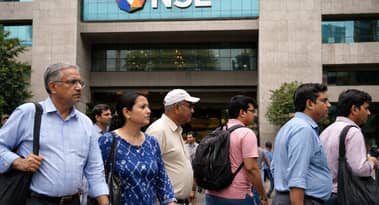

The Indian market has been under a lot of pressure lately.
The market has underperformed its emerging markets peers, its currency depreciated against the dollar, while they were tariffed at a higher percentage compared to other nations by the US.
Although they have struck a trade deal with the EU first and the US, is it enough to change the outlook on the markets?
While analysts have said the recent trade deals ease some of the uncertainty, they have pointed out that the implementation of said deals would also be crucial.
Underperformance woes
India’s Nifty 50 has returned 10.48% in the last 12 months.
In contrast, China’s CSI 300 index at the same time gained 19.34%, while Japan’s Nikkei 225 has surged by 44.3%. South Korea’s Kospi posted a 112% return.
The underperformance has caused foreign investors to pull $18.8 billion from the Indian markets in the last year, according to Bloomberg data.
The Indian rupee also underperformed as the dollar strengthened 3.75% against the rupee in the last 12 months, while the reserve currency weakened by 7% against a basket of 6 other major currencies.
The US had unleashed 25% retaliatory tariff against India in July 2025, then a 25% additional levy for buying Russian oil in August 2025.
Stability and outlook for Indian markets
Market sentiment has weakened in recent months, but analysts say macro stability is improving.
Dharmesh Kant, Head of Equity Research at Cholamandalam Securities, said the currency and interest-rate environment has stabilized investor confidence.
“There was some tentativeness on Indian equities from a sentiment point of view. So that gets stability with rates being stabilized. At least for the time being. And currency is also seemingly stabilized now.”
He added that trade policy uncertainty had not materially altered corporate activity.
“But largely with India and the US, on the market front, nothing was happening apart from the currency depreciation. The software was continuing as it is. Pharma was continuing as it is. Textiles are a very small segment. They are not the ones who are going to have a meaningful impact on the market.”
Eshan Kaul, Global Investment Head at Sinarmas Technology, said foreign investors may be misreading India’s recent underperformance.
“From a foreign investor’s lens, India’s recent underperformance within emerging markets is being misread if viewed purely through short-term currency moves or one-year earnings cycles.”
He added that the weakness reflects consolidation rather than deterioration.
“What looks like underperformance is, in reality, a phase of consolidation after a multi-year rerating driven by domestic capital flows, not foreign hot money.”
Kaul also believes trade agreements strengthen medium-term earnings visibility rather than immediate gains.
“The trade agreements with the US and the EU materially strengthen India’s medium-term earnings visibility rather than delivering an immediate sugar high.”
The reality of implementation and the Trump factor
The trade deal announced with the US lowers India’s tariffs to 18%, removing the 25% tariff for Russian oil, as US President Donald Trump said Indian Prime Minister Narendra Modi has agreed to stop importing Russian oil.
India also signed a trade deal with the EU, where India will reduce tariffs on 96.65% of EU products, while the EU will reduce levies on 99.5% of Indian goods.
However, analysts caution that the real impact will depend on implementation details rather than headline announcements.
Kant notes that the impact won't be overnight.
"As far as the trade deals are concerned, Europe is at least one year away from implementation," Kant explains. "Let the deal happen, and then the outlook will emerge on the fine print. It's that sentimentally, things are moving in the right direction."
The relationship with the US, however, carries a different set of risks due to its transactional nature.
Kant warns that "The US deal will be dynamic. The US won’t be a settled EU kind of deal because it can change any day, any moment. Tomorrow, if Trump says India bought two barrels of oil from Russia and will put the tariffs back to 50%."
Harini Dedhia, Fund Manager and Director, Tamohara Investment Managers, noted that “we are worse off than we were two years back at 18% - but businesses and markets love certainty. Bottom was made the day lockdown was announced, as the new parameters were defined. Same case with the US trade deal, businesses are happy even with 18%, as there is now certainty.”
Dedhia added that “FTA with EU is a very welcome tailwind in addition”.
Growth outlook and IMF data credibility concerns
Concerns about India’s economic statistics resurfaced after the IMF's commentary on GDP measurement quality, but analysts argue that investors rely on broader indicators.
Kaul said global investors do not interpret the IMF remarks as accusations of falsification.
“The concerns raised by the International Monetary Fund were methodological, not accusations of fabrication, and similar debates have occurred in many large economies during statistical transitions.”
Instead, investors cross-verify economic data.
“When you cross-verify India’s official GDP numbers with high-frequency indicators like GST collections, power consumption, digital payments volume, freight traffic, and corporate tax receipts, the growth story broadly holds.”
He emphasized that investment flows ultimately validate economic credibility.
“Foreign investors are not questioning whether India is growing. They are debating how much of that growth is already priced in.”
Dedhia also pointed to structural challenges in measuring a diverse economy.
“It is not easy to tabulate data for a country as diverse and robust as India — industries, geographies, and sheer volume of people at play is huge.”
“Four concerns of which the primary is basing data on 2011-12 base prices- and second on trustworthiness of these price data. A part of this is addressed with the reconstitution of price indices.” Dedhia said.
She noted that one of the concerns - “the gap between production and expenditure way of measuring simply showcase an underreporting on the expenditure side- primarily a rural/agrarian economy by volume of transactions. Spends here can be informal and difficult to report accurately.”
She added that seasonal adjustments may distort interpretation.
“Fourth — no seasonal adjustment. Our festivals which determine a lot of our spend cycle booms and troughs are more scientifically oriented vs. being linked to rigid dates of a Gregorian calendar.”
Dedhia said corporate indicators provide a clearer real-time picture.
“Honestly - if you ask us - we follow BSE500 data. We get to see their sales growth (and volume growth within that) - helps us understand real and nominal growth in the country. We note wage inflation in employee expenses for BSE500. We believe 95% of the country's productive assets get covered one way or another by BSE500 companies and their supply chains and therefore find it a far more robust, real time measure of the health of the economy.”
Despite the confidence on long term outlook, Indian markets have struggled with sentiment hits.
Indian IT stocks have struggled after Anthropic launched an updated model of Claude, which in turn caused a sell-off in software stocks worldwide.
Overall, India’s trade agreements improve policy clarity and medium-term earnings visibility, but near-term market performance will likely depend on implementation details, currency stability, and global risk sentiment.
Analysts see structural growth intact, yet investor confidence may recover gradually as certainty around tariffs, data credibility, and corporate earnings strengthens.

SpaceX stock jumps premarket as Nasdaq-100 inclusion bets grip Wall Street

Zhipu stock surges 33% as Anthropic curbs open door for China AI

Scottish Mortgage stock: SpaceX presents a risk, but Anthropic offers relief

Stoxx 600 hits all-time high as oil slump sparks Europe stock rally

Here’s why the Kospi Index is surging today, and the next target to watch
No results found
Loading articles...
Failed to load articles. Please try again.