
Anthropic-Pentagon standoff unites industry, exposes AI’s new fault lines
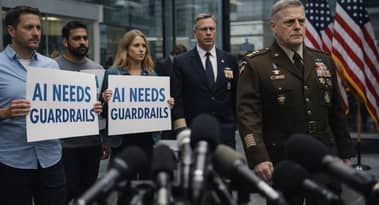

- OpenAI and Google employees back Anthropic in rare show of unity.
- Pentagon threatens action if AI limits on military use aren’t lifted.
- Lawmakers and experts warn of growing power struggle over frontier AI.
The high-stakes confrontation between the Pentagon and Anthropic has evolved into a defining battle over who sets the limits of frontier technology — the US government or the private companies building it — spilling into the broader AI industry and drawing sharp criticism from lawmakers.
The issue has drawn rare public support from rival AI employees and exposed deep divisions over surveillance, autonomous weapons and national security.
Meanwhile, experts have sought to highlight the downsides of unfettered use of the technology around the world in real military settings, but often with limited regulations, even as questions of trust over both governments as well as the AI services providers emerge.
OpenAI and Google employees back Anthropic in open letter
Workers from OpenAI and Google were among those who signed an open letter backing Anthropic, an unusual display of solidarity in an industry defined by fierce competition.
The letter, titled “We Will Not Be Divided”, accuses the US Department of Defense of attempting to coerce Anthropic into lifting restrictions on how its AI models can be used.
In the open letter, employees said the Department of Defense was threatening to invoke the Defense Production Act, force Anthropic to tailor its model to military needs and label the company a “supply chain risk” if it refused to comply.
“All in retaliation for Anthropic sticking to their red lines,” the letter said, referring to the company’s opposition to mass surveillance and autonomous killing.
The signatories argued that the Pentagon was attempting to isolate companies by creating fear that competitors would give in first.
“They're trying to divide each company with fear that the other will give in,” the letter said.
“That strategy only works if none of us know where the others stand.”
The letter urged AI leaders to put aside corporate rivalries and continue refusing what it described as the government’s current demands for permission to use AI models in ways the employees believe are unsafe.
Altman seeks to cool tensions
Although the chief executives of OpenAI and Google did not sign the letter, OpenAI’s chief executive, Sam Altman, told staff that the company was working to help resolve the dispute.
According to a report by The Wall Street Journal, Altman wrote in a note to employees: “We would like to try to help de-escalate things.”
Anthropic and the Pentagon have been locked in disagreement over how Claude can be deployed in sensitive defence and intelligence operations.
Anthropic has said it is willing to work with the government, but only with safeguards in place.
Pentagon reiterates "no desire to surveil" as deadline for Anthropic nears
Pentagon officials argue that decisions about lawful military and intelligence use rest with the government, not private vendors.
The Department of Defense has delivered an ultimatum to Anthropic, demanding acceptance of its terms by Friday afternoon or warning of sweeping consequences.
Earlier this week, chief Pentagon spokesman Sean Parnell said the department had no desire to surveil Americans or develop fully autonomous weapons.
But he stressed that the military would not allow companies to dictate operational decisions.
“This is a simple, common-sense request that will prevent Anthropic from jeopardizing critical military operations and potentially putting our warfighters at risk,” Parnell wrote in a post on X.
“They have until 5:01 PM ET on Friday to decide.”
Anthropic has refused to "accede to their request"
Anthropic has responded by doubling down.
In a statement on Thursday, the company said: “These threats do not change our position: we cannot in good conscience accede to their request.”
The firm detailed its concerns about surveillance, noting that under current law, the US government can purchase detailed data on Americans’ movements, web browsing and associations without a warrant.
While such data may be individually innocuous, Anthropic warned that AI makes it possible to assemble it into a comprehensive portrait of a person’s life at a massive scale, raising serious privacy concerns acknowledged by the intelligence community and lawmakers from both parties.
On weapons, Anthropic acknowledged that partially autonomous systems already play a role in modern warfare and that even fully autonomous weapons could one day be critical to national defence.
But it said today’s frontier AI systems are not reliable enough to make lethal decisions without humans in the loop.
“We will not knowingly provide a product that puts America’s warfighters and civilians at risk,” the company said, arguing that proper guardrails do not yet exist.
"It is the Department’s prerogative to select contractors most aligned with their vision. But given the substantial value that Anthropic’s technology provides to our armed forces, we hope they reconsider," the statement said.
Personal attacks and political backing
The dispute has grown increasingly heated.
Dario Amodei, Anthropic’s chief executive, has come under sharp criticism from senior Pentagon officials.
Emil Michael, the under secretary of defense, accused Amodei of having a “God-complex”.
“It’s a shame that @DarioAmodei is a liar and has a God-complex,” Michael wrote on X.
“He wants nothing more than to try to personally control the US Military.”
State Department officials also took to social media to reinforce the Pentagon’s position, while several Democratic lawmakers publicly supported Anthropic.
Mark Warner, the top Democrat on the Senate Intelligence Committee, said companies must sometimes make concessions to the government but argued that Anthropic’s concerns had merit.
He said the company was being threatened by Defense Secretary Pete Hegseth for prioritising safety.
“He is threatening them, literally by tomorrow,” Warner said in a video posted online.
A broader shift in power
Analysts say the standoff reflects a deeper shift in how advanced military technology is developed and controlled.
“There are no winners in this,” said Lauren Kahn, a senior research analyst at Georgetown’s Center for Security and Emerging Technology, in an interview with CNBC.
“It leaves a sour taste in everyone’s mouth.”
Rear Admiral Lorin Selby, former chief of naval research and now a partner at Mare Liberum, said in the CNBC report that for much of the post-war era, the US government defined the frontier of advanced technology.
“From nuclear propulsion to stealth to GPS, the state was the primary engine of discovery, and industry was the integrator and manufacturer," he said.
AI has inverted that model.
“Today the commercial sector is the primary driver of frontier capability," he said.
"Private capital, global competition, and commercial data scale are advancing AI at a pace that traditional government R&D structures cannot easily replicate. The Department of War is no longer defining the edge of what is technically possible in artificial intelligence — it is adapting to it."
Experts sound the alarm on "haphazard policies"
According to the Council on Foreign Relations, AI is already being deployed in real military settings around the world, often with limited regulation.
Countries including Israel, Russia and Ukraine have reportedly used AI to help identify battlefield targets.
The UN secretary-general has called for international dialogue on AI guardrails, but the US has rejected global governance frameworks, even as its own AI Action Plan calls for aggressive military adoption.
“The growing gap between international dialogue on military AI, which tends to emphasize risks and potential constraints on its use, and the accelerating efforts of militaries worldwide to integrate AI should be concerning to all nations…states are deploying these technologies with a patchwork of haphazard policies—if any—and no opportunity to gain valuable insights on best practices from others," CFR Senior Fellow Michael C. Horowitz said.
What next?
What happens after Friday’s deadline remains unclear.
Any move by the Pentagon to label Anthropic a supply chain risk or force compliance under the Defense Production Act would likely trigger legal action by the company.
Such a move could also disrupt government operations.
Anthropic’s Claude model is widely used in classified systems for intelligence analysis, including by the National Security Agency and the CIA.
Removing it would force agencies to shift to alternatives such as Grok, developed by xAI, which current and former officials consider inferior and difficult to deploy quickly.
"Even if the Anthropic/Pentagon fracas blows over, basic dilemmas still loom with respect to the division of power, labor, and responsibility for AI safety," Michael Froman, president, CFR, wrote.
"Will the role of private firms in ensuring responsible AI use be confined narrowly to producing the most reliable and accurate AI tools which the government can deploy as it sees fit, or will these firms play a more foundational role in determining acceptable use cases for their products? Whom do we trust more, and less—the government or a private firm—to make these decisions?"

Is it a golden opportunity to buy ServiceNow stock as a rare pattern nears?

Adobe stock analysis: Golden cross pattern takes shape ahead of earnings

Rubrik stock drops as gross margin slips: Is the selloff a buying opportunity?

Figma stock just crossed a crucial price: is the bull run starting?

IREN stock falls as the Nvidia-backed neocloud company hits a key milestone
No results found
Loading articles...
Failed to load articles. Please try again.