
Bitcoin (BTC) price in between 2 CME gaps, which gets filled first?

AI Sentiment: 35/100 Bearish
This score is generated through AI-driven analysis of the article's content.

powered by

Buy spot Bitcoin (BTC) and add on dips toward the nearer CME gap boundary, because smaller gaps near current price tend to get revisited quickly (often within days). The article’s setup is “two gaps, which fills first?”—so you front-run the higher-probability, nearer fill while keeping upside if the larger gap fills later.
Key Risk: BTC breaks down and never revisits the nearer gap before momentum flips bearish again.
Sell idle stablecoin cash exposure and buy fixed-structure stablecoin yield plans (e.g., Varntix fixed income plans paying up to ~24% APY) to earn regardless of whether BTC fills the gaps on your timeline. This directly monetizes the article’s point: don’t guess gap order—lock predictable payouts while BTC is uncertain.
Key Risk: Counterparty/structure risk—platform or product fails, delays payouts, or the “fixed” yield is not honored.
- Bitcoin trades between CME gaps, reviving debate on which level fills first.
- CME gaps show high fill rates, but timing remains highly unpredictable.
- Varntix offers fixed crypto yields with returns agreed upfront for clarity.
Earlier this year, Bitcoin dropped from the mid-$80,000 range to below $60,000. Bitcoin is once again trading between two CME gaps, and traders are asking the same question: which one gets filled first?
The problem is, even as new developments like Bitcoin yield products and vaults start emerging to make BTC more “productive,” price action remains unpredictable.
That uncertainty is exactly why many investors are shifting strategies.
Instead of waiting and holding idle funds in Tether or USDC, platforms like Varntix are gaining attention by offering fixed returns up to 24% APY (agreed upfront).
Rather than guessing which gap fills first, the focus is starting to shift toward earning consistently while the market figures itself out.
Understanding Bitcoin CME gap sand current market position
CME gaps are not a predictive tool but a reflection of how two markets operate on different schedules.
The CME chart displays a price gap which exists between the final Friday trading price and the initial opening price after trading starts again.
In late January 2026, for example, Bitcoin closed on CME futures near $84,000 before reopening closer to $77,000, creating a large gap.
The market experienced its first major drop after this event which caused prices to fall under $60,000 until they started to recover.
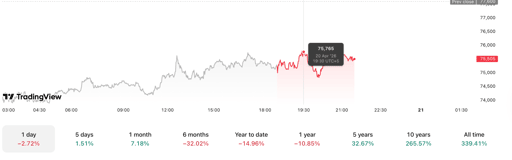
Source: Trading View
Historically, CME gaps have shown a high fill rate, often cited between 77% and 90%.
However, this does not mean they must be filled immediately. Smaller gaps closer to the current price are more likely to be revisited quickly, sometimes within days.
Larger gaps formed during strong trends, often called “runaway gaps,” can remain open for extended periods.
From market uncertainty to predictable yield: How Varntix reshapes crypto income
Instead of waiting for market conditions to improve, capital is designed to generate returns continuously through predefined structures.
Varntix simplifies this by turning crypto into a system where returns can be planned instead of predicted.
Payouts follow a structured schedule, allowing participants to understand exactly when and how income is delivered.
Varntix is a wealth management platform focused on helping users earn predictable crypto yields through structured savings accounts.
For example, a $12,000 allocation in a 12-month plan at 20% APY could generate around $2,400 in stablecoin payouts regardless of market direction.
This income is predefined, meaning returns are mapped in advance instead of being dependent on timing or market conditions.
In contrast, a $30,000 position sitting in a sideways crypto market produces no meaningful yield if the price does not move.
However, the same $30,000 allocated into a structured 15% APY plan over six months could generate roughly $2,250 in predictable returns.
This highlights how Varntix shifts capital from idle exposure into a consistent income stream, where earnings are planned rather than left to market uncertainty.

Fixed vs flexible income models on Varntix
Varntix separates its offerings into two main categories, each designed for different investor preferences.
Fixed Income Plans
- Require a defined commitment period (typically 6 to 24 months)
- Offer higher, pre-defined yield rates
- Provide scheduled payouts (weekly, monthly, or quarterly)
These plans are similar in concept to traditional fixed-income instruments, where returns are known in advance.
Flexi Income Plans
- Allow users to withdraw funds at any time
- Offer lower but more stable yields
- Provide ongoing access to liquidity
This structure is closer to a high-yield savings approach, where flexibility is prioritized over maximum return.
This shift is part of a broader trend toward income-based participation in digital assets, where platforms such as Varntix operate within structured crypto income models that aim to provide defined return frameworks alongside traditional market exposure.
Find out how you can make your crypto work for you with Varntix.

FAQs
1. What makes Varntix different from traditional crypto platforms?
Varntix focuses on fixed, structured returns instead of variable yields that change with market conditions. This means users know their expected income in advance, rather than relying on unpredictable APY rates.
2. Can I access my funds anytime on Varntix?
Yes, Varntix offers flexible income plans that allow withdrawals at any time. This gives users the option to earn passive income while still keeping their funds accessible when needed.
3. Why are investors moving toward fixed income models in crypto?
Market uncertainty, like Bitcoin’s CME gap situation, makes timing trades difficult. Fixed income models provide a more stable alternative by offering predictable returns without depending on price movements.

Zoomex launches ZWTC 2026 multi-asset trading championship

FinchRails registers with FINTRAC as a Money Services Business

GGBR Inc. announces new trust-based collateral structure for Goldfish tokens
How to find 100X crypto presales: why audits, tokenomics, smart contracts matter

Upcoming crypto presales to buy right now: MemeToro smashes $120K presale target
No results found
Loading articles...
Failed to load articles. Please try again.