
Trump claimed huge wins in China, but Beijing's readout barely backed any of it
AI Sentiment: 35/100 Bearish
This score is generated through AI-driven analysis of the article's content.

powered by

Buy BA. Trump’s post-meeting claim of a 200-jet China order is the only specific, high-dollar “trophy” with no matching denial in Beijing’s broad readout. If even a portion becomes real, BA’s China backlog and sentiment re-rate fast versus other large-aircraft makers.
Key Risk: China never confirms or signs the 200-jet order, turning Trump’s remarks into pure political framing.
Buy V. Trump highlighted “greater access for Visa” in China’s tightly regulated credit-card market. Beijing’s readout didn’t contradict it and focused on expanding exchanges/cooperation—exactly the kind of opening that can translate into incremental merchant/issuer permissions and higher transaction volumes.
Key Risk: China blocks or delays any Visa access expansion, keeping payments tightly restricted and making the summit access talk meaningless.
- Trump touted Boeing, energy and Visa wins after Xi summit talks in Beijing.
- Beijing stressed strategic stability, not detailed economic deals publicly.
- Iran and Hormuz exposed gaps between Trump and China public narratives.
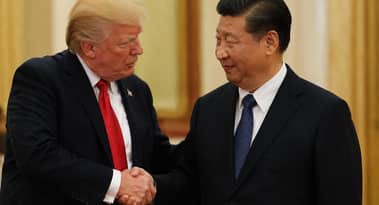
Chinese President Xi Jinping and US President Donald Trump emerged from their Beijing talks with very different public emphases.
Trump described a set of concrete wins, from Boeing aircraft to energy, farm goods, financial market access and chip sales.
Beijing’s official readout, by contrast, stayed broad, stressing “constructive strategic stability,” more cooperation in trade and agriculture, and a warning that mishandling Taiwan could lead to “clashes and even conflicts.”
The gap matters because it shows how much of the summit is being framed by Trump’s post-meeting remarks, and how little of it was spelled out by China itself.
Big-ticket promises, thin confirmation
Trump’s account of the summit leaned heavily on large commercial claims.
He said China had agreed to buy 200 Boeing jets, while also pointing to broader hopes for more US oil, soybeans and liquefied natural gas.
“One thing he agreed to today, he’s going to order 200 jets ... 200 big ones,” Trump told Fox News, referring to Xi.
He also said he had pressed for greater access for Visa in China’s tightly regulated credit-card market.
What Beijing published was much less specific.
In its official readout, Xi said China and the US should expand exchanges and cooperation in areas including trade, agriculture, tourism, people-to-people ties and law enforcement, but it did not confirm the headline purchase pledges Trump described.
The readout also framed the relationship in carefully managed language, calling for a “constructive China-US relationship of strategic stability.”
Iran and Hormuz: Trump’s boldest claim
The sharpest mismatch came on Iran and the Strait of Hormuz.
Trump said Xi would not provide military equipment to Iran and suggested China would help reopen the waterway.
On Iran, Trump said he and Xi agreed that “Iran cannot have nuclear weapons,” while also suggesting China could help reopen the Strait of Hormuz.
Beijing, however, kept its wording far more general.
At a Foreign Ministry briefing, spokesperson Guo Jiakun said the two sides exchanged views on the Middle East and other major international and regional issues, and only added that China’s position on the Strait of Hormuz was “consistent and clear.”
The official readout from Xi’s talks did not give a detailed public commitment on Iran or Hormuz.
Trump’s remarks were markedly more assertive, while China’s official record stayed narrower and more cautious.
On the public record, the summit produced discussion, not a clearly documented Iran deal.
China’s oil pledge
Trump also said China had expressed interest in buying more US oil and liquefied natural gas (LNG), presenting energy as another headline commercial outcome from the summit and part of a broader effort to narrow the bilateral trade gap.
They have agreed they want to buy oil from the United States, they are going to go to Texas, we are going to start sending Chinese ships to Texas and to Louisiana and to Alaska.
The White House later framed it as a way for China to reduce its dependence on Middle East supply routes, particularly the Strait of Hormuz.
But Beijing’s official account made no mention of oil or LNG purchases.
Instead, Chinese officials referred only to broader economic cooperation, highlighting trade and agriculture without offering any details on energy volumes, timelines or formal purchase commitments.
What Beijing chose to emphasize
Beijing’s own emphasis was on tone, not trophy items.
Xi’s readout spoke about keeping bilateral ties stable, expanding trade and agriculture cooperation, and maintaining channels of communication.
It also carried a pointed warning on Taiwan, saying that if the issue is handled properly, the relationship can remain stable, but if mishandled, it could lead to “clashes and even conflicts.”
That is why the summit reads more like a diplomatic reset than a long list of signed concessions.
There were warm words and some limited openings, especially around Boeing, farm goods, energy and chips.
But the official Chinese text is notably cautious, and that caution leaves the most important deals of the visit sitting in a gray zone between announcement and confirmation.

Hang Seng Index: Top 3 reasons Hong Kong stocks are falling today

Kospi Index at a crossroads as Samsung, SK Hynix leverage bets reverse
Rolls-Royce stock: The bull case is strong, but these risks could trigger a drop

Here’s why the Alibaba stock is crashing in Hong Kong today
Here’s the top reasons why the Kospi Index is falling today
No results found
Loading articles...
Failed to load articles. Please try again.